







Introduction:When customers ask for a glass of hot water at a coffee shop and are either refused or even charged a high price, it reflects not just the enforcement of service rules, but also the balance between customer experience and business management. From Hong Kong to Weihai in Shandong Province, recent “hot water incidents” have sparked widespread discussion, prompting curiosity about how international brands like Starbucks handle similar requests. This article delves into the root causes of these controversies, explores the operational logic behind the price difference between espresso and Americano, and offers practical advice to help both customers and shop owners achieve better interactions.
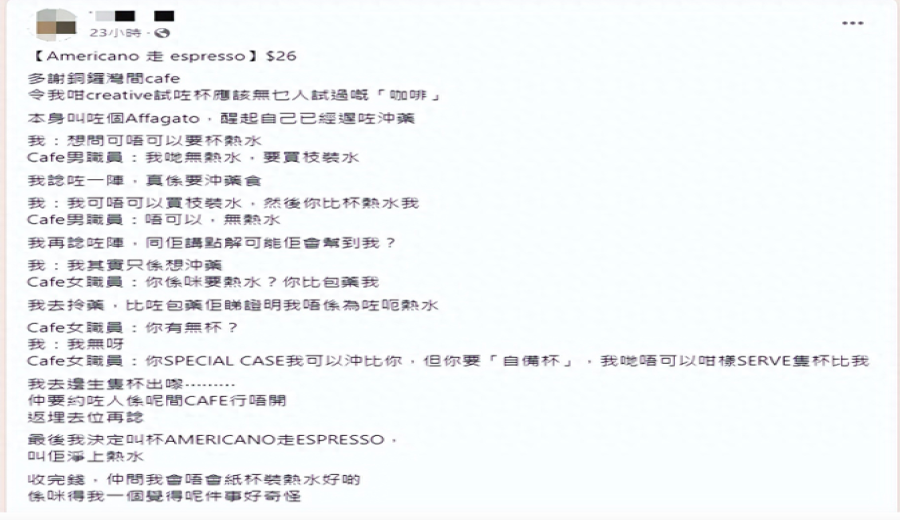
Recently, a coffee shop in Hong Kong sparked online discussion after refusing to provide hot water to a customer. A similar situation occurred in Weihai, Shandong — where a consumer claimed that they were charged 10 RMB just for asking for a glass of plain boiled water. These incidents highlight the dilemma coffee shops face between service flexibility and rule enforcement.
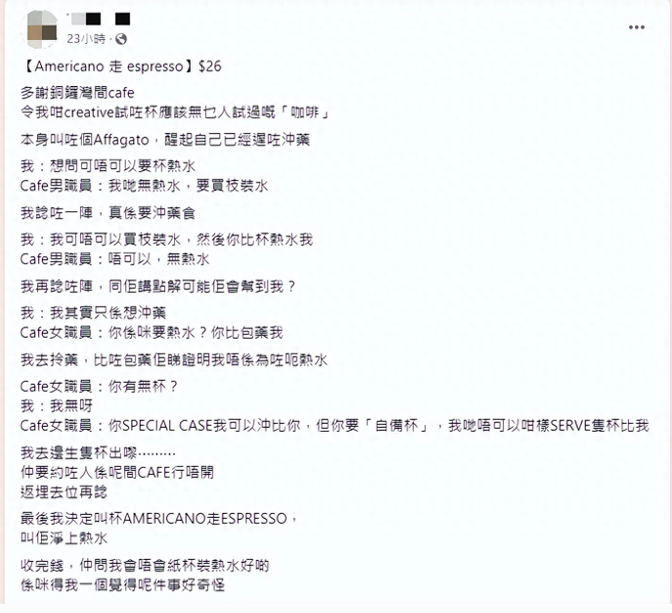
It is understood that in the Hong Kong case, a customer who needed to take traditional Chinese medicine requested hot water to help brew it. Initially, the staff said there was no hot water available. Only after the customer brought their own cup did the staff reluctantly agree to help. Although some staff members were willing to make exceptions, the overall response was rigid, echoing the oft-cited service industry reminder that “this kind of attitude simply won’t do these days.”
However, such cases are not unique to Hong Kong. In early July, a female consumer in Weihai, Shandong, shared her experience of entering a bubble tea shop due to sudden abdominal pain. She hoped to buy a glass of hot water to ease her discomfort, but the staff said that if she only wanted plain water, she would have to pay the same price as a bubble tea. As the specific amount had not been communicated beforehand, the customer only discovered upon payment that this “glass of plain water” cost 10 RMB. The business later explained that according to company policy, cups were not sold separately, so buying just plain water was equivalent to purchasing a bubble tea. However, using one’s own cup to get water would be free. While the business emphasized that this had been communicated in advance, the customer still found it unacceptable, sparking heated online discussion.
Notably, international chains like Starbucks can actually provide hot water for free — customers usually just need to ask the staff proactively, and they will typically be given a cup of hot water. However, such service is not something every coffee shop offers proactively, especially when the customer has not made a purchase or is asking for a special accommodation.
From the operators’ perspective, coffee shops primarily sell beverages like coffee, and providing hot water is generally not part of the standard service offering. When faced with customers who have not made a purchase, some shops may adopt a more conservative approach. In addition, some consumers exploit the price difference by “upgrading” their drink at minimal cost — for example, adding espresso to their own plain water to effectively enjoy an Americano — which is one reason why some shops explicitly state “we don’t provide hot water because the prices of espresso and Americano are different.” The price difference between espresso and Americano usually reflects differences in ingredient proportions and brewing methods, and this pricing gap also becomes a factor for business owners when setting service limitations.
Generally speaking, most coffee shops will handle requests for hot water flexibly depending on the situation. However, it is also recommended that customers understand that if a shop has clear rules, they should ask about them in advance to avoid misunderstandings. If a shop is unable to provide hot water due to cost or procedural considerations, it should also offer an appropriate explanation to maintain good communication and a positive customer service experience.
In summary, these occasional “hot water controversies,” though seemingly minor, reflect the tension between standardized procedures and humanized needs in the service industry. For shop owners, how to maintain operational rules while demonstrating appropriate flexibility and empathy is key to improving customer satisfaction. For customers, understanding the shop’s position and communicating their needs politely can often lead to a win-win outcome. As insiders have said, a good customer experience requires mutual understanding and respect from both sides.
The above content is compiled by CoffeeHunters, a coffee news website.


