







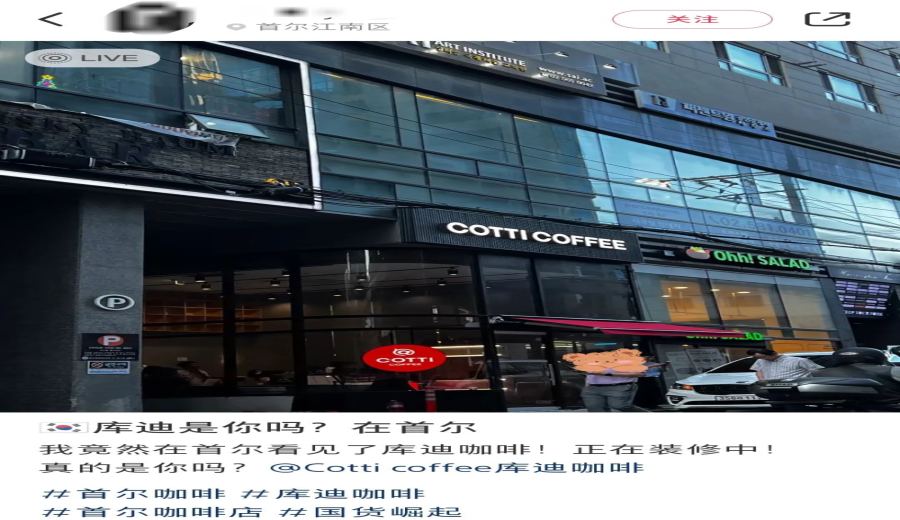
Introduction:Recently, Cotti Coffee has opened a directly operated store in Seoul’s Gangnam District in South Korea, while its 5,000th store in China was also unveiled at Sanlitun SOHO in Beijing. From its first store in Fuzhou in 2022 to its current global presence, the brand has been expanding at a rate of over 500 stores per month. However, once low-price promotions end, store sales tend to decline. So far this year, 332 Cotti stores have closed, with nearly 152 shutting down in the past 90 days. Can Cotti succeed in its overseas expansion amid South Korea’s highly competitive coffee market?
Cotti Coffee’s recent moves in Seoul have drawn attention. Netizens shared photos on social media platforms, pointing out a Cotti store under renovation in Gangnam District. Though its authenticity was initially unconfirmed, multiple informed netizens and users with IP addresses showing they were in South Korea later confirmed that the store is indeed a directly operated Cotti branch. It is also rumored that employees will soon be dispatched to South Korea to provide support.
Moreover, a Cotti store in the Sinchon area is actively recruiting baristas, indicating that the brand’s local layout is gradually taking shape. Many netizens draw comparisons to its main competitor, Luckin Coffee, which currently operates 12 directly operated stores in Singapore but has yet to enter the South Korean market—prompting curiosity about Cotti’s strategic considerations.
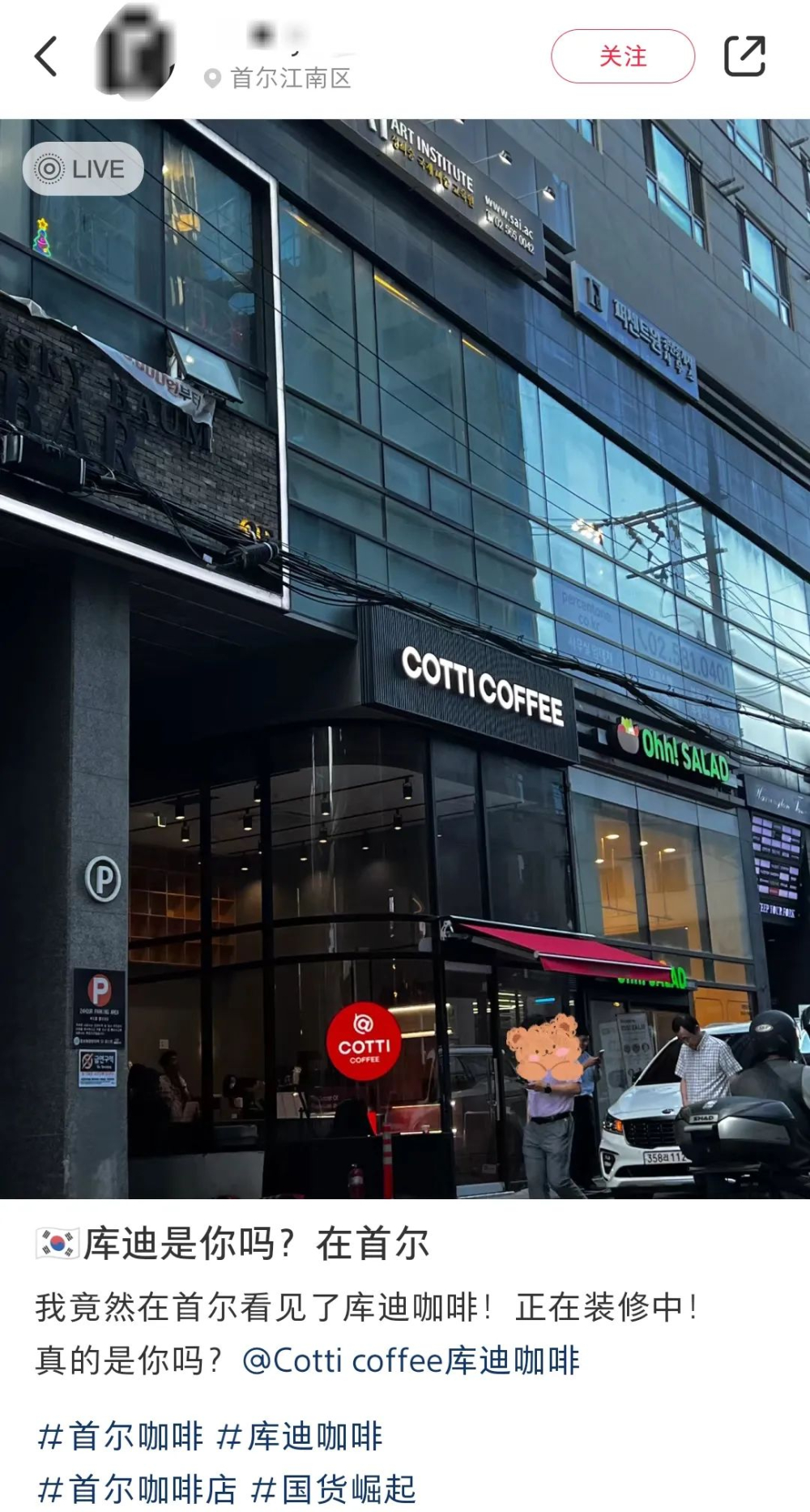
Regarding the choice of South Korea as its first overseas destination, many netizens view it as a risky move. The South Korean coffee market is not only highly competitive—with numerous local brands offering affordable prices, diverse product selections, and high store density—but also poses significant pressure on foreign entrants. One commentator bluntly stated: “The South Korean coffee market is too cutthroat; Cotti is a bit bold,” suggesting it won’t be easy for the brand to establish itself in such an environment.
Meanwhile, news has emerged regarding Cotti’s expansion in China. On August 4, Lu Zhengyao, founder of Cotti Coffee, announced on his social media that the brand’s 5,000th store has officially opened at Sanlitun SOHO in Beijing. Since opening its first store at Fuzhou IFC on October 22, 2022, Cotti has rapidly expanded through franchising by leveraging the “Coffee Dreamers” program and the “Full Franchise” model.
In its early stages, the brand adopted an 8.8 RMB low-price promotion strategy, complemented by frequent co-branding marketing campaigns and substantial subsidies, successfully attracting consumer attention. However, once these incentives ended, store sales significantly dropped, leading to increased profit pressure and longer payback periods. This has been one of the key reasons behind the recent surge in Cotti store closures.
According to financial media reports, Cotti has closed 332 stores so far this year, with 152 of them shutting down in the past 90 days—equivalent to roughly 1.7 stores closing per day. This closure rate is noticeably higher than that of other coffee brands. Such figures raise the question: has Cotti prepared adequately to sustain long-term operations of its stores amid its rapid expansion?
Industry insiders caution that while pursuing market share and store numbers, brands should pay more attention to the stability and sustainability of individual store operations. Especially when facing highly competitive and demanding markets like South Korea, factors beyond price and brand recognition—such as product quality, service consistency, and localization strategies—are crucial determinants of success.
The above content is compiled by CoffeeHunters, a coffee news website.


