








Introduction:Recently, a large number of university student users have left concentrated comments in the comment sections of Luckin Coffee, creating a unique community phenomenon. This not only reflects young consumers’ high sensitivity to price discounts but also highlights Luckin’s deep engagement with the student market. This article will dissect the causes behind this wave of interactive enthusiasm, analyze the coffee consumption characteristics of the university student demographic, and explore how brands can deepen their connection with Gen Z through community management and targeted marketing—while also offering practical shopping and participation advice.
Lately, Luckin Coffee’s official comment sections have frequently seen a surge of concentrated posts from “university students,” quickly sparking heated online discussion. Not only has this drawn attention on social platforms such as Xiaohongshu, but it has also led many netizens to exclaim that the “comment sections have been overrun.” In fact, this kind of phenomenon is not just a continuation of collective online behavior—it also reflects young consumers’ strong demand for coffee discounts, as well as Luckin’s influence in the student market.
Upon opening related posts, one often finds the comment sections flooded with highly uniform-format, repetitive content, including multiple consecutive posts labeled “I am a university student” in a form of comment spam. Such commenting patterns not only disrupt normal interaction between regular users but also make it difficult for readers seeking product information to quickly find valuable comments.
Especially when Luckin launches new products, these types of comments explode in volume—not only are there huge numbers, but each comment is also relatively long, further squeezing out space for other users to speak. Many netizens have expressed that they originally wanted to participate in product discussions or view genuine user feedback, but found meaningful interaction hindered by the overwhelming amount of spam, significantly diminishing the overall experience.
So, why are “university student” users collectively swarming Luckin’s comment sections to engage in what seems like a “bombardment” of comments? At the root of it, this is directly related to past instances where netizens voiced their opinions via social media, successfully prompting Luckin to issue discount coupons. According to some users, simply expressing dissatisfaction with pricing or explicitly mentioning the desire for more discounts on social platforms can lead to receiving system-pushed low-price coupons—even opportunities to buy specific items for as little as 0.1 yuan.
The logic behind this recent wave of “university student” concentrated commenting is similar. Some users have posted that using specific formats for comments can increase the chances of qualifying for ultra-low-price purchases of certain products, thus attracting a large number of students to follow suit. However, this approach has also sparked polarized views: some netizens believe this is actually a kind of alternative “commercial warfare strategy,” using concentrated commenting to influence the rhythm of interaction between the brand and its users; other observations note that there are indeed genuine university student users, since Luckin already holds a high share among the student demographic and they are eager to try any opportunity that lowers the consumption threshold.
Regardless of the underlying motives, university students are an undeniable consumer group in the coffee market, and their characteristics are worth deeper understanding by brands. This group mostly hasn’t officially entered the workforce yet, but already possesses a certain level of independent spending power, along with a high sensitivity to price—so affordable yet flavorful coffee products naturally become their daily go-to choice. And Luckin, with its diverse product lineup and flexible pricing strategies, has successfully captured the demand traits of this group.
In addition, Luckin is also adept at leveraging community interaction, consistently paying attention to consumers’ real-time feedback. Not only does it provide a platform for users to voice their opinions, but it also frequently rolls out limited-time coupons or hidden discount activities, further easing the economic burden on the student demographic when it comes to “coffee socializing.” Through this two-way interaction, the brand not only brings itself closer to younger users but also successfully cultivates a loyal base of repeat customers.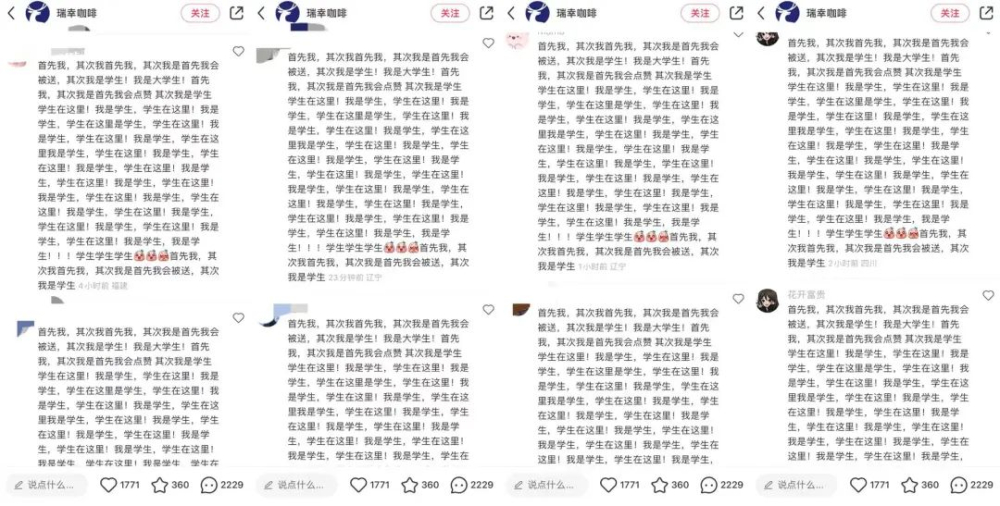
In summary, this wave of “university student comment flooding” in Luckin’s comment sections is both a microcosm of young people’s consumer behavior and a reflection of the brand’s agile response in community marketing. For readers who want to gain a deeper understanding of coffee market trends or grasp the psychology of the student consumer demographic, such cases offer plenty of practical insights. Whether it’s tips for buying affordable coffee or strategies for engaging with brand interactions, there’s much to be learned.
The above content is compiled by CoffeeHunters, a coffee news website.


