







Introduction:The spring tea beverage market is witnessing a competitive wave of new Longjing tea releases, but the spotlight has shifted to GuMing and Nayuki after both brands chose the same West Lake Longjing intangible cultural heritage master — Fan Shenghua — as their collaborator. While one brand refers to him as a “guiding master” and the other as a “supervising producer,” the uncanny similarities in the master’s image, attire, and even facial expressions have sparked heated online discussions. This article delves into the high-end marketing strategies and traffic-driven logic behind this “shared master” phenomenon in the tea beverage industry.
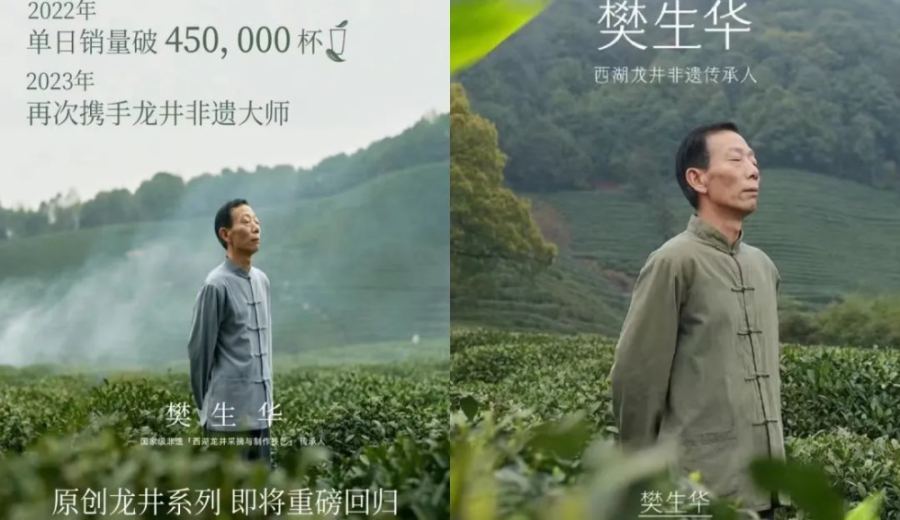
Spring is traditionally the season when tea beverage brands launch new Longjing-themed products. However, this year, GuMing and Nayuki unexpectedly became the center of attention for both selecting Fan Shenghua, the representative inheritor of the national-level intangible cultural heritage “West Lake Longjing Picking and Processing Techniques.” One brand announced its Longjing-themed new product with a “guiding master,” while the other touted “supervisory participation.” Surprisingly, the promotional images of the master from both brands — in terms of clothing, posture, gestures, and even the extent of his smile — were strikingly similar, prompting netizens to joke: “Is the master working double shifts?”
On March 17, GuMing was the first to announce its renewed collaboration with Fan Shenghua, reviving the well-received Longjing series from 2022, emphasizing that this time it was a “guidance partnership.” Soon after, on March 30, Nayuki unveiled the first season of its “Scent-Seeking Chinese Tea” program, launching the “Longjing Green Dumpling Treasure Tea.” The official copy mentioned that the season’s products were “supervised by Teacher Fan Shenghua,” clearly positioning Longjing as the starting point.
A close comparison of the promotional materials from both brands reveals that although GuMing uses the term “guiding” and Nayuki “supervising,” there is no doubt they are referring to the same Longjing-making master from Hangzhou. Even more coincidental is the fact that in both brands’ promotional images, Fan Shenghua’s outfit, camera angle, body movements, and even the degree of his eye contact and smile are nearly identical, leading some to suspect they came from the same photoshoot and styling session.
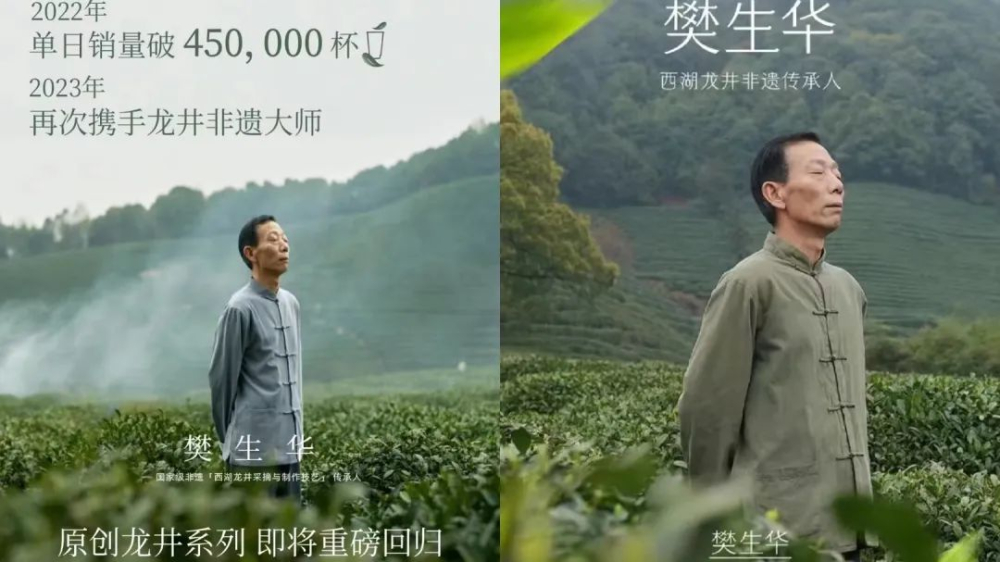
This phenomenon quickly sparked widespread discussion on social media platforms. Netizens voiced their opinions, with some joking, “Did Nayuki borrow the master from GuMing?”, “Are the two brands sharing one master?”, or “Is the master working in shifts?” Others humorously remarked, “The master keeps his eyes closed the whole time — I can’t even tell which brand it is.” These comments not only reflect consumers’ sharp awareness of brand marketing tactics but also highlight the challenge of achieving differentiation in an increasingly homogenized market.
In fact, this “shared master” phenomenon reflects a common dilemma faced by the entire tea and even coffee industry in the pursuit of premiumization and deeper brand culture. To enhance the perceived value and market appeal of their products, brands often rely on iconic artisans or expert figures as symbols of product quality and craftsmanship. In the specialty coffee field, common practices include sourcing beans from renowned regions or enlisting world competition champions; in the tea beverage market, the focus is on origin traceability and the inheritance of traditional handcraftsmanship, leveraging these elements to reinforce a brand’s “artisan spirit.”
However, the number of truly representative and credible artisans is limited, especially in culturally rich and regionally distinctive areas like West Lake Longjing, where those who have earned national-level intangible cultural heritage recognition are few and far between. As a result, when multiple brands independently choose the same master as a brand ambassador or technical advisor, such “collisions” become almost inevitable.
Faced with online discussions and skepticism, some observers have pointed out that although it may seem like a “shared master” situation among brands, in today’s traffic-driven marketing environment, such coincidences might actually generate extra exposure and discussion. Consumers, upon noticing these interesting “overlaps,” often actively share and discuss them, inadvertently creating unexpected promotional effects for the brands. In a way, this “shared master” phenomenon is not just the outcome of marketing strategies but has also become part of brand interaction and user engagement in the social media era.
In summary, the “shared master” incident involving GuMing and Nayuki not only reveals the intensity of competition during the spring new product launches in the tea beverage market but also reflects the practical challenges behind premiumization and cultural branding. For brands, the key to standing out in the market will be how to craft more distinctive and authentic product narratives while leveraging the image of artisan figures.
The above content is compiled by CoffeeHunters, a coffee news website.


