







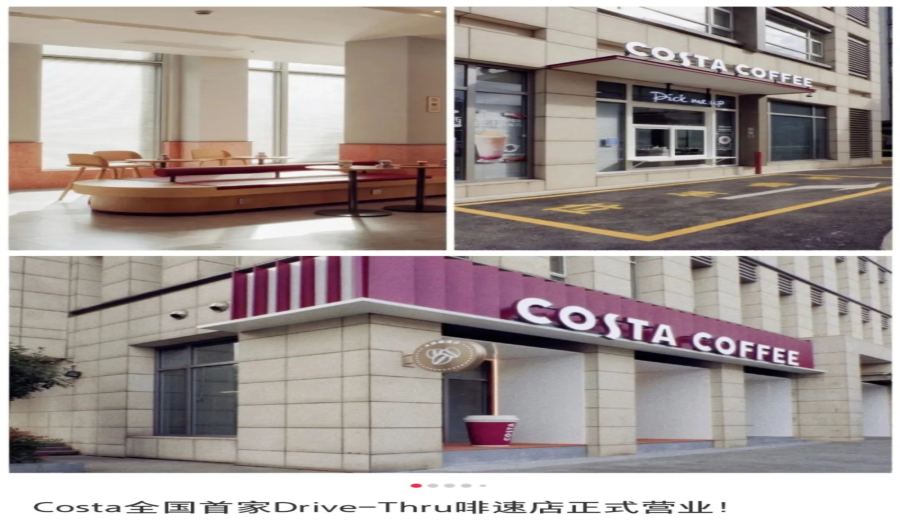
Introduction:The globally renowned coffee brand Costa recently launched China’s first ever ‘Drive-Thru’ store in Shanghai’s Pudong New Area, using an innovative ‘drive-up purchase’ model to capture the takeaway market. This article delves into the development of this model overseas, compares it with Starbucks’ ‘shared space’ concept, and explores how Costa is leveraging this approach to close the gap with leading brands in store presence.
The battle in China’s coffee market has expanded from a simple focus on store count to competition over diverse consumption scenarios. Recently, coffee brand Costa officially opened China’s first ‘Drive-Thru’ store on Tainan West Road in Shanghai’s Pudong New Area. Customers can complete their orders and pick up their drinks without leaving their vehicles, significantly enhancing takeaway convenience. This service model has been well-established in European and American markets for years but remains a new endeavor in China.
Notably, in addition to traditional coffee beverages, this location also features four rentable meeting rooms and a shared office space equipped with projectors, conference tables, and more, accommodating up to 18 people simultaneously. This move is seen as a direct response to Starbucks’ previously introduced ‘shared space’ concept stores, showcasing the brand’s strategic layout in non-traditional coffee consumption scenarios.
The so-called ‘Drive-Thru’ is a service format originating in the United States and widely adopted in the fast food and coffee industries, allowing consumers to complete the entire process of ordering, paying, and picking up food and drinks without leaving their cars. As early as 1921, a similar prototype appeared in the United States, and after McDonald’s launched its first ‘Drive-Thru’ restaurant in 1975, the model quickly expanded globally, being applied across various sectors including fast food and coffee.
For Costa, the establishment of ‘Drive-Thru’ stores is not only an innovation in service models but also a crucial part of its competitive strategy in the Chinese market. The brand was founded in 1978 by the Costa brothers in London, Italy, entered the Chinese market in 2006 with its first store located on Nanjing East Road Pedestrian Street in Shanghai, and has long regarded Starbucks as its main competitor.
Looking at overseas markets, as early as mid-2019, Costa already had over 40 ‘Drive-Thru’ stores in the UK. During the pandemic, driven by a surge in delivery demand, the number of stores with similar functions expanded to more than 300 within just a few months. This experience laid the foundation for introducing the model in China.
In terms of market landscape, Starbucks’ latest financial report in 2022 showed that its number of stores in mainland China had exceeded 6,021, with plans to further increase to 9,000 by fiscal year 2025. In comparison, according to data from Zhaomen Canyan, Costa currently has only 424 stores in China, highlighting a significant gap between the two brands in terms of expansion speed and market penetration.
The pilot Shanghai ‘Drive-Thru’ store, covering an area of approximately 500 square meters, in addition to regular coffee sales, particularly emphasizes meeting and shared office functions, demonstrating Costa’s attempt to attract a more diverse customer base through differentiated services. The meeting rooms offer noise-reducing designs and are equipped with devices such as projectors, suitable for small team discussions or business meetings.
Starbucks China launched its ‘shared space’ concept store last November, also featuring private meeting rooms, open work areas, sofa discussion zones, and rest areas, with an emphasis on privacy and functionality. It is evident that the competition between these two major brands in non-dine-in scenarios has intensified.
A Costa spokesperson stated: ‘We are committed to providing every visitor with excellent service and experience. Opening our first ‘Drive-Thru’ store in China is an important milestone in showcasing our innovation capabilities and strengthening our competitive edge in the market.’ Whether this model will help Costa accelerate its store expansion remains to be closely observed.
The above content is compiled by CoffeeHunters, a coffee news website.


