







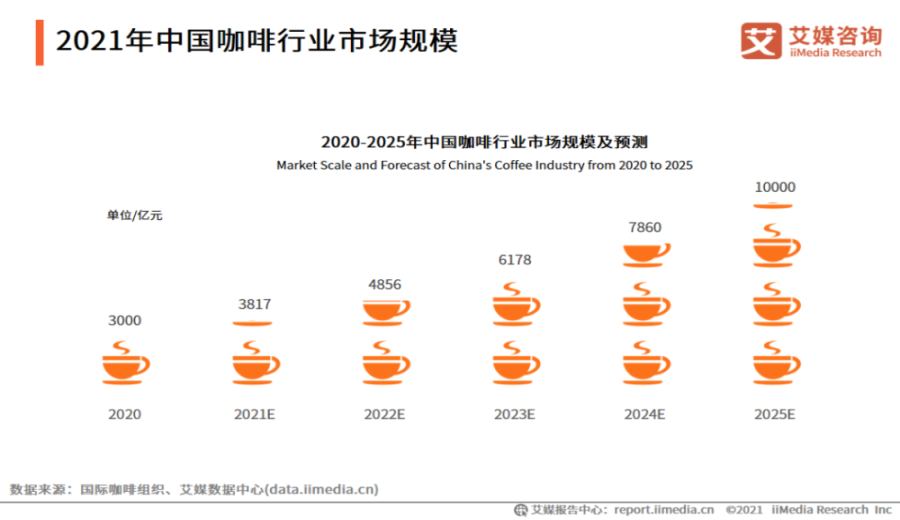
Introduction:China’s coffee market is projected to surpass one trillion yuan by 2025, with the consumer base expanding to 300 million people, pushing competition into a white-hot phase. From Luckin’s reversal to overtake Starbucks, to emerging brands and international chains vying for layout, this article delves into the strategies, market data, and future trends of each camp, guiding you through the key variables in this coffee battle.
China’s coffee consumer group has grown to approximately 300 million people, with the market size continuously expanding and expected to approach the one trillion yuan mark by 2025. Amidst this wave, Luckin has regained its footing after turmoil, not only rapidly recovering its performance but also surpassing Starbucks in store count to become China’s largest chain coffee brand. Starbucks, on the other hand, adheres to a fully company-operated model, steadily expanding the market, and plans to open over 9,000 stores in mainland China by 2025.
In 2021, China’s coffee market size was about 381.7 billion yuan. According to a prediction by iiMedia Research, it will grow significantly to 10,000 billion yuan by 2025, roughly 12 times that of 86.1 billion yuan in 2020. For a long time, chain coffee brands have dominated the market, but the overall chain rate remains below 13%, far lower than the US market, indicating huge future growth potential.
After experiencing a financial storm, management turbulence, and changes in the founding team, Luckin achieved a performance turnaround in just two years through strategic adjustments and product innovation. In the fourth quarter of 2021, its store count reached over 7,000, officially surpassing Starbucks to become the market leader.As of the third quarter of 2022, Luckin’s total number of stores nationwide increased to 7,846, with revenue reaching 3.895 billion yuan, a year-on-year growth of 65.71%.The average monthly transaction customer count also surged by 70.5% compared to the same period last year, exceeding 25.1 million.
In the first three quarters of 2022, Luckin launched 92 new products, among which the Iced Rich Milk Latte, Iced Coconut Latte, and Iced Oatmilk Cloud Latte successfully sparked consumer enthusiasm, becoming important drivers of brand growth. However, the battle for market leadership is not yet over, with competitors hot on its heels.
Since 2018, Starbucks has completely closed its franchised stores in the Chinese market, switching to a fully company-operated model, emphasizing standardized and refined operations, demonstrating its emphasis on this key market. This move not only helps maintain brand image and service consistency but also lays the foundation for a possible future “company-operated + franchise” hybrid model. Starbucks plans to expand to over 9,000 stores in mainland China by 2025.
Beyond international and traditional major brands, domestic emerging chain coffee brands such as Manner, M Stand, and NOWWA are also rapidly expanding with the support of capital markets. Taking NOWWA as an example, its store count exceeded 1,500 in June 2022, and it successively announced expansion plans for opening 100 and 120 stores simultaneously. Manner Coffee completed four rounds of financing within half a year, with its valuation reaching the tens of billions level, gradually increasing its market presence.
On the international brand front, Tims, with a pricing strategy between Starbucks and Luckin, and %Arabica, known for its high-end boutique image, have also entered the Chinese market one after another, further intensifying the competitive landscape.
Notably, heavyweight capital investors such as Sequoia Capital, Black Ant Capital, IDG, Tencent, Meituan, and ByteDance have all placed bets on the Chinese coffee market, showing the investment community’s high expectations for this sector. In just a few years, coffee has transformed from a “niche beverage” into an emerging trend in the eyes of the capital market.
Despite the promising market outlook, the current degree of chain operation among domestic coffee shops remains low, with the overall proportion not yet reaching 13%. If more cross-industry giants such as Li-Ning and China Post join the fray in the future, it is bound to bring a new wave of impact to the existing competitive landscape.
Looking at the big picture, whether it’s the steadily operating traditional brands, the aggressively expanding emerging forces, or the capital players venturing across industries, all are driving the rapid maturation of China’s coffee industry chain, and market competition will also enter a higher-level contest. For consumers, this means more diverse choices and a higher quality coffee experience, while the battle among brands has only just begun.
The above content is compiled by CoffeeHunters, a coffee news website.


