







Introduction:Luckin Coffee's third-quarter 2022 financial report shows that revenue grew 65.7% year-on-year to RMB 3.895 billion, with a net profit of RMB 529 million, successfully turning losses into profits. The total number of stores exceeded 7,846, firmly establishing it as the leading domestic chain coffee brand. As direct-operated store growth slows, Luckin announced in December that it will reopen recruitment for joint-operation partners in lower-tier markets to further capture market share. This article provides an in-depth analysis of its financial highlights, store strategy adjustments, and competitive market dynamics.
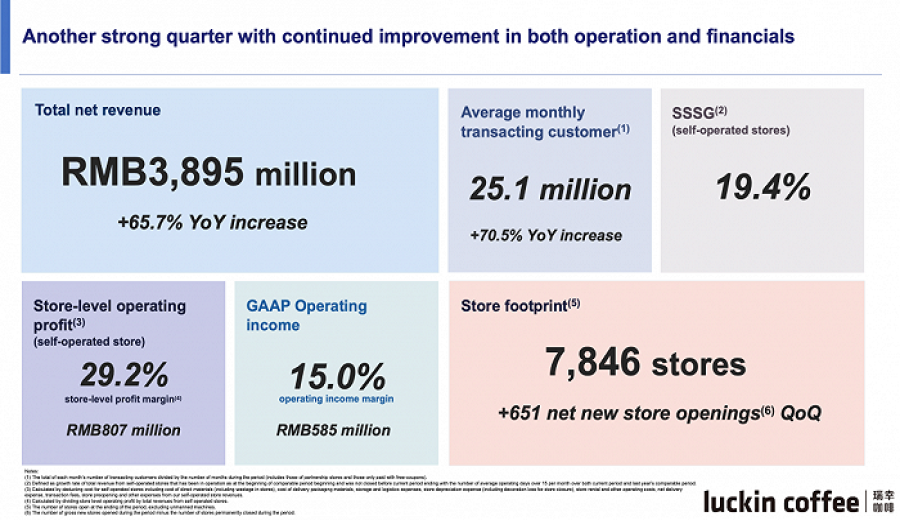
Luckin Coffee recently released its third-quarter 2022 financial statements, with impressive figures: total revenue surged 65.7% compared to the same quarter last year, reaching RMB 3.895 billion, and it recorded a net profit of RMB 529 million, marking the brand’s transition from loss to profitability. Calculated under U.S. Generally Accepted Accounting Principles (GAAP), operating profit was RMB 585.3 million, with an operating profit margin as high as 15.0%. The average monthly number of transacting customers also grew by 70.5% to 25.1 million, indicating continuous improvement in consumer loyalty and brand appeal.
In terms of store expansion, this quarter Luckin added 651 new stores, bringing the cumulative total to 7,846, including 2,473 joint-operation stores and 5,373 company-operated stores. Compared with the same period in 2021, the total number of stores increased by a net 2,175, further solidifying its leading position in China’s chain coffee market. It is worth noting that although company-operated stores still dominate layouts in first- and second-tier cities, their growth has begun to plateau, increasing by only about 7% over the past three quarters, prompting the brand to adjust its expansion direction.
Looking back at the brand’s development, from the opening of its first store in Beijing’s Galaxy SOHO in October 2017 to the registration of its headquarters in Xiamen, China, in March 2018, Luckin Coffee rose rapidly and now has more stores than Starbucks. In the second quarter of this year, market expectations suggested its revenue might surpass that of Starbucks China, although Starbucks ultimately maintained its market share lead with a net revenue of USD 696 million (approximately RMB 4.968 billion). Its 29% quarter-on-quarter growth still demonstrates resilience.
Financial details show that Luckin’s total operating expenses in the third quarter were RMB 3.3094 billion, up 40.4% year-on-year. Among them, sales and marketing expenses reached RMB 159.3 million, a 64.3% increase, mainly invested in multi-channel brand exposure and advertising to strengthen market competitiveness. Additionally, in August this year, Luckin temporarily suspended recruitment for joint-operation partners and clarified that it had not launched any sub-brands, reminding consumers to be wary of misinformation online.
During the latest earnings call, Chairman and CEO Guo Jinyi revealed that the brand plans to reopen joint-operation partner recruitment targeting lower-tier markets in December. This move reflects Luckin’s aim to accelerate penetration into cities below the third tier by leveraging the joint-operation model, beyond the already dense network of company-operated stores in first- and second-tier cities, in order to tap into the potential of emerging markets.
Competition in China’s coffee market is becoming increasingly fierce. In addition to traditional food and beverage brands, cross-industry giants such as China Railway, China Post, Huawei, and NIO have also entered the fray, driving overall market enthusiasm. Meanwhile, international brands such as Canada’s Tims China are also actively expanding, collaborating with Alibaba to grow online sales and receiving investment from Tencent, aiming to establish 2,750 stores in China by 2026.
Currently, Luckin’s company-operated stores cover 60 cities nationwide, while joint-operation stores reach over 230 cities. With the reopening of joint-operation recruitment in lower-tier markets by the end of the year, it is expected to bring a new wave of growth momentum for the brand, further deepening market penetration and brand influence.
The above content is compiled by CoffeeHunters, a coffee news website.


