







Introduction:T97 Coffee has attracted over 1.5 million followers in just over two months thanks to its distinctive shouting-rap style livestreams and its iconic, big-mouthed host. Founder Li Xiao has even publicly challenged Luckin Coffee and Starbucks. However, with only 48 physical stores, it remains uncertain whether this wave of online traffic can translate into actual sales. This article takes an in-depth look at T97’s path to fame, market strategy, and potential risks, offering insight into the real strength of this rising brand.
T97 Coffee quickly rose to fame through its unique shouting-rap livestreams and a highly recognizable host. In just over two months, its official Douyin account amassed more than 1.532 million followers, demonstrating impressive community growth capabilities. Even founder Li Xiao admitted that this sudden surge in popularity was beyond his expectations.
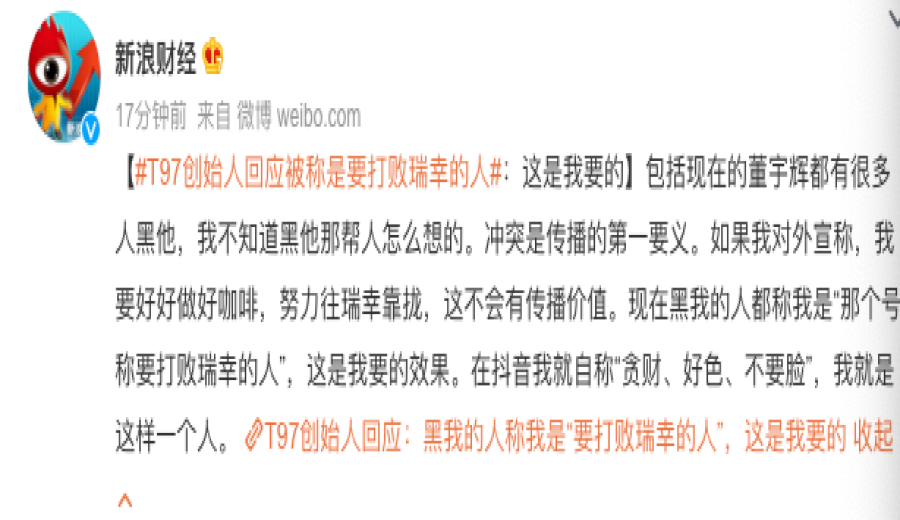
Faced with external skepticism about his bold claim of “defeating Luckin,” Li Xiao not only didn’t shy away from it but openly stated in livestreams that this is indeed his goal. He even jokingly referred to himself in a Douyin livestream as “greedy for money, lecherous, and shameless,” showcasing a highly controversial personal image. In April this year, T97 first attempted to sell products via livestream on Douyin, but the initial response was lukewarm. It wasn’t until September, when they switched to the shouting-rap style, that the trend began to heat up.
Notably, T97’s initial shouting-rap livestreams did not intentionally highlight the host’s big mouth feature—in fact, the host used light lipstick and beauty filters to shrink the appearance of their mouth due to its size before going live. However, one unfiltered livestream unexpectedly led to a surge in traffic. The team then adjusted their strategy, turning the host’s big mouth into a brand trait, paired with their lively and approachable personality. This successfully attracted a large audience, propelling the brand to go viral.
The high popularity from the livestreams also extended to founder Li Xiao. In addition to the official account, he manages multiple personal accounts such as “Li Xiao” and “Li Xiao – Boss Xiao,” which mainly promote Douyin marketing courses rather than coffee products. Their marketing model typically involves attracting users to add WeChat and then guiding them to purchase courses, making the process relatively straightforward.
During the livestreams, Li Xiao repeatedly publicly challenged Luckin, even claiming, “I’ve never taken Luckin seriously in my life,” and confidently described the structure of China’s coffee market: T97 first, Luckin second, and Starbucks third. He also reflected on his past experiences, claiming to have once lost 1 billion yuan and generated 50 billion yuan in performance, questioning Luckin’s sales scale.
However, according to data from T97’s Douyin flagship store, it only has 48 physical stores. This scale is noticeably small compared to Luckin’s network of thousands of stores. Although the brand has rapidly gained visibility through traffic, whether it can sustainably convert viewers into actual consumers without enough physical outlets remains uncertain.
Aside from the controversy stirred by the founder’s media tactics, the T97 brand itself is also facing market challenges. In the fiercely competitive coffee market, relying solely on short-lived livestream hype makes it difficult to build a long-term loyal customer base. Without a unique flavor or distinct product advantage, it’s challenging to stand out in an environment already crowded with strong competitors.
For T97, the key to determining whether it can continue to grow lies in transforming its short-term internet celebrity effect into a stable customer base, while further improving product quality and customer experience. The current situation, where high popularity hasn’t effectively driven up sales, serves as a reminder that the brand cannot rely solely on traffic—it must also focus on solidly managing its core business.
The above content is compiled by CoffeeHunters, a coffee news website.


