








Introduction:Changsha’s viral tea beverage brand, Chayanyuese, recently announced that it will completely cease using the English store signage “Sexytea,” sparking widespread discussion on the suitability of branding in international contexts and cultural adaptation. This article delves into the full backstory of the incident, revealing the boundaries that domestic trend-driven brands must be wary of in creative marketing, and explores through real-world cases how to balance product uniqueness with value communication.
The well-known domestic trend tea brand, Chayanyuese, has made a significant adjustment by announcing that, starting immediately, it will stop using the English signage “Sexytea” for newly opened stores and promises that all future new outlets will no longer adopt this name. The brand has also launched a plan to replace the English signs at existing stores, with the goal of gradually completing updates across all channels.
According to the brand’s official statement, the controversy centers around the multiple semantic interpretations of the word “Sexy.” While the brand originally intended to use the core meaning of the English term—“charismatic”—to convey the experience of offering consumers a unique and surprising encounter with each cup of tea, the word is often associated with sensuality in English-speaking contexts, leading to misunderstandings among some audiences. Chayanyuese publicly apologized and admitted that the team had already discussed optimization options for the English name during an internal review in the middle of the year, but progress had not met expectations.
It is worth noting that this is not the first time Chayanyuese has sparked controversy over its copywriting creativity.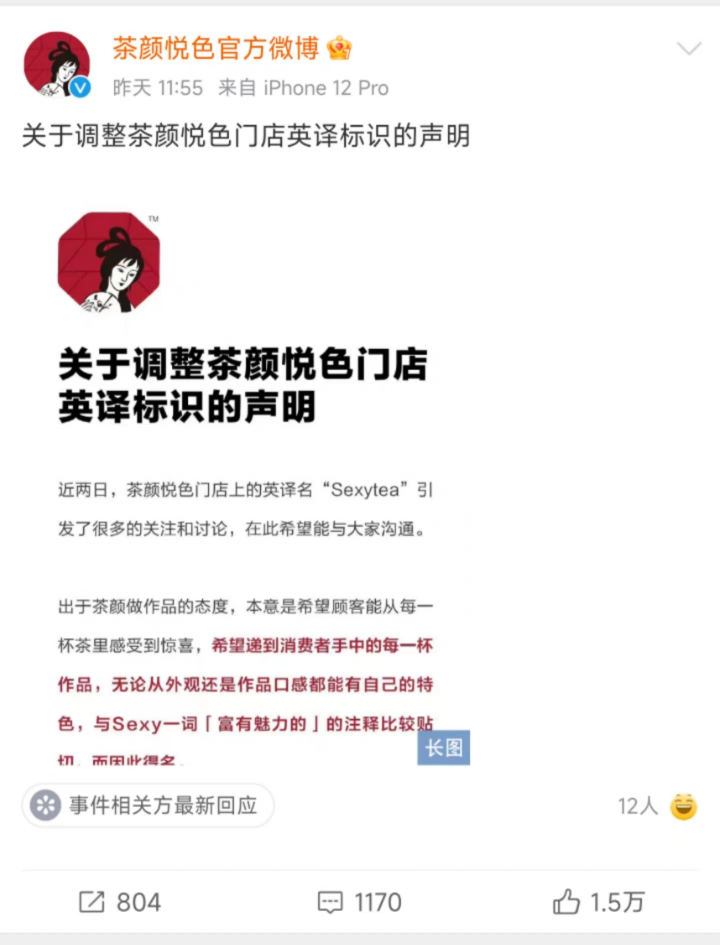 Previously, the brand had issued public apologies twice—once for the playful phrase “Pick up a basket” printed on its mugs, and another for the tea packet label reading “My lord, I want you.” These cases collectively reflect the common issue of value judgment discrepancies that domestic brands often encounter in cross-cultural communication.
Founded in 2013, Chayanyuese has built a distinctive brand identity in the tea beverage market through its Chinese-style visual system: store designs are anchored by traditional Chinese elements, the brand logo features a classical maiden holding a round fan, and its product line includes poetic tea names such as “Layered Oolong” and “Phoenix Perching on Green Osmanthus.” This unique cultural positioning has made it one of the iconic representations of Changsha, but it also places higher demands on the brand’s content review processes.
Professional observers point out that domestic trend brands often face three major challenges in the process of internationalization: semantic loss during language translation, differences in cross-border interpretations of cultural symbols, and the balancing act between youthful expression and mainstream values. The recent incident with Chayanyuese highlights the commonly seen phenomenon of “local humor failing abroad”—expressions considered playful or witty in a domestic context may be received very differently in international settings.
From an operational perspective, optimizing brand naming requires the establishment of a systematic evaluation mechanism. Practitioners are advised to pay special attention to the following when designing multilingual signage:Target market language taboo lists,Cross-border recognition research on cultural symbols, andConsumer emotion mapping tests. For signage that has already sparked controversy, a gradual replacement strategy, while requiring additional investment, can effectively safeguard the brand’s long-term assets.
The case of Chayanyuese offers an important lesson for the industry: while pursuing viral marketing moments, it is essential to establish a value filtration mechanism. Ultimately, what consumers choose is not just a product with buzzworthy appeal, but a brand ecosystem that aligns with their values. As market analysis emphasizes, healthy and sustainable brand growth is always built upon a precise balance between social responsibility and commercial creativity.
The above content is compiled by CoffeeHunters, a coffee news website.


