







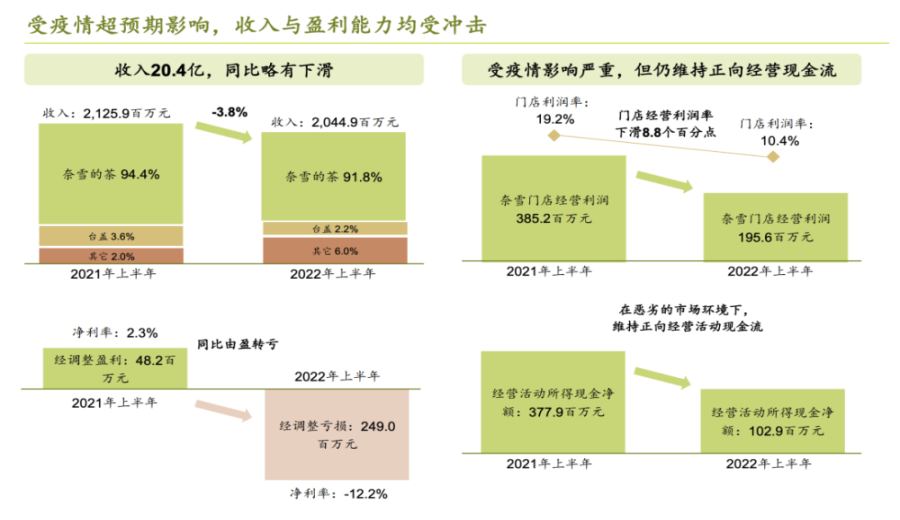
Introduction:Nayuki, once a dominant force in the new-style tea beverage market, saw its revenue decline in the first half of 2022 and reported a net loss of 249 million yuan. Faced with intense market competition and the impact of the pandemic, the brand opted to cross over into the coffee industry by investing in the coffee brand AOKKA in search of a breakthrough. Is the collective move by new tea brands into coffee a self-rescue strategy or a new trend? This article analyzes the highlights of Nayuki’s financial report, its brand transformation efforts, and helps you understand the potential and challenges within the coffee market.
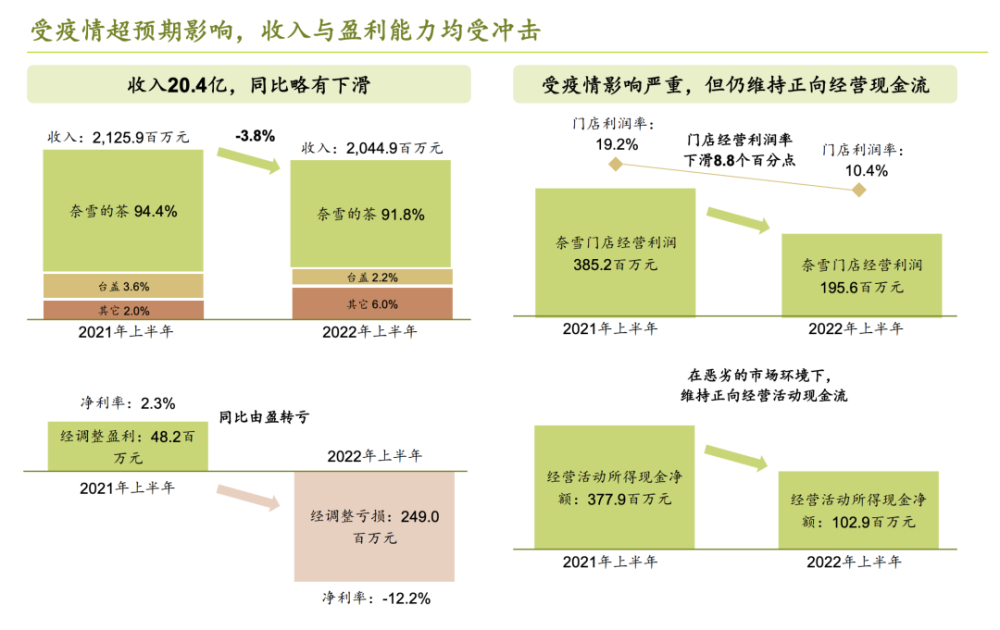
As the former “first stock of new-style tea beverages,” Nayuki recently released a less-than-ideal semi-annual performance report: its revenue slightly declined by 3.8% compared to the same period last year, reaching 2.045 billion yuan; when non-recurring items are excluded, it turned from profit to loss, recording a net loss of 249 million yuan — a sharp contrast to the 48.2 million yuan profit in the same period last year.
This high-end tea beverage brand, once highly favored by the market, did not develop as smoothly as expected after going public. Facing continuous price reduction pressure, a sharp decline in store foot traffic due to repeated pandemic outbreaks, and intensified competition within the industry, Nayuki had to seek new growth trajectories, gradually turning its attention to the rapidly rising coffee market.
Notably, Nayuki also joined the new-style tea “price reduction trend” at the beginning of 2022, attempting to attract a broader consumer base by lowering the price per cup and introducing mid-tier products. However, although this move attracted some price-sensitive customers, it also sparked considerable skepticism. Some consumers pointed out that while the listed prices of certain drinks were lower, the actual portion sizes had decreased, and the overall taste and quality seemed inferior to before, leading to the “price reduction strategy” being criticized as “not very consumer-friendly.”
In addition, Nayuki’s stores are mostly concentrated in first- and second-tier cities, which were severely affected during repeated pandemic outbreaks. Consumer willingness to visit physical stores dropped significantly, further increasing operational burdens and pushing the brand to consider more diversified development directions.
Meanwhile, other new-style tea brands are also actively seeking transformation and self-rescue. For example, HEYTEA has chosen to invest broadly in the beverage-related field. As of now, its investment portfolio includes the coffee brands Seesaw and Minority, the plant-based milk brand Wild Plants YePlant, the tea beverage brand HeHe Taotao, the ready-to-drink cocktail brand WAT, and even the juice brand YeCuishan, showcasing its strategic intent for diversified operations.
Once jokingly called the “brand that can’t get out of Changsha,” Cha Yan Yue Se has accelerated its expansion. Since 2022, it has established seven new companies, extending its business reach into supply chain management, food and beverage management, and the beverage sector, covering cities such as Nanjing, Wuhan, Changsha, and Chongqing. More symbolically, the brand has also crossed over into the coffee market, launching a new sub-brand “YuanYang Coffee” and opening five stores at once on August 10 in Changsha’s popular commercial district, the “Wuyi Commercial Circle,” demonstrating a strong offensive stance.

In comparison, Nayuki focuses more on creating a “third space” experience, continuously experimenting with cross-industry store models — from the cocktail-themed “Nayuki Bla Bla Bar,” the bookstore-concepted Tsinghua University South Gate store, to the multi-experience integrated “Nayuki Dream Factory” — all highlighting its emphasis on innovative consumption scenarios. However, the “Nayuki Dream Factory” was temporarily closed for renovation in May this year and reopened on August 31 with a completely new look as the “Nayuki Life” experience store.
In terms of strategic layout, Nayuki Tea officially entered the venture capital field at the end of March 2022 by establishing an investment company. It not only invested in its own suppliers — as disclosed by Tyan Ye Shares when filing for the Beijing Stock Exchange — but also recently became a shareholder of the coffee brand AOKKA. According to information, the related company of AOKKA, Shanghai Aodi Mei Food Co., Ltd., has completed industrial and commercial changes, with Nayuki Tea’s related company, Shenzhen Pindao Catering Management Co., Ltd., joining as a shareholder with a 21.41454% stake, and the company’s registered capital increased from 2 million yuan to 2.545 million yuan.
In fact, the trend of new-style tea brands investing in the coffee market is not an isolated case. Data shows that China’s coffee market reached a scale of 381.5 billion yuan in 2021, and with the gradual maturation of domestic coffee consumption habits, the overall market size is expected to exceed 1 trillion yuan by 2025, demonstrating huge growth potential.
In summary, Nayuki Tea, facing the dual pressures of intense competition within the new-style tea market and the pandemic, chose to cross over and invest in the coffee brand AOKKA. Whether it can successfully transform and reverse its downturn still depends on its subsequent execution and market response. For consumers and the industry alike, the integration trend between new-style tea and the coffee market is undoubtedly an important development direction worth continuous attention.
The above content is compiled by CoffeeHunters, a coffee news website.


