







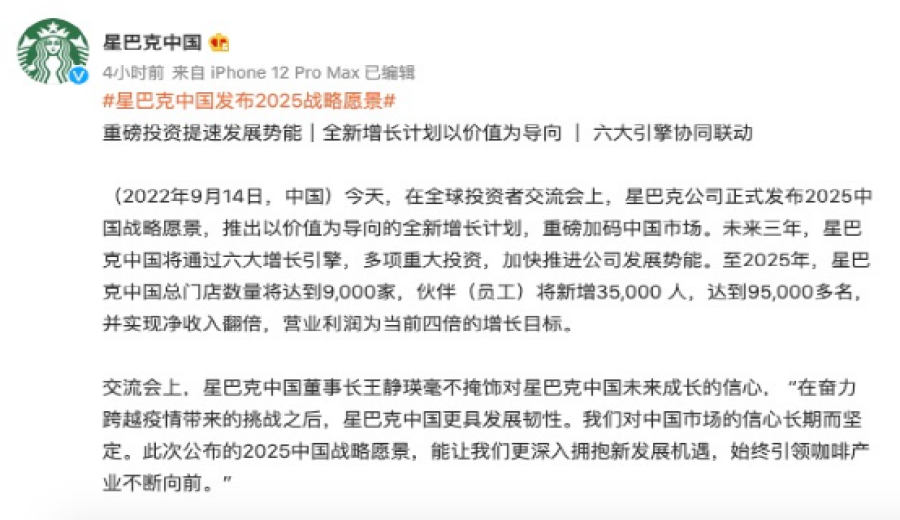
Introduction:Starbucks China recently announced its 2025 strategic vision, planning to expand its footprint over the next three years through six growth drivers. The goal is to reach 9,000 stores, grow its workforce to 95,000 employees, and double both net revenue and operating profit. In addition to accelerating store openings, the company will also promote a green store certification system, deepen digital membership services, and enhance localized product R&D. Faced with competition from domestic brands like Luckin, can this strategy help it maintain its market share? This article details the key objectives and implementation specifics.
The 2025 Starbucks China strategic blueprint has officially been unveiled! The brand announced that over the next three years, it will accelerate growth through the "Six Growth Engines," which include expanding the store network, promoting green stores, upgrading the digital membership system, strengthening localized new products, adjusting employee compensation structures, and optimizing operational efficiency. The core targets are clear: by 2025, the total number of stores will increase from the current over 5,600 to9,000, with the number of employees simultaneously rising to95,000, and net revenue and operating profit expected to double and quadruple, respectively.
Since entering China in 1999, Starbucks has already surpassed 5,600 stores, growing nearly tenfold over the past decade, with an estimated 6,000 stores by the end of 2022. This plan proposes reaching 9,000 stores by 2025, meaning an additional net increase of3,000 storesover the next three years—translating to roughly one new store opening every9 hours, an astonishing expansion pace.
To achieve more precise layout planning, Starbucks will leverage digital tools to analyze customer lifestyle habits and develop store types suitable for different scenarios. Among them, "Reserve stores" will continue to focus on elevating the premium coffee experience, while core stores will be positioned to "integrate into communities," offering approachable and warm service. This differentiated strategy helps meet diverse consumer needs and enhances brand loyalty.
The green store initiative is also a key focus. The brand aims to open approximately2,500 green storesnationwide by 2025. These stores will adhere to strict environmental standards, fully implementing sustainability concepts across architectural design, energy use, and waste management. As early as last year, Starbucks launched the world’s first "Greener Store" pilot at Shanghai’s Qiantan Taikoo Li, introducing multiple cutting-edge green retail measures and meeting the eight criteria of the "Green Store" certification system jointly developed by Starbucks and authoritative institutions. Certified stores can reduce carbon emissions by approximately10.57 metric tonsand water usage by301.7 metric tonsper year compared to ordinary stores of similar size, demonstrating significant environmental benefits.
Green stores have already been launched in cities such as Beijing, Shanghai, Shenzhen, Hangzhou, and Suzhou, with plans for further expansion. The brand hopes to encourage customers to embrace green living through these outlets, starting with everyday consumption, and collectively move toward a sustainable future.
In response to the digital wave, Starbucks will also increase investment, especially in its "Starbucks Delivers" delivery service. By 2025, delivery sales are expected to growmore than two-foldcompared to current levels. Currently, there are over 5,000 dedicated delivery riders, with an average delivery time of just19 minutesper order, ensuring customers enjoy coffee quality consistent with that in-store. The expansion of this service not only meets modern consumers' demand for convenience but also further strengthens the brand’s competitiveness in the digital market.
Additionally, the "Starbucks China Coffee Innovation Park," with an investment of approximately 1.1 billion RMB (156 million USD), is expected to officially launch in the summer of 2023. This facility in China will become Starbucks’ most environmentally friendly coffee roasting factory globally and the largest roasting base outside the U.S. market. Upon completion, Starbucks China will complete the localization of its entire industry chain—from green bean procurement and roasting to retail—enhancing supply chain efficiency and quality control.
Wang Jingyi, Chairman of Starbucks China, stated, "Having overcome the challenges of the pandemic, the brand is more resilient, and our long-term confidence in the Chinese market remains unchanged. The 2025 strategic vision will help us seize new opportunities and continue to lead the development of the coffee industry." However, the market competition remains fierce, with Luckin Coffee already surpassing Starbucks to become China’s largest coffee chain brand with 7,195 stores by the first half of this year—the gap between the two is narrowing. Whether Starbucks can hold onto its market share in the future remains to be seen.
The above content is compiled by CoffeeHunters, a coffee news website.


