







Introduction:Seven years after his 2015 WBC espresso championship win, Sasa Sestic returned to the competition stage with an experimental lot of Green Tip Geisha from Panama’s Iris Estate, paired with his proprietary Paragon brewing method and ice stone aroma-locking technique, ultimately securing second place in the 2022 Australian Coffee Brewing Championship. This article delves into his ultra-long 90-hour CO₂ immersion process, segmented pouring parameters (93°C → 88°C), flavor expression (raspberry sweetness, rosewater aroma), and the science behind the ice stone’s cooling and aroma-preservation, offering extractable logic for amateur enthusiasts.
Sasa Sestic, who previously claimed the 2015 World Barista Championship (WBC) espresso title with his CO₂ immersion method (CM) on Rume Sudan, stepped back onto the competition stage seven years later—this time in the pour-over category: the 2022 Australian Coffee Brewing Championship. He presented an experimental lot of Green Tip Geisha from Panama’s Iris Estate, cultivated in collaboration with Deborah Farm owner Jamison Savage. Through his exclusive processing method and innovative extraction techniques, he showcased astonishing candy-like sweetness and complex aromatics.
Amid the trend of anaerobic fermentation methods dominating competitions, Sasa chose instead to focus for years on studying the relationship between terroir and volatile compounds. He noted that while CM methods can leverage anaerobic environments to let lactic acid bacteria dominate fermentation, thereby enhancing specific flavors, over-fermentation can sometimes mask the inherent characteristics of a coffee’s origin. Thus, he shifted his research focus to how environmental factors shape coffee flavors. Alongside the Deborah Farm team, he cultivated vibrant Geisha in Panama’s Chiriquí Province at elevations of 1,850–2,300 meters on volcanic terrain, using Inga tree shade and natural ecosystems to simulate Ethiopian forest conditions.
The experimental micro-lot of Green Tip Geisha used in this competition was made from fully red cherries and subjected to an ultra-long 90-hour CO₂ immersion process. The harvested coffee cherries were immediately placed in a stainless steel sealed tank, injected with CO₂ to create an anaerobic environment, and fermented at an appropriate temperature. Sasa explained that as the tank’s temperature gradually decreased, lactic acid bacteria became the dominant microbial group. After 90 hours of low-temperature fermentation, opening the tank released a distinct raspberry aroma and candy-like sweetness—precisely the core flavor profile he aimed to present.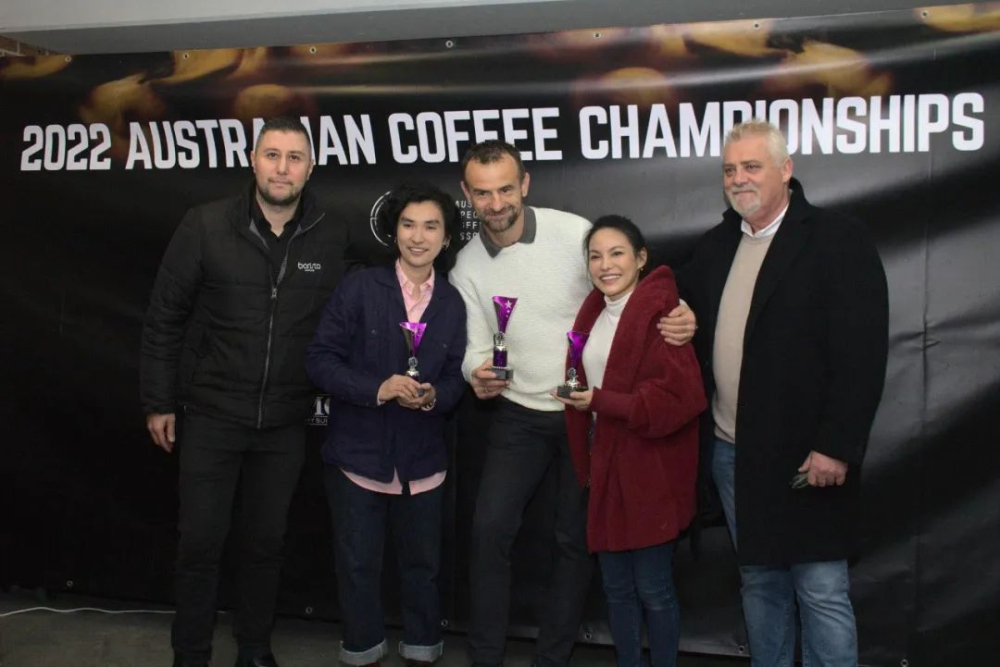
To fully capture these delicate aromas during extraction, Sasa collaborated with scientist Professor Jahan to develop a proprietary brewing method called Paragon Coffee Brewing. The most notable feature of this technique is the placement of a self-made ice stone in the filter cone to rapidly cool the initial phase of extracted coffee liquid. According to Sasa, this design effectively locks in up to 40% of volatile aromas, allowing the subtle notes of rosewater, raspberry, and hibiscus tea to linger longer.
In practice, Sasa’s segmented pouring strategy is highly meticulous: first, he uses circular pouring to uniformly wet all coffee grounds, ensuring consistent extraction; then, he switches to high-flow center pouring, pushing fine particles to the top layer of the liquid while extending the contact time between coarse particles and hot water, thereby balancing bitterness and extraction yield. The first two extraction phases use 93°C hot water throughout to enhance tartaric acid expression; by the fourth phase, the water is switched to 88°C Malaysian spring water with a silica concentration of 50ppm, leveraging the mineral properties to further elevate candy-like sweetness. Notably, the ice stone is removed after the first three pouring phases to allow the latter phases to enhance overall flavor intensity.
This intricate process ultimately delivers a multi-layered flavor evolution: at high temperatures, hibiscus tea dominates, with lingering notes of purple grapes and rosé champagne; at medium temperatures, it presents the bright acidity of red apples; and at low temperatures, it transforms into a red candy-like flavor expressed through raspberries, with a finish of red apple acidity and chocolate-wrapped Turkish delight, showcasing exceptional flavor tension.
Although the competition concluded with a runner-up finish (the champion was Korean-Australian barista Harry Ko, who would later represent Australia at the WBC), Sasa emphasized that his primary motivation for participating was to share his passion for coffee-making and showcase years of research to family and friends. He admitted that even with advanced processing methods and precise extraction techniques, competition is ultimately an extension of daily craftsmanship. Beyond winning or losing, the focus and dedication of each competitor are the core values most worth learning.
Regarding the specific principles and production details of the ice stone’s aroma-locking effect, Sasa has revealed that he will share further insights on social media platforms soon. For amateur coffee enthusiasts, while fully replicating competition parameters may be challenging, understanding the logic behind the processing method and the core concepts of segmented extraction can still provide fresh inspiration for everyday pour-over practices.
The above content is compiled by CoffeeHunters, a coffee news website.


