







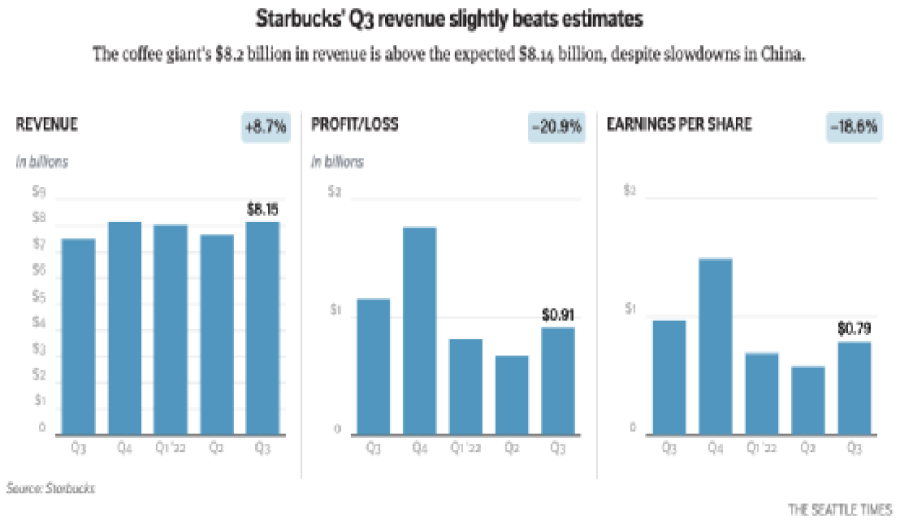
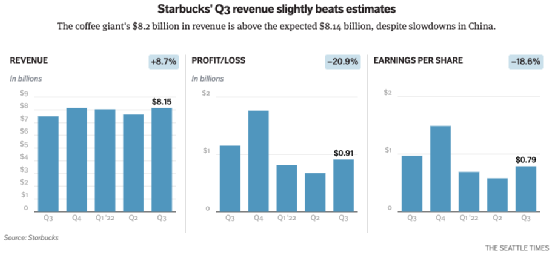
Introduction:Starbucks' latest Q3 earnings report shows global revenue reached $8.15 billion, surpassing market expectations. While the North American market performed strongly, same-store sales in the Chinese market plummeted by 44%. This article provides an in-depth analysis of the performance gap between Starbucks' global and Chinese markets, exploring cold beverage sales trends, the impact of the pandemic, and future expansion strategies to help readers grasp the latest developments and market dynamics of this international coffee brand.
Starbucks recently released its Q3 earnings report, with total global revenue reaching $8.15 billion, better than market expectations, and a 3% growth in global same-store sales. Among them, same-store sales in the North American market grew significantly by 9%, becoming the main pillar of this quarter's performance; however, same-store sales in international markets fell by 18%, with the Chinese market facing severe challenges—same-store sales dropped sharply by 44%, and revenue decreased by 40% year-on-year.
Although the U.S. market is affected by inflationary pressures, consumer demand for cold beverages remains strong, especially for products such as iced shaken espresso and fruit teas, which continue to sell well. Even against a backdrop of heightened economic uncertainty, Starbucks' U.S. customers have not reduced their spending on coffee; instead, they have boosted overall revenue performance, setting a new quarterly revenue high.
Starbucks interim CEO Howard Schultz pointed out that cold beverages accounted for as much as 75% of drink sales in Q3, showing a strong preference among younger consumers, particularly Gen Z, for cold drinks. He noted that these consumers favor personalized customization and are keen to share photos of their drinks on social media platforms, further driving the sales boom of cold beverages.
Compared to the stellar performance in the North American market, the Chinese market has become Starbucks' biggest uncertainty this quarter. Affected by repeated COVID-19 outbreaks, especially in cities like Shanghai, Starbucks faced prolonged store closures. Wang Jingyi, Starbucks China Chairman, stated that this year’s Q3 was the most severely impacted quarter for the Chinese market since the outbreak of the pandemic, with around 940 stores in the Shanghai area, nearly two-thirds of which were under lockdown for much of the time.
The uncertainty brought by the pandemic led to a 44% drop in same-store sales in China, even exceeding analysts’ original estimate of 39%. Overall, Starbucks' China market revenue in Q3 was $540 million, plunging 40% compared to the same period last year. Although Shanghai gradually reopened from early June and performance has stabilized somewhat, it still could not mask the overall downward trend.
Dragged down by the performance in the Chinese market, Starbucks' overall international sales fell by 18% this quarter. Although the COVID-19 situation in China is now easing and store operations are gradually resuming, the region remains highly uncertain. Starbucks has long regarded China as a key growth market, previously stating that most of its future business expansion will focus here, with a target of operating 6,000 stores in China by the end of the year.
In addition to the pandemic, Starbucks also faces multiple challenges including rising commodity costs, increased labor wages, and currency fluctuations, all of which put pressure on its overall profitability. Despite poor performance in the Chinese market, investors still gave positive recognition to Starbucks' overall earnings report, especially its strong performance in the North American market, which successfully offset declines in other regions.
The above content is compiled by CoffeeHunters, a coffee news website.


