







Introduction:Do you drink coffee every day to stay alert, or has it already become an addictive habit? The latest research has found that for most people, the act of drinking coffee is actually driven more by daily routines than by genuine physiological needs. By delving into psychological mechanisms and real-life examples, this article helps you understand your relationship with coffee and reveals how habits can shape our daily choices without us even realizing it.
In the fast-paced modern life, coffee is no longer just a flavorful beverage but has become an indispensable “energy source” for many. Some people enjoy its aroma and layers of flavor, while others simply rely on it to help them concentrate and ward off drowsiness. Especially for those working a nine-to-five job, brewing a cup of coffee in the morning has almost become a standard way to start the day. But have you ever thought about whether this action is truly because your body needs caffeine, or just an unconscious habit formed over time?
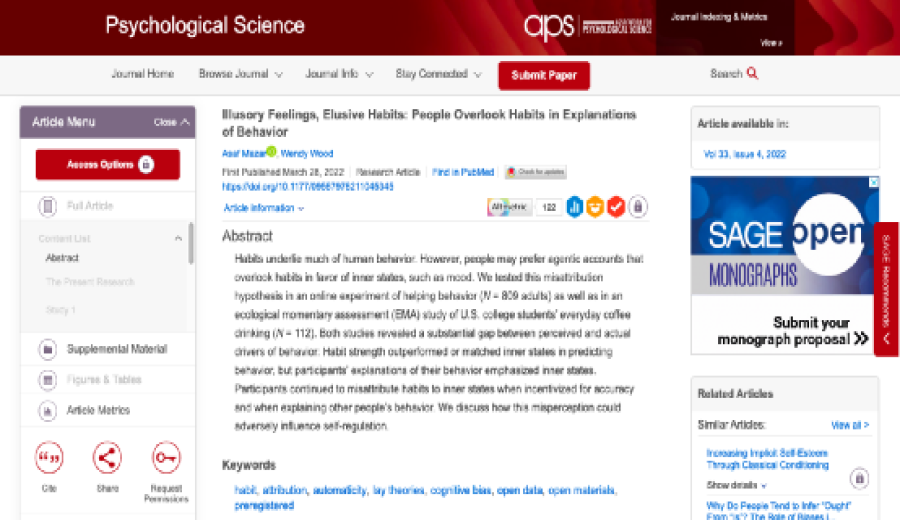
A study published in the journal Psychological Science points out that people often mistakenly believe they drink coffee due to actual needs, such as eliminating fatigue or boosting energy. However, the real driving factor is more likely to be long-established daily behavioral patterns. The study shows that when self-evaluating, respondents generally overestimated the influence of physiological or emotional motivations and underestimated the control habits have over their behavior.
So, every time you pick up a coffee cup, is it because your body genuinely needs that caffeine, or are you unconsciously repeating the previous day’s actions? Many respondents in the survey stated that when they feel tired, they believe it is the main reason prompting them to drink coffee, even considering the impact of “fatigue” to be more than twice that of “habit.” However, when the research team further tracked these respondents for a week, recording their coffee intake every two hours and their real-time fatigue levels, the results were surprising—people are actually acting out of habit in most cases, rather than responding to immediate needs.
Wendy Wood, one of the study’s authors, explains that many of our daily behaviors, including eating, exercising, and even environmentally friendly habits, are often carried out automatically according to established patterns, rather than being thought through each time. She emphasizes that this does not mean habits are necessarily bad—in fact, positive behaviors such as maintaining exercise, eating fruits and vegetables, and recycling are often sustained because they’ve become habits. The issue is that we often fail to honestly assess whether it is an internal need driving us or an unconscious habit taking the lead.
Some might argue that drinking coffee is a mix of both need and habit. Indeed, many office workers initially drink coffee to combat drowsiness after staying up late. Over time, this behavior becomes fixed and eventually evolves into a morning ritual. Eventually, even without feeling particularly tired, just reaching the usual coffee time can trigger the body’s automatic craving for that cup of black coffee. This transition from “need-driven” to “habitual automation” is a pivotal point in behavioral psychology worth noting.
The role of coffee also varies across different cultural contexts. In Europe and America, coffee has long been part of life—not only as a pick-me-up but also serving social and relaxation functions. However, in the Chinese market, coffee consumption is still in the early stages of rapid growth. Here, people’s motivations for drinking coffee can generally be categorized into three types: first, to meet actual physiological needs, such as boosting energy or improving concentration; second, to fulfill emotional needs, using coffee to showcase lifestyle taste and self-discipline; third, based on social needs, interacting with friends or colleagues in coffee shops. When these needs are repeatedly met through the same behavior, stable individual behavioral patterns gradually form—what we call “habits.”
Returning to the original question—when you drink that cup of coffee every day, is it really because your body needs it, or is it just out of habit? Perhaps the answer isn’t black and white, but rather the result of constant tug-of-war and mutual shaping between need and habit. But no matter what the motivation is, understanding the psychological mechanisms behind it can help us better grasp our relationship with this beverage while enjoying our coffee.
The above content is compiled by CoffeeHunters, a coffee news website.


