







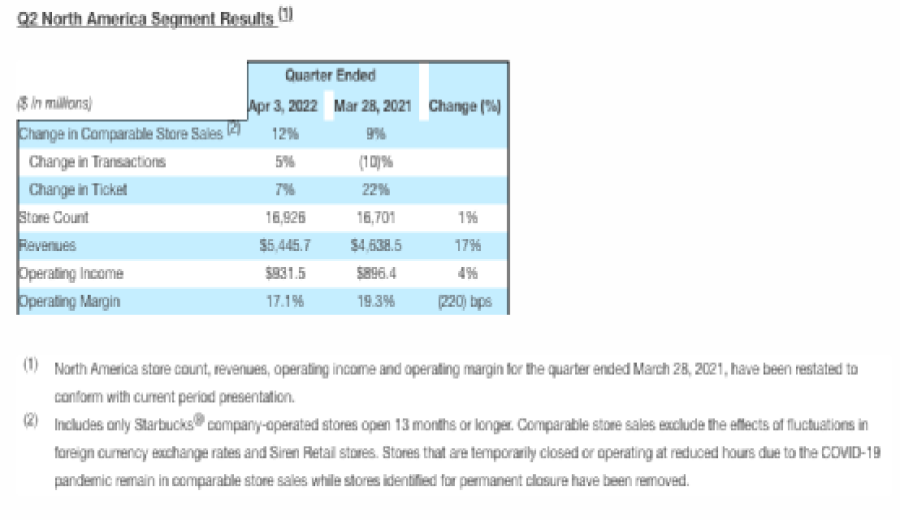
Introduction:Starbucks' latest Q2 2022 financial report shows strong performance in the North American market, with comparable store sales up by 12%, but revenue in China declined by 14%. At the same time, Starbucks announced a $1 billion investment to improve employee benefits, including pay raises and training, but excluded stores that have unionized. This article breaks down the key figures from Starbucks’ quarterly report, details of the pay raise plan, and its current status and strategic adjustments in its two major markets — the U.S. and China.
On May 3rd U.S. time, Starbucks released its Q2 fiscal 2022 earnings report, which is also the first full quarterly report since Howard Schultz returned as CEO. One of the highlights of this report is the strong performance in the North American market, where comparable store sales grew12%, indicating improvements in both customer return rates and average spending. However, the Chinese market faced headwinds, with net revenuedown 14%, same-store transactions plummeting20%, and average ticket price also decreasing4%.
Despite the poor performance in China, Starbucks has not adjusted its expansion goals there, still planning to open up to6,000 storesby the end of 2022. At the same time, Starbucks also announced it will invest$1 billionto raise employee wages, enhance training, and improve store operational quality, but this benefit does not apply to stores that have unionized.
This pay raise policy mainly targets non-union store employees. According to Starbucks’ announced plan, employees with2 to 5 yearsof service will receive a salary increase of5%, or be adjusted to above the market entry-level salary standard5%, whichever is higher; for senior employees withover 5 yearsof service, the pay raise will be even greater at7%, or above the market entry salary10%, again choosing the higher option.
In addition, Starbucks also announced that starting Monday, it will raise the compensation levels of store managers, assistant managers, and shift supervisors bydouble the investment. This is a one-time adjustment, and employees will still be eligible for another planned pay raise in the 2023 fiscal year. However, Starbucks made it clear that stores that have voted to unionize will not be eligible for the aforementioned pay raises and benefit enhancements and must seek improvements through collective bargaining.
In terms of store operations and technology upgrades, Starbucks plans to introduce credit or debit card tipping functionality in stores by the end of 2022, and will also upgrade in-store equipment, including updating iPads and coffee-making machinery, to improve service efficiency and customer experience.
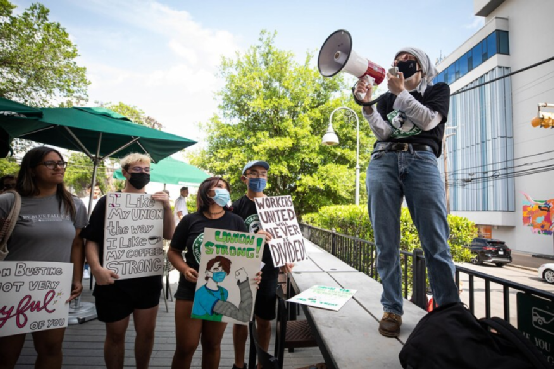
Since Howard Schultz returned to the CEO role, facing rising internal calls for unionization, in addition to launching pay raise and training programs, he has also publicly referred to unions as “outside interference forces.” However, media reports revealed that Schultz once described unions in an internal meeting as factors undermining Starbucks culture — ironically, many of these voices come from frontline employees.
Since Schultz resumed the CEO position in early April, Starbucks’ stock price slid from $88.09 per share on April 4thto $74.33 on May 4thonce dropped to that of May 4th, showing that market confidence in his handling of union issues and overall strategy still needs to be rebuilt. However, after the Q2 earnings report was released, its stock price rebounded in after-hours trading, rising by about, indicating that market confidence in its handling of union issues and overall strategy still needs to be rebuilt. However, after the release of the second-quarter earnings report, its stock price rebounded in after-hours trading, rising by approximately3%.
Overall, although the Chinese market is underperforming, the strong sales growth in North America has effectively balanced overall performance, enabling Starbucks to meet market expectations for profitability. The competition in the Chinese coffee market is becoming increasingly fierce, especially after Luckin recovered from its financial crisis and took the lead in the market. Whether Starbucks can achieve its store expansion goals as scheduled still depends on its subsequent strategies and market response.
The above content is compiled by CoffeeHunters, a coffee news website.


