







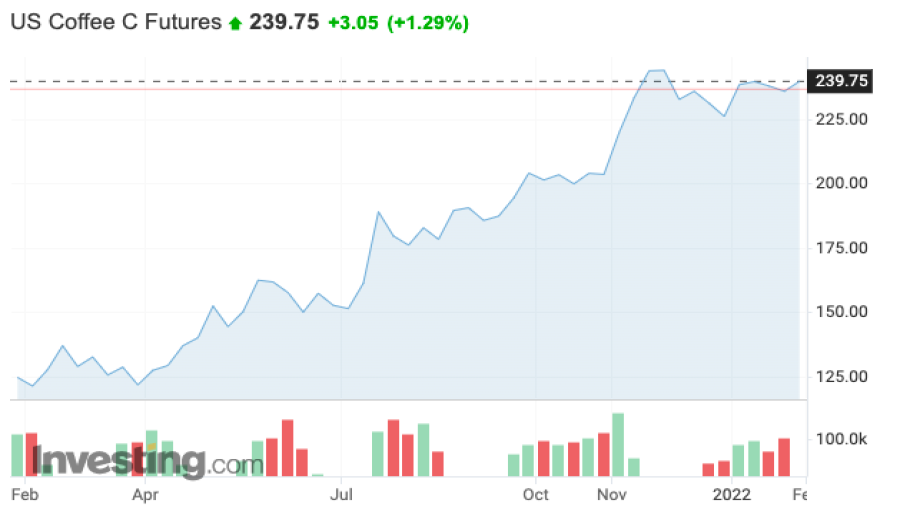
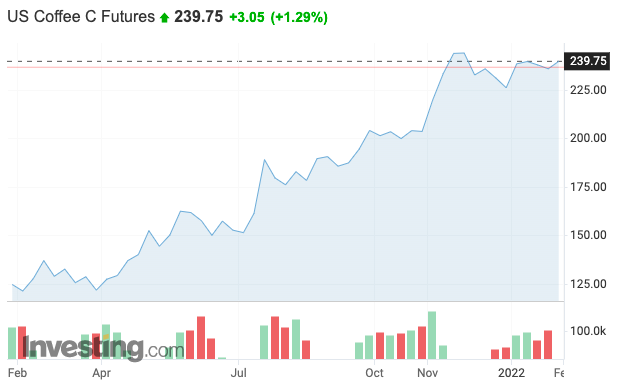
Introduction:Recently, Starbucks has been hit with frequent reports of price hikes. The CEO publicly stated that due to multiple factors such as increased employee salaries, soaring coffee bean futures prices, and supply chain instability, another round of price adjustments may be launched in the coming months. Over the past four months, there have already been two price increases, while the price of coffee beans has surged from 120.2 US cents per pound to 239.20 US cents within a year. This article analyzes the reasons behind the price hikes, market reactions, and trends consumers should watch out for.
Coffee enthusiasts may need to start getting used to new prices. Following South Korea’s Starbucks, which was the first to raise the price of Americano, the global brand Starbucks is also rumored to be adjusting its prices again soon. Starbucks CEO Kevin Johnson admitted in early February that due to challenges such as rising labor costs, a sharp spike in coffee bean prices, and supply chain disruptions, the brand may implement multiple price hikes in the coming months.
In fact, within just the past four months, Starbucks has adjusted its product pricing twice. According to market data, the price of coffee bean futures has soared from 120.2 US cents per pound to 239.20 US cents over the past 52 weeks, an increase of over 90%. This is not only Starbucks’ main raw material but also a key factor affecting its overall cost structure.
It is worth noting that Starbucks has not explicitly stated whether the price hikes will apply to the Chinese market. However, as its second-largest global market, China’s performance is not optimistic. In the last quarter, Starbucks saw a significant 14% drop in same-store sales in China. The brand’s reputation has also taken a hit due to incidents such as the use of expired ingredients and inadequate handling of consumer complaints. These topics once trended on Weibo, sparking widespread discussion among consumers.
Looking back at the South Korean market, shortly before the Spring Festival, local Starbucks outlets were reported to have raised the price of Americano. Soon after, due to tightened “plastic ban” regulations, a chain reaction ensued, with many coffee shops following suit and raising their prices, leaving many consumers lamenting the loss of “Americano freedom.” Now, this wave of price hikes seems to be gradually spreading globally.
Starbucks’ CEO further explained in a public statement that in addition to the rising cost of coffee beans, adjustments in employee salaries and other operational cost increases are also major reasons for the price hikes. Especially in the post-pandemic period, the global supply chain continues to face disruptions, coupled with persistently high inflationary pressures, leading to a substantial overall increase in corporate operating costs.
Moreover, recently, employees at U.S. Starbucks locations have demanded unionization to fight for fair treatment due to issues such as low hourly wages, high work pressure, and insufficient training. Although the Chinese market announced in November last year the implementation of a 14-salary system for 40,000 employees, which temporarily boosted employee morale, it also simultaneously increased the company’s human resource cost burden. In addition, the recurring pandemic has led to a rise in employee sick leave rates, forcing some stores to shorten operating hours, further impacting revenue performance.
At the same time, global inflation rates have repeatedly hit record highs, and freight costs have continued to climb due to the impact of the pandemic. From green bean procurement and packaging material production to logistics and distribution, costs have risen across all stages. These additional expenses continue to erode Starbucks’ profit margins, resulting in its latest financial report falling short of market expectations and the company revising its 2022 fiscal year earnings growth target downward from an originally estimated minimum of 10% to 8%–10%.
To address this cost crisis, in addition to adjusting menu prices, Starbucks is also adopting a strategy of cutting non-essential expenses, hoping to offset the impact of soaring labor and raw material costs and stabilize overall profitability.
It is worth noting that although the Chinese market remains Starbucks’ second-largest global consumer market, with the rise of local coffee brands, consumers now have more affordable yet quality options. Starbucks’ competitive advantage in China is gradually shifting from the product itself to the consumption atmosphere, stylish merchandise, and brand experience. However, when these “added values” encounter price hikes and service controversies, whether they can still retain customers remains a point worth continuous observation.
The above content is compiled by CoffeeHunters, a coffee news website.


