







Introduction:Jamaica Blue Mountain coffee is renowned for its balanced and delicate acidity, sweetness, bitterness, and rich body, making it a representative of the world’s finest coffees. But what exactly makes it worthy of the “Blue Mountain” name? This article delves into the legal growing regions, altitude, and certification standards of Blue Mountain coffee, introduces the history and sustainability practices of the Clifton Estate, and details the characteristics of the Typica variety, as well as the differences between washed and natural processing methods. Finally, it provides expert pour over parameters and flavor evaluations to give you a comprehensive understanding of this rare coffee.
Jamaica Blue Mountain coffee is hailed as one of the world’s top-tier coffees, celebrated for its delicate and well-balanced flavors of sweetness, acidity, and bitterness, along with its rich mouthfeel. However, not all coffee grown in the Blue Mountains can be called “Jamaica Blue Mountain.” To understand its rarity, one must examine everything from regional certification and varietal traits to grading systems and processing methods. This article will provide a detailed look at the geographical conditions of Jamaica Blue Mountain, the CIB certification area, the historical background and environmental initiatives of the Clifton Estate, and an in-depth analysis of the uniqueness of the Typica variety, as well as the differences between washed and natural processing methods, to help you fully appreciate this globally renowned specialty coffee.
Jamaica Blue Mountain coffee is famed for its complex flavor profile, where acidity, sweetness, and bitterness are perfectly harmonized, delivering a smooth and elegant taste that many consider the pinnacle of coffee. It is also one of the most expensive coffees in the world. Compared to the floral and fruity notes of Ethiopian coffee, the dark chocolate tones of Colombian coffee, and the citrus and berry aromas of Panama Geisha, Blue Mountain coffee has a truly unique flavor that is hard to replicate elsewhere. For example, even within the same Geisha variety, flavors vary greatly by origin—and the same is true for Blue Mountain. Once the growing location changes, the flavor profile shifts noticeably.
The superior natural conditions of the Blue Mountains provide an ideal environment for coffee cultivation. The region features a tropical rainforest climate with abundant rainfall year-round and high air humidity. The mountains are often shrouded in mist, offering natural shade for coffee trees. Located near the 25th parallel north within the coffee belt, the Blue Mountains have high elevations, with the highest peak reaching 2,256 meters. Coffee is primarily grown on slopes below 1,700 meters, where the sloped terrain aids in drainage. With ample sunlight during the day and nutrient-rich volcanic soil, coffee trees can fully absorb nutrients and convert them into aromatic compounds, resulting in the extraordinary quality of Blue Mountain coffee.
However, not all coffee produced in the Blue Mountain region can be labeled as “Jamaica Blue Mountain.” The Jamaica Coffee Industry Board (CIB) strictly defines that only coffee grown within the four parishes of Saint Andrew, Saint Thomas, Saint Mary, and Portland, and at elevations between 1,000 and 1,700 meters, can be certified as genuine Blue Mountain coffee. This designated area covers only about 6,100 hectares. Coffee grown outside this zone, regardless of quality, cannot bear the Blue Mountain name. The CIB also continues to provide technical guidance to coffee farmers, ensuring that harvesting and processing meet high standards to maintain the exceptional quality of Blue Mountain coffee.
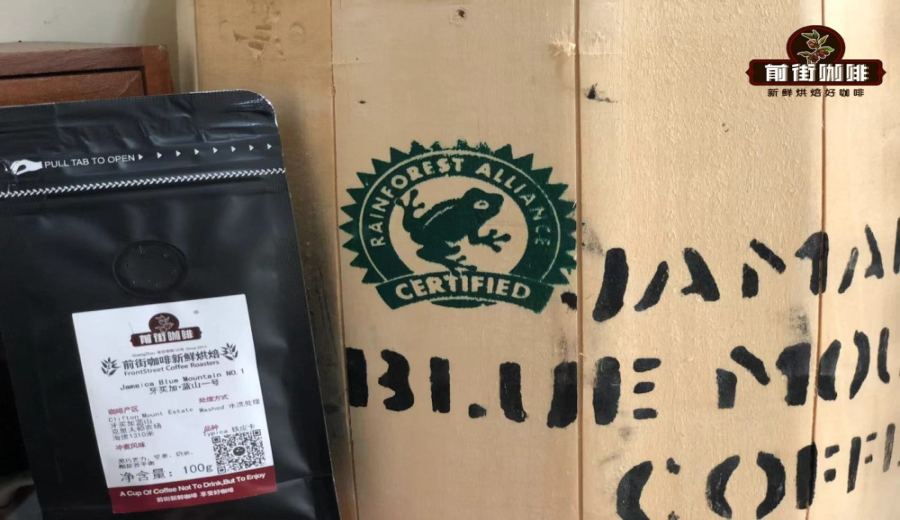
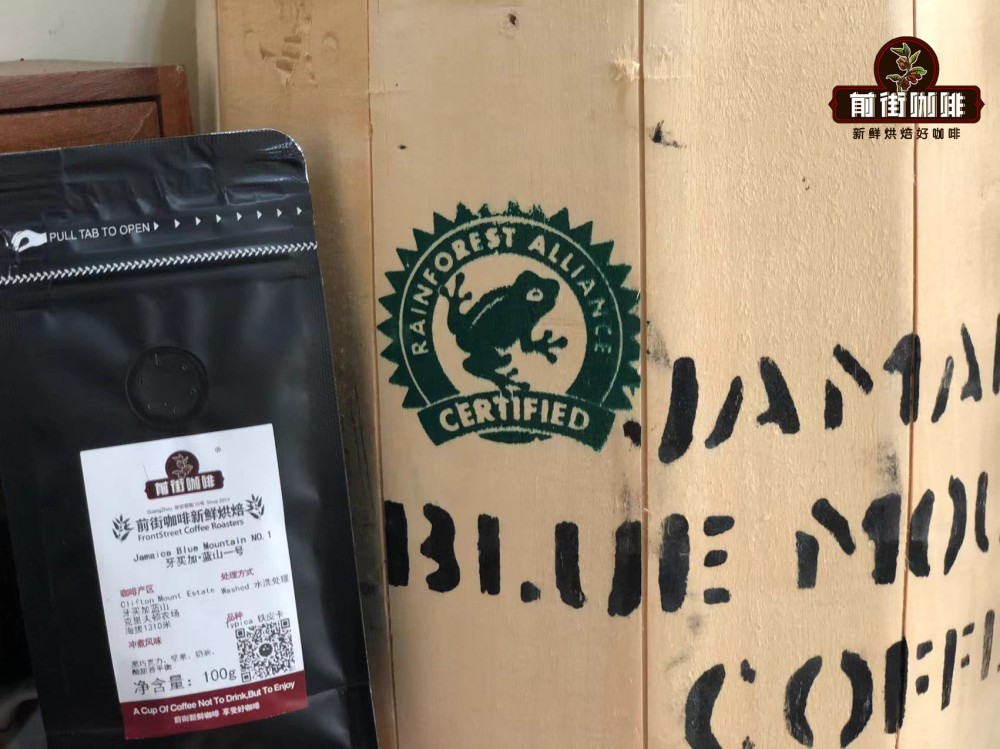
It’s worth noting that Jamaica is one of the few coffee-producing regions in the world that uses wooden barrels to ship green beans, whereas most other places use jute sacks. These barrels bear the Rainforest Frog logo, indicating that the Clifton Estate meets the “Sustainable Agriculture Network Standard” and has been certified by the Rainforest Alliance, reflecting its commitment to environmental sustainability.
Jamaica Blue Mountain coffee is divided into four grades based on bean size and growing altitude, from highest to lowest: NO.1, NO.2, NO.3, and PB (Peaberry). Among these, NO.1 is the highest grade, requiring bean size of 17 mesh or larger, a defect rate below 2%, and a moisture content of around 13%. Some well-known coffee shops source their Blue Mountain No.1 green beans according to these standards. The beans appear plump and uniform, with a bluish-green hue, and offer a flavor profile that balances acidity, sweetness, bitterness, aroma, and body—extremely well-rounded.
The Clifton Estate is Jamaica’s oldest coffee plantation, having begun coffee cultivation in the mid-18th century and growing to become the country’s largest estate by 1900. Since 1978, it has been managed by the Sharp family, who have improved growing conditions, introduced advanced equipment, and built BMCP, Jamaica’s largest coffee processing facility. The estate is committed to environmental conservation, investing in solar power stations and wastewater treatment systems, and converting pulp waste into organic fertilizer—demonstrating a strong dedication to sustainable operations.
Jamaica Blue Mountain primarily grows the Typica variety, one of the oldest Arabica cultivars, known for its pure and elegant flavor but relatively low disease resistance and yield—factors that also contribute to the premium price of Blue Mountain coffee. Typica trees are tall, with copper-colored top leaves, hence also referred to as “red-top coffee.” Although individual yields are low, the Typica planted in Blue Mountain has, over more than two centuries, developed stronger disease resistance—especially better resistance to coffee berry disease compared to typical Typica varieties.
In terms of processing methods, Blue Mountain coffee traditionally used washed processing, but since 2019, the Clifton Farm has also released limited batches of natural-processed coffee. However, washed Blue Mountain coffee generally offers a cleaner flavor, showcasing the classic Blue Mountain profile, and is recommended for first-time tasters. The harvest season for Blue Mountain coffee runs from June to November each year. Female workers familiar with the terrain manually pick ripe cherries on steep slopes. After hand sorting and removal of the fruit skin, the beans undergo 12 to 18 hours of fermentation, followed by washing with clean water to remove the mucilage, and finally drying until the moisture level is appropriate. Every step must be precisely controlled to ensure the final flavor quality.
A certain coffee shop commonly uses the KONO filter, with a water temperature of 88°C and a coffee-to-water ratio of 1:15 (15g coffee grounds), setting the grind size to 75% passing through a #20 sieve. They employ a three-stage extraction method: first blooming with 30g of water for 30 seconds, then pouring to 125g and 225g. The total extraction time is about 2 minutes. These parameters help highlight the rich and balanced mouthfeel of Blue Mountain coffee, particularly well-suited for medium-dark roasted Blue Mountain No.1.
In terms of flavor, a certain coffee brand’s natural-processed Blue Mountain coffee offers subtle berry-like acidity, reminiscent of black plum and mulberry, along with intense dark chocolate and nutty notes, with a slight fermentation character. In contrast, the washed Blue Mountain showcases clear dark chocolate and nut aromas, with a creamy-smooth mouthfeel and an outstanding balance of acidity, sweetness, and bitterness.
When brewing Blue Mountain coffee, the freshness of the beans is crucial. It is recommended to choose beans roasted within five days and to consume them after the 4 to 7 day degassing period post-roast, when the flavors are most vibrant. If purchasing pre-ground coffee, while it can be brewed immediately, be mindful of oxidation and aim to consume it as soon as possible. For the best flavor experience, it is advised to buy whole beans and grind them fresh before brewing.
The above content is compiled by CoffeeHunters, a coffee news website.


