







Introduction:Phoenix Dancong and Wuyi Rock Tea both belong to the oolong tea family, yet each possesses unique flavors and terroir characteristics. This article delves into a detailed comparison of their varietal origins, aroma profiles, explains why Phoenix Dancong can occasionally exhibit bitterness, and explores the geographical and mineral advantages of the Wuyun Mountain area as a core producing region. It also analyzes the key differences in taste and chemical composition between high-mountain old-tree tea and common plantation tea, helping readers identify the true hallmarks of high-quality Phoenix Dancong.
Both Phoenix Dancong and Wuyi Rock Tea fall under the broad category of oolong tea. While they share botanical relatives in tea classification, their flavor expressions and growing conditions are vastly different. Many tea enthusiasts often confuse the two, especially on the international market where Phoenix Dancong, though less well-known than Wuyi Rock Tea, boasts highly distinctive aroma layers and aftertaste profiles. This article will take you deep into understanding their core differences, analyze the reasons behind the occasional bitterness in Phoenix Dancong, and explore the unique value of Wuyun Mountain as an exceptional producing area for premium Phoenix Dancong.
In terms of varietal origin, Phoenix Dancong and the Shuixian variety found in Wuyi Rock Tea actually share a common genetic background. It is said that around four hundred years ago, some tea trees from Phoenix Mountain were transplanted to Wuyi Mountain, giving rise to the prototype of what we now know as Wuyi Shuixian. Notably, the oldest surviving Shuixian tea trees on Phoenix Mountain are aged between five hundred and nine hundred years—far older than the average age of Wuyi Shuixian—demonstrating its long cultivation history and genetic diversity.
The uniqueness of Phoenix Dancong stems not only from its varietal traits but also from its complex biological evolution. Early tea trees on Phoenix Mountain were mostly propagated by seeds, with each seed-grown plant potentially genetically distinct from its parent—a phenomenon akin to trait segregation in Mendelian genetics. Over hundreds of years of natural hybridization and mutation, each tea tree developed its own unique aroma and flavor profile. As a result, even when using the same processing methods, teas from different trees can still yield vastly different flavors. The various cultivar names of Phoenix Dancong are based precisely on the aroma and flavor characteristics of the original trees.
Many tea drinkers have reported that Phoenix Dancong can sometimes exhibit noticeable bitterness or astringency, even believing it needs years of aging to improve. In reality, such issues often stem from harvesting timing. Tea leaves picked in early spring typically feature delicate aromas and mellow flavors, without pronounced bitterness. On the contrary, tea harvested in late spring, summer, or autumn tends to be fast-growing with altered internal chemical compositions, often resulting in astringent or unpleasant lingering sensations. Most commercially available Phoenix Dancong comes from multiple seasonal harvests of plantation tea, making its quality and price naturally hard to compare with single-spring-harvest old-tree tea.
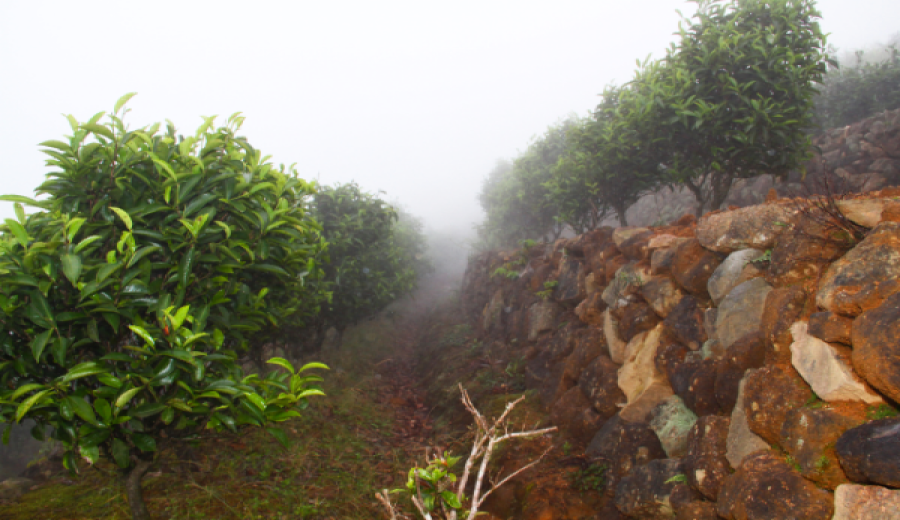
Speaking of terroir, Wuyun Mountain at elevations above one thousand meters is regarded as the golden zone for cultivating premium Phoenix Dancong. This mountainous region not only enjoys cool climates and significant diurnal temperature variation, but its soil is also rich in various minerals, contributing to the tea’s profound mouthfeel and long-lasting aftertaste. Especially around Wuyun Mountain, there are numerous old tea trees aged several hundred years, growing in the crevices between rocks. Though the environment is harsh, it results in tea leaves that are rich in minerals. This “rock tea” attribute bears similarities to the growing environment of Wuyi Rock Tea.
Observing the tea gardens of Wuyun Mountain, you’ll notice the tea trees aren’t planted alone but coexist with a variety of native plants. Local farmers don’t deliberately remove these wild plants because their fallen leaves, once decomposed by microbes, release minerals for the tea trees to absorb. Additionally, the tea gardens are often covered with rice straw, which during the rainy season releases nutrients into the soil, further nourishing both the earth and the tea trees. This natural nutrient cycle is one of the key factors in maintaining the stability of the tea’s flavor and internal compounds.
Interestingly, many tea farmers on Wuyun Mountain adopt a fertilizer-free, natural farming approach. They believe that nitrogen-fixing bacteria on the roots of leguminous plants can extract nitrogen from the air to nourish surrounding flora. Coupled with leaf decomposition and microbial activity, this provides sufficient nutrients for the tea trees. Artificial application of chemical fertilizers, on the other hand, can easily lead to nitrogen excess, causing the tea trees to grow too rapidly, diluting the internal compounds in the leaves, resulting in a thin-tasting infusion, and ultimately disrupting the soil’s microbial balance in the long run. Therefore, tea enthusiasts seeking the authentic flavors and aftertaste of Phoenix Dancong should pay special attention to the tea’s origin and cultivation methods.
The above content is compiled by CoffeeHunters, a coffee news website.


