







Introduction:As classic black tea representatives from the Wuyi Mountain area, Lapsang Souchong and Zhenghe Souchong derive their distinctive longan aroma and smoky flavor from the precise control of traditional tea-making techniques. This article thoroughly dissects the complete process — from natural withering and enzymatic fermentation to pan-firing for fixation and slow-smoke baking — analyzing each step’s temperature parameters, operational details, and flavor formation principles. It also compares the processing differences between the two Souchong black teas, helping you master the key elements behind high-quality black tea production.
Lapsang Souchong and Zhenghe Souchong are the most iconic specialty black teas from the Wuyi Mountain region. Their production blends natural conditions with human craftsmanship, where every step from withering, fermentation, to baking influences the final flavor. This article will detail the actual operation, temperature control, and flavor development mechanisms of these key steps, while also exploring how Zhenghe Souchong differs in application within Keemun black tea, giving you a deeper understanding of the unique charm of Souchong black teas.
During the withering stage, spring sunlight in the Wuyi Mountain area is relatively weak. Tea makers typically burn pine wood to raise the withering room temperature to around 30°C. This method is similar to that used in Wuyi Rock Tea withering, but it’s important to note that burning pine wood does not directly impart special aromas to the tea leaves. The leaves are spread flat in bamboo baskets, with a thickness controlled between 3 to 7 centimeters, placed on wooden racks with the fire source below. Every 20 minutes, the leaves must be turned until they become soft and lose their gloss. They are then moved to the ground to cool before moving on to the rolling process.
Fermentation is a critical step in forming the tea’s aroma and color. After rolling, the tea leaves are placed in wooden barrels and covered with cloth to maintain an appropriate temperature, facilitating enzymatic oxidation. Due to the high altitude and relatively low temperatures of the Wuyi Mountain region, the leaves are piled together to retain the necessary heat. In case of cold weather, the barrels can be moved closer to the stove to keep warm. When about 80% of the leaves exhibit a coppery hue and emit a unique fragrance, fermentation is considered complete.
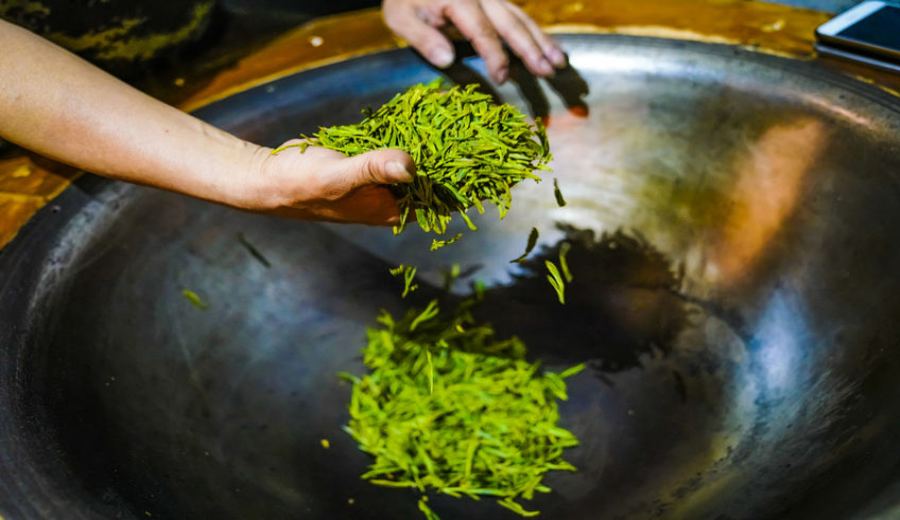
A key difference between Lapsang Souchong and other black teas is the use of pan-firing to halt fermentation. When the pan temperature reaches 200°C, the tea leaves are added and stirred for 2 to 3 minutes. The grassy aroma gradually fades and transforms into a pleasant fragrance. This high-temperature treatment generates more volatile compounds, enriching the tea’s aroma and serving as a crucial source of Lapsang Souchong’s distinctive flavor profile.
After pan-firing, the tea leaves must be immediately re-rolled while still warm. This step involves vigorous kneading to squeeze out the tea juices, allowing them to adhere to the leaf surface and form a thin film. This film helps absorb pine wood essential oils during subsequent drying and releases more essence during brewing, enhancing the tea’s richness and layered taste.
Baking is the final key step in giving Souchong black tea its unique aroma. Lapsang Souchong uses a drying basket, but unlike other premium teas, its fuel is burning pine wood, and it employs a slow, low-heat bake. First, high heat is applied to reduce the tea's moisture content to around 20%. Then the heat is reduced, and a gentle, smoldering flame continues the baking until the moisture drops below 5%. This process takes 8 to 10 hours. The amber-colored essential oils from the pine wood slowly seep into the tea leaves, giving them a dark red hue along with their signature dried longan and smoky aromas.
It’s worth noting that overly strong flames can damage the essential oil components, whereas low heat allows the pine wood essential oils to volatilize gently, enabling the tea leaves to fully absorb them and form a unique aroma. It’s commonly believed that the dried longan aroma comes from the tea variety itself, but in reality, it mainly results from the influence of pine wood essential oils. Although Zhenghe Souchong is also used in Keemun black tea, only Pinus massoniana (the pine used in Lapsang Souchong) can produce the same aromatic profile. Keemun black tea does not possess this characteristic.
The above content is compiled by CoffeeHunters, a coffee news website.


