







Introduction:Although Burundi is not a major coffee-producing country, its high-altitude mountainous regions and refined washed processing techniques have firmly established it as an important player in Africa’s specialty coffee scene. This article delves into the evolution of its coffee-growing regions, processing technologies, and unique flavor profiles. Through hands-on cupping experiences, it reveals how these beans from the “Heart of Africa,” processed via washed methods, showcase bright acidity and layered aromas.
When it comes to African specialty coffee, many people first think of Ethiopia or Kenya, often overlooking Burundi, which also holds exceptional potential. This landlocked country, situated on the East African Rift, is surrounded by vast highlands and mountainous terrain, with an average elevation exceeding 1,600 meters across the entire nation — a classic high-altitude coffee-growing region. As it lies precisely at the watershed between the Nile and Congo River basins, it has earned the nickname “Heart of Africa.”
Burundi’s coffee cultivation history dates back to the 1930s, when it was introduced by Belgian colonizers. However, due to the lack of local drinking traditions and cultivation background, the quality of early coffee beans was not remarkable. Moreover, as a landlocked nation, although its geography shortens the distance from fresh cherry to washing stations, the export procedures are complex, transportation costs are high, and information transparency is limited. These factors have long restricted the international visibility of its coffee industry.
A turning point came in 1993, when the World Bank and the International Monetary Fund provided targeted assistance that significantly improved Burundi’s coffee infrastructure. This project not only added numerous washed processing stations but also actively expanded coffee tree planting areas. Currently, Burundi yields approximately 230 kilograms of fresh cherries per hectare, with overall annual production steadily maintained at around 18,000 metric tons.
The year 2007 marked another milestone. Prior to this, all coffee processing stations were state-run, resulting not only in low efficiency but also inconsistent quality, causing Burundi coffee to often be categorized as ordinary African beans. It wasn’t until the government opened up private processing sites and sun-drying stations, and increased farmer participation, that the industry gradually moved toward refinement. In 2011, Burundi hosted its first Cup of Excellence (COE) international competition, successfully drawing global attention from the specialty coffee community and creating a turning point for the country’s coffee.
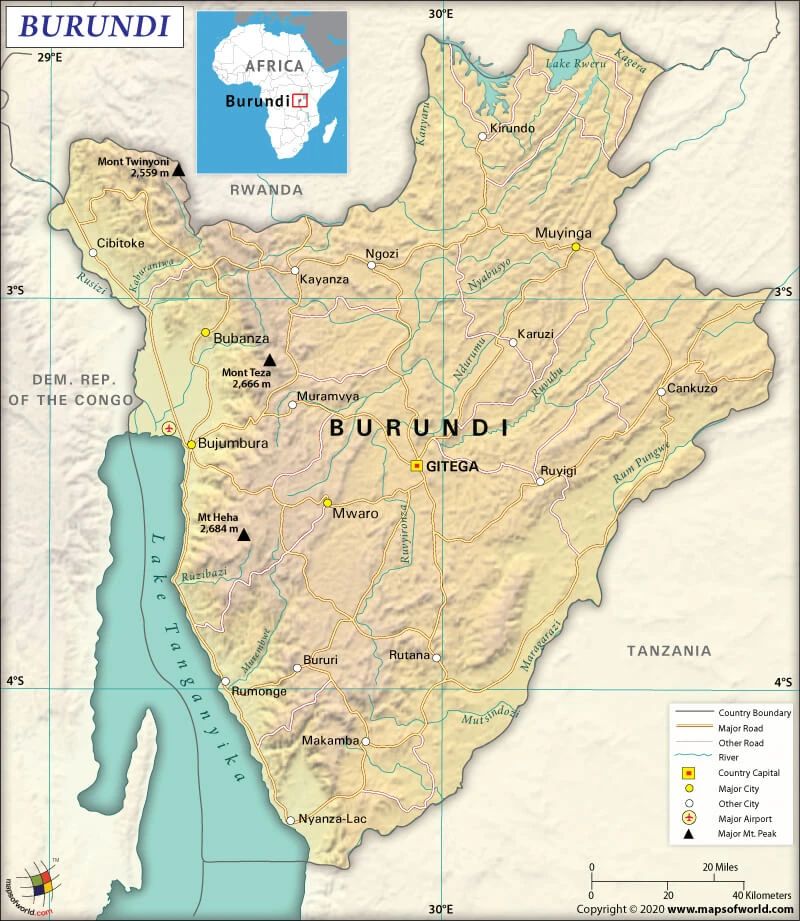
Today, coffee is grown almost everywhere in Burundi, but the most renowned regions include Buyenz (布雍吉), Kayanza (卡揚薩), Ngozi (恩戈吉), Mumirwa (慕密瓦), and Kirimiro (奇裡密羅). These regions are mostly concentrated in the high-altitude mountainous areas north of the capital GITEGA, typically ranging from 1,700 to 2,000 meters above sea level. With cool climates, significant diurnal temperature variations, and distinct dry and wet seasons, these conditions provide ideal environments for coffee growth. Particularly, Kayanza and Ngozi have won the Cup of Excellence multiple times, demonstrating their high quality potential.
Smallholder farmingis a defining feature of Burundi’s coffee industry. Most coffee farms are family-run, with very few being large plantations. The country has over 300 green coffee processing stations and eight hulling factories, but most processing stations are small-scale, serving only nearby farmers. As a result, the fresh cherries collected at each station do not vary greatly in altitude, helping to maintain a certain level of quality consistency.
Washed processing is the predominant method in Burundi, accounting for up to 95%. The processing approach can generally be divided into two types: one where farmers perform initial washed processing at home before sending the cherries to processing stations for further steps — this is commonly referred to as “Washed.” Farmers can command higher prices this way, but due to equipment and technical limitations, the quality is less stable. The other type involves fresh cherries being sent directly to professional processing stations for unified washed processing. Sacks are labeled “FW (Fully Washed),” and because these stations have professional equipment and standardized workflows, the overall quality is more consistent and reliable.
The typical washed processing procedure in Burundi is as follows: upon arrival, fresh cherries are first subjected to floatation to remove impurities and unripe beans, followed by pulping. Then they enter a 12-hour wet fermentation stage to remove the mucilage layer. After mucilage removal, the beans are washed multiple times, then the parchment beans undergo manual defect sorting before being spread on raised beds for sun drying. Once dried, the parchment beans are sent to hulling facilities for green bean grading and packaging, ensuring the final product meets export standards.
This meticulous washed processing technique gives Burundi coffee its distinctive flavor profile: bright yet gentle acidity, moderate body, and layers featuring caramel-like sweetness and subtle spicy notes. Many cuppers and roasters note that its flavor presentation is akin to a perfect blend of floral-fruity aromas with delicate spicy undertones.
Taking actual cupping experiences as an example, when roasted to a medium-light level, its floral and fruity acidity highlights are fully brought out. With each sip, notes of passionfruit, pineapple, dried fruit, and honey unfold layer by layer, complemented by a refreshing lemony acidity, resulting in a clean and lingering mouthfeel. It is particularly well-suited for coffee enthusiasts who appreciate bright acidity and fruity flavors.
The above content is compiled by CoffeeHunters, a coffee news website.


