







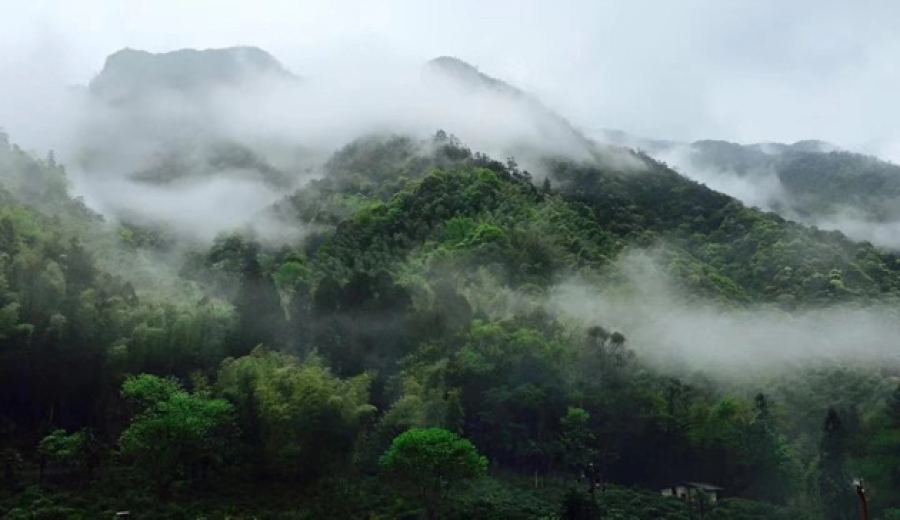
Introduction:Lapsang Souchong is hailed as the progenitor of black tea in the world. Its distinctive pine smoke aroma and dried longan-like sweetness once rewrote European tea-drinking culture. But are the commonly seen Wai Shan Souchong, Yan Souchong, Xingcun Souchong, and Tongmu Souchong all the same tea? This article will guide you through the production regions, processing methods, and historical context to clarify these easily confused names, help you master the key points in identifying authentic Lapsang Souchong, and take you deeper into the classic flavors of the core production area in Tongmu Village, Wuyi.
Lapsang Souchong is widely recognized as the earliest black tea in the world. Its most representative pine smoke aroma and sweet fruitiness reminiscent of dried longan are not only uniquely flavorful but also deeply influenced European tea-drinking habits. However, many consumers often get confused when choosing between Lapsang Souchong, Wai Shan Souchong, Yan Souchong, Xingcun Souchong, and Tongmu Souchong. Are these all the same type of tea? What exactly is the difference between Lapsang Souchong and Wai Shan Souchong? This article will delve into the historical background, regional definitions, and naming evolution to help you untangle these commonly misunderstood concepts, and gain a deeper understanding of the orthodox flavors nurtured in the core production area of Tongmu Village in the Wuyi Mountains.
As the origin of black tea, the charm of Lapsang Souchong often lies hidden within its rich and unique smoky aroma. Many first-time tasters may be put off by this intense smokiness, but it is actually one of its defining characteristics. Historically, the black tea that captivated Princess Catherine of England was very likely this smoky-flavored Lapsang Souchong. Its dried longan-like sweetness is distinctly different from the fresh grassy aroma typical of most teas. This exotic fruity note became an important catalyst for the transformation of European tea culture.
If you want to enjoy the most authentic Lapsang Souchong, its place of origin is crucial. Through multiple field visits, we have found that genuine Lapsang Souchong from Tongmu Village in Xingcun Town, Wuyi Mountains—which is now quite rare on the market—is the choice closest to the original flavor. Once served as a royal tea, it still retains a Lap Shan Su Chuan flavor similar to that of a hundred years ago. Whether enjoyed on its own, used as a base for blends, or made into milk tea, it showcases diverse charm.
You might wonder why Lapsang Souchong is made using tea tree varieties from Wuyi Rock Tea. In fact, the term “Xiao Zhong” (小种), meaning “small kind,” originates from the native wild tea tree varieties of the Wuyi Mountains. These tea trees were originally important raw materials for producing high-quality Wuyi Rock Tea (an oolong tea). Historical documents record that as early as 1734, the name “Xiao Zhong (Suchong)” already appeared in tea trade records, testifying to its long history.
The international fame of Lapsang Souchong can be traced back to the early 17th century. Around 1604, Dutch merchants introduced it to Europe as a precious medicinal commodity, selling it at high prices and once monopolizing the European tea trade. By 1669, Britain began importing Lapsang Souchong on a commercial scale, but due to the East India Company’s monopoly, the tea was long restricted to consumption within the British court. In 1662, when Charles II married Princess Catherine of Portugal, she brought her love for Lapsang Souchong to England, further popularizing the tea and establishing it as a luxurious beverage favored by the British royal family for a long time.
The unique production process of Lapsang Souchong actually stems from an accident. During the Xianfeng era of the Qing Dynasty (1850–1864), due to warfare, troops were stationed at the tea factory in Xingcun Town. Local farmers primarily produced oolong tea, and teahouses were plentiful. The traditional tea-making process included natural withering, shaking (partial fermentation), rolling, and drying inside the teahouses. Amid the chaos of war, teahouse workers fled into the mountains, leaving behind wet tea leaves that had not yet been dried. When the troops left, the farmers found that the tea leaves had oxidized and darkened due to the high temperature and humidity, emitting a special aroma—but they lacked the equipment to dry them promptly. To salvage the batch, the farmers pan-fried the tea leaves in flat pans and heated them with burning pine wood to raise the temperature. This accidentally caused the tea leaves to absorb the pine smoke aroma and essential oil fragrance, creating the distinctive smoky flavor of Lapsang Souchong.
When this tea was later introduced in Fuzhou, it caught the keen attention of foreign traders and quickly became all the rage in Europe, even becoming a tribute to the British royal family. Interestingly, at the time, Chinese people called this tea “乌茶 (Wu Cha),” meaning “black tea,” due to its dark, glossy appearance—this is also the etymological origin of the English word “Black Tea.” In China, it is called “red tea” due to its reddish liquor color, a term also used in Japan. In the production area, since it is made from the “Xiao Zhong” tea variety, it is called “Xiao Zhong Hong Cha” (小种红茶), or “small kind red tea.” In its early promotion in Fuzhou, Fujian tea merchants who spoke Southern Min referred to it as “Suchong,” and because it came from the Tongmu area, it also became known as “Tongmu Souchong.” Since Xingcun was the distribution hub, the name “Xingcun Souchong” also emerged.
As the fame of Lapsang Souchong grew, the market saw many imitations. Some merchants transported aged tea or tea made from other varieties to Tongmu, reprocessed it by adding smoke flavor, and sold it as Lapsang Souchong. These low-quality teas had only smoke flavor but lacked the authentic taste, thus earning the name “Yan Souchong” (烟小种, smoked small kind). Meanwhile, other regions also began producing similar black teas. To distinguish themselves, producers of authentic, high-quality small kind black tea started calling their product “Nei Shan Souchong” (内山小种), meaning “inner mountain small kind,” since Tongmu Village is located deep within the Wuyi Mountains—that is, “within the mountains.” During the Qing Dynasty, the Southern Min pronunciation of “nei” (内) was “Lap,” so it was also called “La Pu Shan Souchong” (拉普山小种), while those produced in other areas were collectively referred to as “Wai Shan Souchong” (外山小种, outer mountain small kind). To further differentiate, genuine inner mountain small kind producers replaced “nei” (内) with “zheng” (正), meaning “authentic,” eventually leading to the name we know today as “Lapsang Souchong” (正山小种).
The above content is compiled by CoffeeHunters, a coffee news website.


