







Introduction:Did you know that black tea grading isn’t just about appearance—it also significantly affects the flavor of the brewed cup? This article delves into India’s black tea grading system, helping you understand the meaning behind terms like OP and BOP, as well as the differences in processing and taste between loose-leaf tea and tea bag fannings. From whole leaves to broken leaves, from traditional methods to CTC production, we’ll help you choose the black tea that best suits your taste.
When we sip a cup of black tea, few of us realize that the flavor of the tea is actually determined from the very beginning—by its grading and production process. Especially in the world of Indian black tea, there is a highly rigorous grading system, and understanding this system is the first step toward appreciating tea quality and flavor.
Among the many grading terms, Orange Pekoe (abbreviated as OP) is one of the most commonly heard. However, many people mistakenly think OP is related to orange flavor. In fact, its name originates from the Chinese term “白毫” (baihao), referring to the fine white down on the tea leaves, and it has nothing to do with oranges. This term is just the beginning of the black tea grading system, and it is often followed by other letters to more precisely describe the characteristics and grade of the tea.
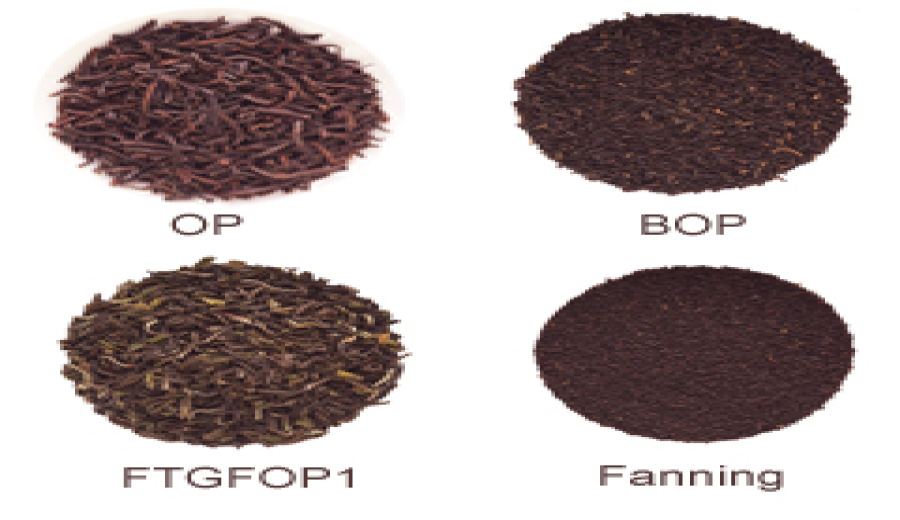
The grading of Indian and Ceylon black teas can generally be divided into four main categories: whole leaf tea, broken leaf tea, fannings, and dust. Among these, whole leaf tea is considered the highest grade, starting with OP and then further subdivided into FOP, GFOP, TGFOP, FTGFOP, and even SFTGFOP or SFTGFOP1. Each grade increase represents higher tenderness of the leaves, more intact appearance, and usually more abundant aroma and complexity.
For example, OP (Orange Pekoe) is the entry-level grade among whole leaf teas. It is made from leaves picked during the period when the bud has just begun to unfold into a leaf. The leaves are usually longer and more pointed, and do not include the bud tip. Moving up to FOP (Flowery Orange Pekoe), it is made from tender buds and the first leaf, containing noticeable buds and is regarded as a symbol of high quality. The next level, GFOP, emphasizes the presence of golden bud tips, while TGFOP has an even higher proportion of golden tips. Grades like FTGFOP and SFTGFOP are designed specifically for tea enthusiasts who seek the ultimate flavor experience.
As for broken leaf tea, BOP (Broken Orange Pekoe) is representative. These teas are made by rolling and crushing whole leaf tea, retaining some characteristics of whole leaf tea but appearing in a fragmented state. BOP may sometimes be modified with terms like TGBOP (Tippy Golden Broken Orange Pekoe) to indicate that the broken leaves still possess golden bud characteristics. Such teas, due to their shape, are suitable for quickly releasing flavor and are often used as the base for blended teas, as well as being the main ingredient in many tea bags.
Even finer teas, such as tea powder or so-called “dust tea,” are usually the remnants of the grading process. These finely broken leaves are mostly used in instant teas, bottled beverages, and other ready-to-drink products. While convenient, they usually cannot compare to whole leaves in terms of aroma and complexity.
Beyond grading, the production process of black tea is also a major factor influencing its flavor. Loose-leaf tea mostly uses traditional methods, which aim to preserve the complete shape of the tea leaves using conventional techniques—whether hand-processed or machine-processed—to maintain the original state of the leaves as much as possible. The tea produced through this method not only looks beautiful but also gradually releases aroma during brewing, offering a layered experience, making it ideal for those who enjoy savoring their tea slowly.
In contrast, the broken leaf tea found in tea bags is often produced via the CTC process (Crush, Tear, Curl—meaning crush, tear, and curl). This method uses machines to chop, tear, and compress the tea leaves into tight little pellets at high speed. While it significantly reduces brewing time and allows the tea to infuse quickly, it also tends to release more astringency and offers a more one-dimensional flavor profile.
Visually speaking, loose-leaf tea allows you to appreciate the natural form of the tea leaves, and watching them unfurl during brewing is also an enjoyable experience. Tea bags, while convenient, mostly only show broken bits of leaves, unable to convey the texture and beauty of whole leaves. Additionally, loose-leaf tea offers greater flexibility during brewing, allowing you to adjust strength and steeping time according to personal preference.
In summary, the grade and processing method of black tea aren’t just academic classifications—they directly impact the aroma, taste, and overall drinking experience of the cup in your hand. If you’re pursuing depth and layers of flavor, it’s recommended to choose high-grade loose-leaf tea and personally experience the changes from the first brew to the last drop. If you prefer convenience and speed, tea bags are still a good option, but it’s worth paying attention to the grade and processing method of the tea inside to truly appreciate the differences and value.
The above content is compiled by CoffeeHunters, a coffee news website.


