







Introduction:Have you ever been amazed by coffee beans that emit a strong floral aroma right when you open the bag, only to wonder if flavorings have been added? The Colombian Rose Valley coffee, known for its rose-like fragrance, is a frequently discussed example. This article explores anaerobic fermentation technology, breaks down the double anaerobic enzymatic fermentation process, takes you on an in-depth visit to the Granja La Esperanza estate in Colombia’s Santander region, analyzes the characteristics of the Caturra variety, and helps you distinguish between naturally fermented aromas and artificial additives—offering insights on how to select high-quality coffee beans.
The market is filled with a wide variety of coffee beans, some of which release intense floral and fruity aromas upon opening the package, making one wonder if artificial flavorings have been used. Among them, Colombian Rose Valley coffee beans are often mentioned—as to whether their distinctive rose scent is the result of natural fermentation or flavoring manipulation. In reality, the unique aroma of these much-discussed beans comes from their use of the “double anaerobic enzymatic fermentation” process, not from artificial additives.
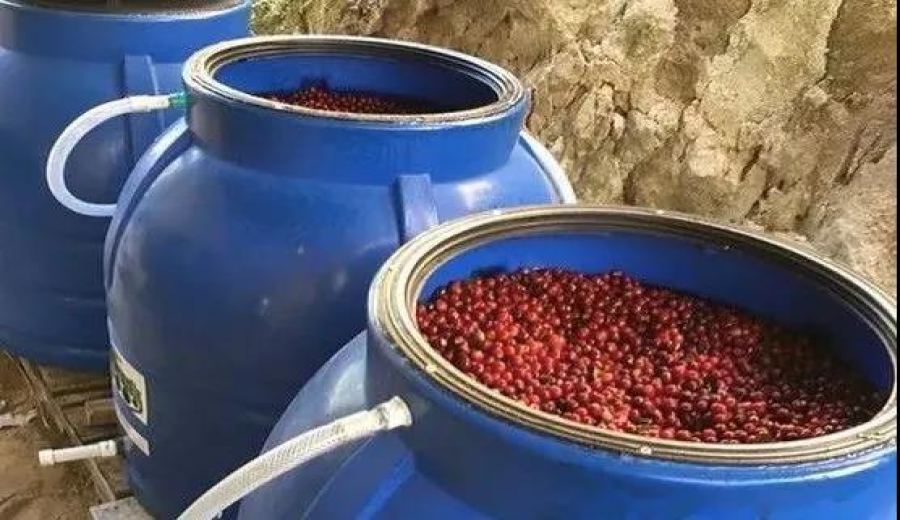
Anaerobic fermentation technology has been increasingly widely adopted in the specialty coffee field in recent years, drawing inspiration from wine production. Simply put, this method involves placing whole coffee cherries into a sealed container and injecting carbon dioxide to displace oxygen, creating an anaerobic environment. Under oxygen-deprived conditions, the breakdown of sugars in the mucilage slows down, the drop in pH becomes more moderate, and the fermentation process is prolonged, thereby bringing out richer sweetness and a more balanced flavor profile. “Double anaerobic enzymatic washed” goes a step further than traditional anaerobic washed processing by adding a special enzyme and undergoing a second round of anaerobic fermentation. The specific procedure is as follows: the coffee cherries first undergo a first stage of anaerobic fermentation, then the pulp and skin are removed, leaving the beans coated with mucilage, which are then placed in a sealed plastic bag or other airtight container for a second round of anaerobic fermentation—resulting in more complex and layered aromas and flavors.
This Colombian Rose Valley coffee, with its captivating rose aroma, comes from Colombia’s northern Santander region, specifically from the well-known Granja La Esperanza estate. Santander is located in northern Colombia, bordering the Magdalena department to the west, with cultivation altitudes ranging between 1,400 and 1,600 meters, covering a total area of 30,537 square kilometers. Although it is not as frequently mentioned as other famous coffee-growing regions within Colombia’s coffee map, Santander is actually one of the country’s earliest areas to begin coffee cultivation, and it still accounts for approximately 5% of the nation’s total coffee output. Based on cupping experience, beans from this region are generally known for having intense flavors, long aftertastes, and unique herbal notes. The Granja La Esperanza estate has been managed by owner Vargas for over 20 years. During harvest, they carefully select only fully ripe coffee cherries with bright red skins, first removing defective and floating beans via washing, then proceeding with two rounds of anaerobic fermentation and adding a custom enzyme blend to refine the fermentation process. During the drying phase, particular attention is also paid to temperature control, utilizing slow drying methods to preserve as many flavor characteristics as possible.
The coffee bean variety used here is Caturra, a natural mutation of the Bourbon variety. As early as 1915 to 1918, this mutated variety was discovered in a coffee plantation in Minas Gerais, Brazil. At the time, some Bourbon plants in the plantation underwent a genetic mutation, resulting in shorter plants that resembled dwarfs—this is the origin of Caturra. The Caturra variety thrives at altitudes ranging from 700 to 1,700 meters, demonstrating strong adaptability to elevation. Generally, the higher the altitude, the more pronounced the resulting coffee flavors, though yield tends to decrease accordingly.
When it comes to the flavor profile of Colombian Rose Valley coffee, you’ll often taste layers of wine-like, chocolate, rose, cranberry, peach, and creamy notes. These flavors are inseparable from the double anaerobic enzymatic fermentation process and the meticulous post-harvest handling techniques employed.
Readers may also be concerned: while this specially processed coffee offers a uniquely flavorful cup, could it pose any health risks? In fact, aside from delivering distinctive flavors, coffee beans processed using anaerobic fermentation and similar special methods are just as safe as regular coffee beans, and do not produce harmful substances due to their fermentation approach. Of course, like all coffee, it is still recommended to consume in moderation to avoid sleep disturbances caused by excessive caffeine intake—especially for those sensitive to caffeine, who should reduce consumption in the evening.
In summary, to determine whether a coffee’s aroma comes from natural fermentation or artificial flavorings, start by examining information about the origin, processing method, and brand transparency. Coffee beans like those from Colombian Rose Valley, which openly disclose details such as origin, altitude, variety, and fermentation process, usually derive their aromas from rigorous processing—not artificial additives. Understanding the processing techniques and regional characteristics behind the beans can help you make smarter choices when selecting truly high-quality, uniquely flavored coffee.
The above content is compiled by CoffeeHunters, a coffee news website.


