







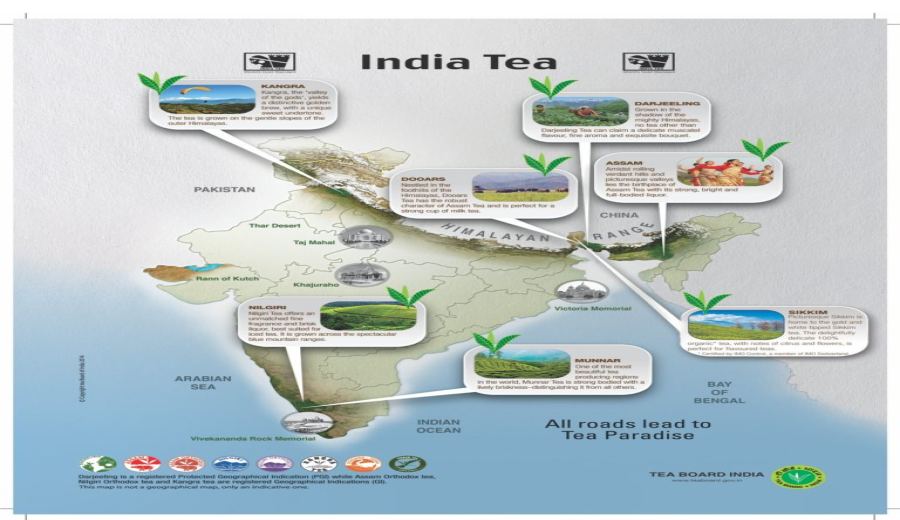
Introduction:The landscape of Indian tea is not limited to Darjeeling, Assam, and Nilgiri—there are four other lesser-known but highly potential regions. Based on official Geographical Indications data from India, this article provides a comprehensive overview of the seven major tea-producing regions, including their terrains, climates, tea varieties, and flavor profiles, along with tea selection recommendations to help you find the Indian tea that best suits your taste preferences.
When it comes to Indian tea, many people immediately think of the three classic regions: Darjeeling, Assam, and Nilgiri. However, India’s tea map is far more diverse than just these well-known names. Drawing on the officially designated Geographical Indication tea regions by the Tea Board of India, this article delves into the seven major tea regions: Darjeeling, Assam, Nilgiri, Kangra, Dooars-Terai, Sikkim, and Tripura. It explores everything from altitude and climate to historical background, tea garden distribution, and flavor characteristics, helping readers build a more complete understanding of Indian tea and offering practical guidance on choosing the right tea.
The Darjeeling tea region is arguably one of India’s most iconic tea-producing areas. Its history dates back to the 19th century when British colonists introduced Chinese tea varieties and established tea gardens on the higher-altitude hillsides. According to Geographical Indication certification, Darjeeling currently has 87 officially recognized tea estates. Since most of the estates are located at high altitudes with cool climates, the teas produced here are especially known for their "muscatel" flavor. In particular, the Second Flush teas, harvested annually during the second picking season, often exhibit pronounced floral and fruity notes, making them highly prized among tea enthusiasts.
Assam, located in the low-altitude northeastern part of India, has a typically hot and humid climate with particularly distinct monsoon seasons. Unlike Darjeeling, the initially introduced Chinese tea varieties struggled to adapt, while the indigenous Assamica tea plant proved to have greater potential. These native varieties had been utilized by local inhabitants long before the arrival of the British, traditionally dried and stored in bamboo tubes. Assam teas are renowned for their strong, bold maltiness and full-bodied mouthfeel, forming the base for many breakfast tea blends. With around 800 tea estates, Assam is one of the highest-yielding tea regions in India.
The Nilgiri tea region, also known as the "Blue Mountains," is another high-altitude producing area. Tea cultivation here began in 1845. While CTC black tea was the dominant production method in the early days, an increasing number of tea gardens have shifted toward traditional orthodox methods in recent years. The Nilgiri region has hundreds of tea estates, along with numerous smallholder farmers who sell their freshly plucked leaves to nearby processing factories. Compared to the bold flavors of Assam, Nilgiri teas offer a fresher, more layered taste, with some high-quality traditional teas even exhibiting pleasant citrus notes, making them popular among those who prefer lighter, refreshing flavors.
Kangra is located in the northern Indian state of Himachal Pradesh and is known as the "Valley of the Gods." Tea cultivation began here in 1852, initially using Chinese tea varieties. However, a major earthquake in 1905 severely damaged the local tea industry, which only gradually recovered by the 1960s. Currently, the region is primarily operated by one cooperative tea factory and several private tea gardens, with about 6,000 smallholder farmers also involved in production. Around 90% of the output consists of traditional black tea. Kangra tea features a lighter liquor color and soft aroma, but with a sweet lingering finish, making it suitable for tea drinkers who appreciate delicate flavors.
The Dooars-Terai region lies at the foothills of the Himalayas near Darjeeling, at lower altitudes, and borders Bhutan. The region has approximately 300 tea gardens and contributes around 20% of India’s total tea production. It mainly produces CTC black tea, which has a bright liquor color and smooth mouthfeel. Though not as intense as Assam teas, Dooars-Terai teas still maintain a consistently robust body, making them a practical choice for everyday tea drinkers.
Sikkim is India’s smallest Geographical Indication tea region, with a total planted area of less than 180 hectares, located north of Darjeeling. The main tea estate here is the Temi Tea Estate, but an increasing number of smallholder farmers are also getting involved in cultivation. Sikkim teas have a clear, bright liquor with subtle floral notes and a sweet, mellow finish. Their flavor profile is quite similar to that of Darjeeling, yet the price is more affordable, making it an excellent option for consumers who want to experience high-altitude tea flavors on a budget.
Finally, Tripura is the only one of India’s seven major tea regions not established under the British colonial plantation system. Its tea-growing history dates back to 1916. The region currently has about 54 tea gardens, 21 processing factories, and over 2,500 smallholder households involved in production, ranking fifth nationally. The main products are CTC black teas, along with a small amount of green tea. Although it lacks high international visibility, Tripura holds a solid position in the domestic Indian market and is a promising choice for those seeking locally distinctive teas.
In summary, the world of Indian tea is rich and diverse, ranging from the delicate muscatel notes of high-altitude teas to the bold maltiness of lowland brews. Each region has its unique terroir and story. We hope this guide helps you make more informed choices when selecting Indian tea. Whether you’re a black tea lover, a pour over enthusiast, or simply looking to expand your flavor horizons, you’re sure to find an Indian tea that’s just right for you.
The above content is compiled by CoffeeHunters, a coffee news website.


