







Introduction:Understanding the leaf development standards in tea plucking is one of the keys to mastering the quality of oolong tea. This article delves into the practical differences in how Tieguanyin and Fenghuang Dancong apply the categories of “unopened,” “slightly opened,” “moderately opened,” and “fully opened” when harvesting, exploring how varying maturity levels affect withering difficulty, tea liquor flavor, and brewability. This helps you more precisely grasp the essence of high-quality oolong tea production.
In the process of tea harvesting, besides the common standards such as one bud and two leaves or one bud and three leaves, there is actually another classification method based on the degree of opening of the new shoots’ terminal buds — namely “unopened,” “slightly opened,” “moderately opened,” and “fully opened.” This method of using leaf openness as a basis for harvesting primarily aims to allow the tea leaves to accumulate more abundant internal components, thereby enhancing the texture and flavor performance of the final tea product.
The so-called “leaf openness” refers to the unfolding state of the topmost bud and leaf on the new shoot of the tea plant. When the terminal bud has not yet unfolded, it is called “unopened”; if the terminal bud has formed a dormant bud and the top leaf has slightly unfolded, it falls under “slightly opened”; when the top leaf’s surface area is about half that of the second leaf, it is termed “moderately opened”; and when the top leaf’s surface area approaches or reaches two-thirds of the second leaf, it is considered “fully opened.” These detailed gradations have a direct impact on the subsequent withering process and flavor formation during tea production.
In practice, determining the overall openness level of a batch of tea leaves requires observing the overall growth condition of the new shoots in that batch, rather than focusing on a single bud or leaf. Generally speaking, more mature leaves have thicker tissues, with a more stable ratio of polyphenols and other internal components, making the withering process relatively easier. The resulting tea liquor tends to have a mellower taste and distinct aroma, though the flavor profile may be somewhat less layered. In contrast, younger buds, while rich in internal components, have thinner cell walls and components still in the midst of transformation, making the withering process more challenging and prone to bitter aftertastes. However, such teas often yield a richer liquor and better brewability.
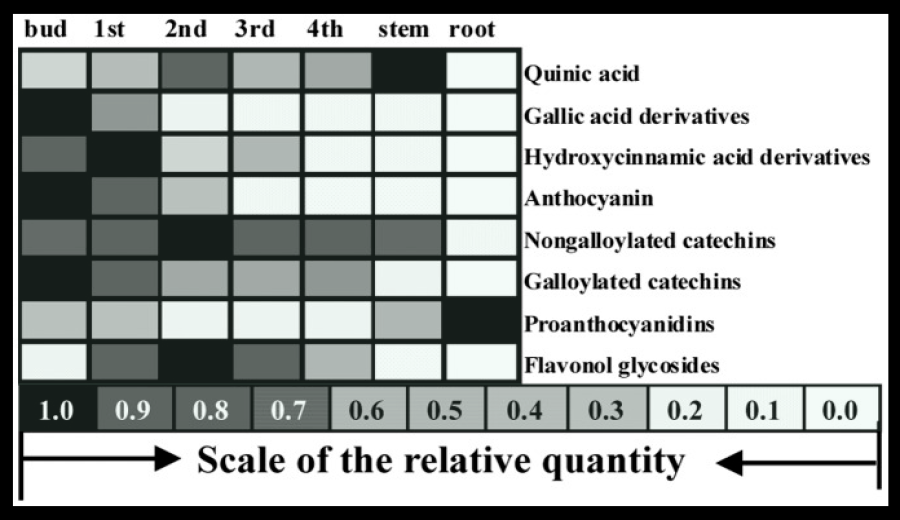
There are also significant differences in the distribution of chemical components across different parts of the tea leaf. The tender shoots are often covered with a layer of fine hairs, which protect the young buds from ultraviolet rays and pests, and contain higher levels of amino acids, but relatively lower levels of tea polyphenols. For this reason, tender shoots are more suitable for making green tea, white tea, and even certain types of pu’er and yellow tea. As you move down the leaf, the levels of theanine and polyphenols gradually decrease, while lignin content increases. Especially in the leaf veins, the concentration of lignin is higher. These components release special roasted aromas during the heating process.
It is worth noting that the formation of lignin mainly occurs in the veins and the walls of aging leaf cells. The more mature the leaf, the more developed the veins, and the greater the lignin content. During the production process, the breakdown of lignin may produce compounds such as guaiacol, which carries a smoky scent, or methoxyphenols, which have a slightly herbal aroma. If these components are present in excess, they may affect the freshness of green tea, but in black tea production, they can actually contribute to added complexity and layered flavors.
In the past, it was commonly believed that the highest quality tea leaves should be harvested as one bud and one leaf or one bud and two leaves. But for oolong tea, the standards are actually more diverse. For example, Fenghuang Dancong often prefers to pluck two to three slightly unfolded leaves, whereas Tieguanyin typically selects one bud along with two more mature leaves. This selection strategy is precisely to meet the leaf maturity requirements during the withering process, further adjusting the direction of the tea liquor’s aroma and flavor expression.
Additionally, even when producing high-quality black tea, it is common to use opened leaves as raw materials. This is because the internal component ratios in mature leaves are more suitable for the oxidation reactions during black tea fermentation, helping to form a full-bodied tea liquor and a rich spectrum of aromas. In summary, whether it’s Tieguanyin or Fenghuang Dancong, mastering the degree of leaf openness is one of the core techniques that influence the final flavor expression of the tea product.
The above content is compiled by CoffeeHunters, a coffee news website.


