







Introduction:Specialty coffee enthusiasts often hear about SCAA, COE, and SOE, but do you really understand the differences between them? This article delves into the background, scoring logic, and operational frameworks of the Specialty Coffee Association of America (SCAA), the Cup of Excellence (COE) competition, and Single Origin Espresso (SOE). Using the 2020 Ethiopia COE competition as a case study, it takes you from green bean evaluation to cupping flavors, helping you grasp the selection criteria and behind-the-scenes stories of the world’s top-tier coffees.
In the specialty coffee field, SCAA and COE are two highly representative authoritative systems. The former lays the foundation for industry standards and cupping protocols, while the latter selects the world’s finest green beans through rigorous competitions. But what are the differences in their scoring logics? Why are COE and SOE often misunderstood as the same thing? This article will guide you through historical context, evaluation systems, and actual competition processes to fully understand the true meanings of these key terms.
When it comes to international certifications in specialty coffee, the first one that must be mentioned is SCAA (Specialty Coffee Association of America). In 2017, this association merged with the European Specialty Coffee Association (SCAE) to form the current SCA (Specialty Coffee Association), now the most influential global coffee professional organization. SCA is a non-profit membership-based institution dedicated to promoting coffee education and establishing industry standards, including green bean grading, cupping procedures, water quality guidelines, and the Golden Cup extraction standards. These regulations remain important references for the industry to this day.
Another closely related institution is CQI (Coffee Quality Institute). Originating in 1996 as a dedicated committee established by SCAA to address the income and quality gap faced by coffee farmers, it has since operated independently. The Q Grader certification program introduced by CQI is a globally recognized training system for coffee quality evaluators. After undergoing rigorous courses and tests, participants who earn the Q-Grader qualification can assess coffee using a unified language, improving the efficiency of global green bean quality communication. This evaluation follows the SCA’s cupping standard procedures.
CQI’s scoring focuses on green bean quality, first examining the proportion of defective beans by appearance, deducting points or disqualifying based on the type and number of defects. If you wish to apply for CQI certification for your own green beans, you can send samples to your country’s In-Country Partner (ICP), where three qualified Q Graders will evaluate the beans. Beans scoring 80 or above are classified as specialty grade, and CQI will issue certification and publish the information; if the beans do not meet the standard, a technical feedback report will be provided.
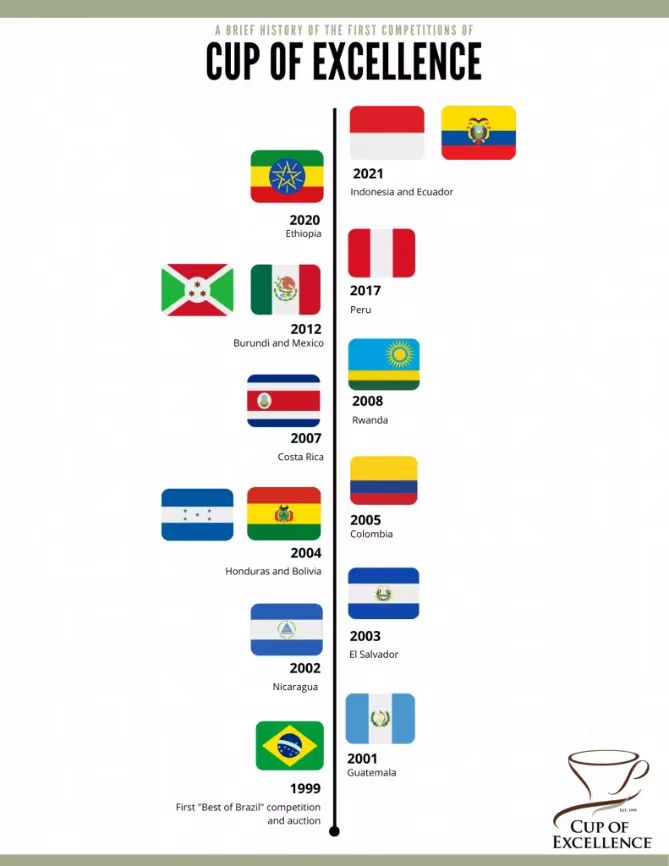
Next, let’s get to know COE, or the “Cup of Excellence.” This competition is hailed as the Oscars of the coffee world, akin to the AOC system in wine. If you see a coffee package labeled as “COE competition beans,” it means the beans have gone through multiple layers of strict selection from the COE competition. Currently, more than ten major producing countries adopt the CoE model as the standard for national-level competitions.
The COE competition is divided into six stages, evaluated by both domestic and international panels of professional judges. Any round that shows obvious defective flavors results in immediate disqualification. Competing coffees must first score above 86, then proceed through pre-selection, the National Jury Week, and the International Jury Week. In the end, only beans scoring above 87 and ranking in the top 30 qualify for the auction phase.
Domestic judges are usually cuppers from the production area, responsible for the initial screening; those that pass are then re-evaluated by the international jury—primarily buyers, roasters, and cupping experts from coffee-importing countries. In the final three rounds, two domestic judges also participate to ensure fairness and professionalism. Coffee farmers who stand out in the COE not only gain honor but also substantial earnings through auctions, which they can reinvest in quality improvement, creating a positive cycle.
It’s worth noting that the scoring systems of COE and SCA actually differ significantly, and their scores cannot be directly compared. The SCA cupping form includes 10 scoring categories, each ranging from 6 to 10 points, for a total of 100 points. COE, on the other hand, uses 8 scoring categories, each ranging from 6 to 8 points, plus a fixed base score of 36, also totaling 100 points. COE places particular emphasis on the details of sweetness, such as the intensity and persistence of sweet flavors, and includes this in the scoring; SCA, however, only distinguishes between “presence” or “absence” of sweetness. Additionally, COE lists aroma as a descriptive item, not scored, but incorporates it into flavor assessment; meanwhile, cleanliness is a decisive indicator in COE, and the presence of defective flavors can lead to immediate disqualification.
The SCA cupping form has a wide range of applications and provides detailed classifications even for commercial beans scoring below 80, but its ability to differentiate at the higher score range is relatively limited; COE, however, focuses on evaluating high-quality beans scoring above 80, making it more sensitive in identifying top-tier green beans.
For example, in the first Ethiopia COE competition in 2020, a coffee brand successfully bid on the #22-ranked natural-processed Typica, which scored 87.64. This coffee was grown by 66-year-old farmer Adem Banta Sute, who owns about 6 hectares of coffee farms in West Arsi, Nensebo, and Refisa village in the Oromia region, with an annual yield of approximately 4,500 kilograms. Prior to this, he mainly sold his coffee to local traders, but winning this award allowed him to earn higher returns through the auction.
The variety of this COE #22 coffee is Typica, one of the traditional and common varieties in Ethiopia. Notably, among the 2020 Ethiopia COE award winners, Typica, 74110, 74158, and Kurume were the main varieties, and the commonly used term “heirloom” is actually not an official variety name. Due to the vast and mixed cultivation of Ethiopian coffee varieties, many cannot be clearly identified, so “heirloom” has become a general term. In reality, 74110 and 74158 are disease-resistant varieties developed by the Jimma Agricultural Research Center in the 1970s to combat coffee berry disease.
This award-winning coffee uses the natural (sun-dried) processing method, one of the most common processing methods in Ethiopia. Although traditional sun drying is often done in courtyards or rooftops, leading to less stable quality, sun-dried beans processed in cooperation with cooperatives or washing stations—through more meticulous management, such as turning every 30 to 60 minutes, controlling moisture content and fermentation status—can effectively reduce off-flavors and enhance flavor performance.
Finally, here are the recommended brewing parameters for this COE #22 natural-processed Typica: use a V60 #01 filter, control water temperature at 90–91°C, use 15 grams of coffee, a 1:15 coffee-to-water ratio, and a medium-fine grind (approximately 80% passing through a Chinese standard 20-mesh sieve). Use a three-stage pouring method: start with a 30-second bloom using 30 grams of water, then pour in small streams until reaching 125 grams for the first pour, wait for the water level to drop, then pour to 225 grams, and finally remove the filter just before the water runs out, with a total brew time of about 2 minutes, highlighting bright acidity and rich tropical fruit layered flavors.
The above content is compiled by CoffeeHunters, a coffee news website.


