







Introduction:Want to understand how the coffee beans from Ethiopia’s three renowned regions—Sidamo, Guji, and West Arsi—differ? This article delves into the terroir, processing differences, and actual cupping flavors of these three areas. Through the green bean characteristics, roasting profiles, and pour over recommendations of Huakui 4.0 and West Arsi beans, we’ll guide you in mastering their respective ideal brewing methods to find your perfect Ethiopian specialty bean.
As one of the birthplaces of coffee, Ethiopia boasts numerous distinctive coffee-growing regions, among which Sidamo, Guji, and West Arsi are the three most internationally acclaimed star regions. These three regions not only share close geographical proximity but also exhibit subtle variations in altitude, climate, and processing methods, which ultimately influence the aroma, acidity, and body of the coffee. This article will analyze their respective geographic features and common processing techniques in detail, using actual beans such as Huakui 4.0 and West Arsi beans as examples. We’ll compare their differences and similarities—from green bean appearance and roasting suggestions to pour over flavor performance—to help you more accurately choose your favorite coffee.
First, let’s talk about the Sidamo region, a major coffee hub located in southern Ethiopia with a vast coverage area. It borders the Arsi and Bale administrative zones to the east and the Gamogofa zone to the west, with elevations generally ranging between 1400 and 2000 meters. Thanks to its diverse terrain, rich microclimates, and a wide variety of native coffee tree species, Sidamo coffee offers a highly diverse flavor profile. Many well-known sub-regions, such as Guji and West Arsi, are actually located within the Sidamo area but became independent regions after subsequent administrative boundary adjustments. The most common processing method for Sidamo coffee is natural (sun-dried), which preserves more fruity aromas and sugars, giving the coffee a rich juice-like character and smooth mouthfeel—perfect for coffee lovers who enjoy sweet fruit notes.
Speaking of Guji, this region was once part of Sidamo but was officially designated as an independent area in 2010. Located southeast of Yirgacheffe, Guji features a complex and varied terrain, including mountains, deep valleys, and plateaus. Its soil is primarily composed of fertile black clay (Vertisol), which is deep and helps retain nutrients. More importantly, Guji’s average elevation exceeds 1800 meters, with significant day-night temperature variations, providing optimal conditions for sugar accumulation and flavor development in coffee cherries. Among them, Hambella is one of the most representative sub-regions within Guji and also the birthplace of the famous Huakui beans. Huakui initially gained fame in 2017 when it won the Ethiopia National Taste of Harvest Competition. The natural-processed beans produced by Buku Abel, a processing station under DW Company, exhibited intense strawberry and cream aromas, quickly becoming a market favorite. Although subsequent versions like Huakui 2.0 and 3.0 continued similar flavor profiles, many roasters and cuppers believe the original Huakui had a richer body and longer finish. By 2020, Huakui 4.0 reached new heights in flavor performance with more mature planting and processing techniques, earning widespread acclaim from coffee enthusiasts worldwide.
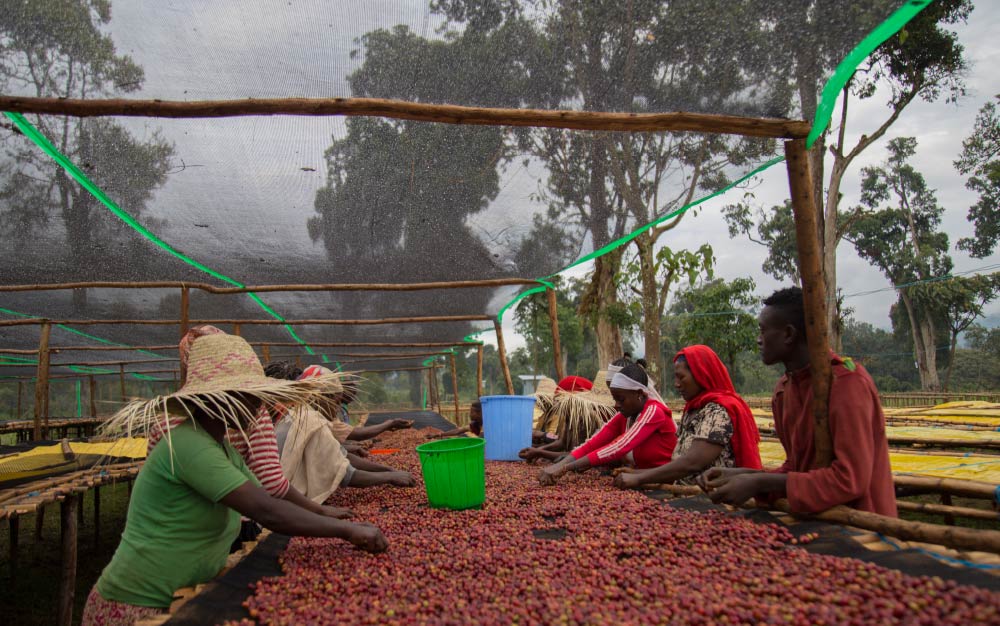
As for West Arsi, it is located west of Sidamo, adjacent to Yirgacheffe and Hararghe, with elevations ranging between 1900 and 2200 meters. The name of this region originates from the Oromo people who reside here. They are not only the predominant ethnic group in the area but also among the earliest known discoverers and drinkers of coffee, having a profound impact on global coffee culture. Over 88% of the population in West Arsi are Oromo, and coffee production is predominantly managed by smallholder farmers, with each household cultivating an average of about 2 to 3 hectares. Though the scale is modest, family-based meticulous management actually helps enhance quality. Local processing stations often reward farmers who carefully select ripe red cherries, further encouraging refined processing. West Arsi coffee also primarily uses the natural method, with careful selection of mature red fruits during processing. Through manual sorting, even spreading, and regular turning, the fruits are ensured to dry uniformly, ultimately delivering rich fruit aromas and a full body.
In terms of processing techniques, these three regions commonly use the natural (sun-dried) method, though there are still nuanced differences in actual practice. Generally, farmers first select fully ripe red cherries, removing unripe or overripe beans, then evenly spread them on elevated wooden drying beds to avoid contact with the ground and absorption of off-flavors. During sun drying, the cherries need to be turned multiple times daily to ensure even moisture evaporation and to continuously remove moldy or defective beans. Typically, after about two weeks of drying, once the skins become hard, a hulling machine is used to remove the outer layer, leaving behind dried green beans, which then undergo a final fine sorting to ensure consistent quality.
Below, we’ll use Huakui 4.0 and West Arsi beans as examples to compare their green bean appearance, roasting suggestions, as well as cupping and pour over performances. In terms of appearance, both beans are natural-processed, exhibiting a greenish-yellow hue in their raw state. However, Huakui 4.0 has slightly uneven bean size, with a few smaller grains visible, while West Arsi beans are generally more uniform in size and shape.
For roasting recommendations, to highlight their fruity aromas and acidity, a light roast is advised. Using the Yangjia 800N roaster as an example, for Huakui 4.0, the charge temperature is set at 175°C, with the damper at 3 and flame at 120. Around the 6-minute mark, the bean surface turns yellow; at 140°C, the damper is adjusted to 4 until around 9:50 minutes when first crack begins—then the damper is fully open. The final drop temperature is 196°C. For West Arsi beans, the charge temperature is slightly lower at 160°C, with the damper also at 3 and flame at 120. At around 115°C, the damper is adjusted, and the bean surface turns yellow at 6 minutes. First crack starts at approximately 9:08 minutes, and the final drop temperature is 193.5°C. The overall roasting time is slightly shorter, helping preserve a brighter acidity.
Cupping results show that Huakui 4.0 exhibits citrus and berry aromas in the dry scent, with wet aromas of blackcurrant and rose upon brewing. The cup delivers layers of almond, strawberry, and blackcurrant, accompanied by distinct fermentation notes and a lasting sweetness. On the other hand, West Arsi beans showcase intense berry and jam aromas, with cup flavors dominated by plum, berries, and cranberry jam, along with a lingering finish of nectarine, mango, and honey—offering a rich, juicy fruit experience overall.
For pour over recommendations, both beans are suitable for the V60 #01 filter. Water temperature should be controlled at 90–91°C, with a dosage of 15 grams, a 1:15 coffee-to-water ratio, and a grind size recommended as BG6M (granulated sugar size, about 80% through a #20 sieve). The pour over process can follow this flow: start with a 30-gram bloom for 30 seconds, then pour 95 grams (total ~125 grams), and around the 1-minute mark add the remaining 100 grams (total ~225 grams). Total brew time is about 2 to 2 minutes and 10 seconds. Huakui 4.0 presents almond aromas at high temperatures, releasing berry acidity and blackcurrant juiciness as it cools, with a honey-sweet finish. West Arsi beans exhibit bright berry juice flavors at higher temps, with plum, nectarine, and mango aroma layers becoming distinct as it cools, and a soft, lingering honey finish.
The above content is compiled by CoffeeHunters, a coffee news website.


