







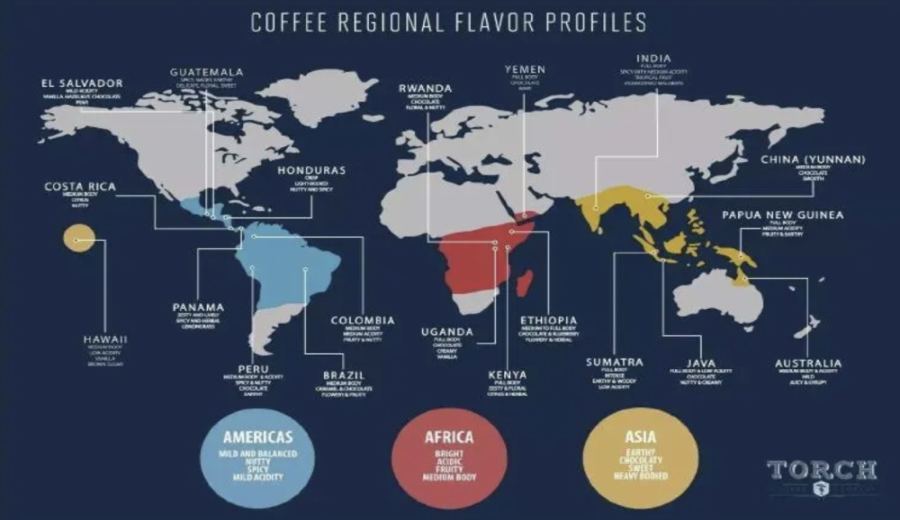
Introduction:Want to understand why coffee beans from different regions taste so distinctly different? This article dives deep into the geographic characteristics of the "coffee belt" between the Tropic of Cancer and the Tropic of Capricorn, exploring how altitude, climate, and soil across three major producing regions—Africa, Central and South America, and Asia—shape the unique flavor profiles of coffee. You’ll also get a grasp of the typical flavor characteristics of classic beans from each region.
Coffee trees are extremely particular about their growing environment. The world’s high-quality coffee beans almost all come from the narrow band between the Tropics of Cancer and Capricorn, an area known in the industry as the “coffee belt.” This belt spans Africa, Central and South America, and Asia, blessed with uniquely favorable climatic conditions—steady annual temperatures above 20°C, no frost in winter, abundant sunshine, and plentiful rainfall, providing the ideal environment for coffee tree growth.
It’s worth noting that even if the same variety of coffee tree is planted, the final brewed flavor can vary greatly depending on the location. Differences in altitude, microclimate, and soil composition collectively endow each coffee bean with a unique “terroir,” which is also the key reason expert cuppers can identify the origin of a coffee just by tasting it.
Next, we’ll explore the main producing regions across the three continents, analyzing how their climatic characteristics influence coffee flavors, and introduce several representative classic beans to help you build a foundational understanding of global coffee flavors.
First, let’s look at African producing regions, where coffee beans are known for their bright acidity. Professional analysis points out that this characteristic partly stems from the chemical makeup of native African varieties, while the higher phosphate content in the local soil also helps enhance the expression of acidity. For example,Ethiopia Yirgacheffe Gedeb Cooperativabeans, grown at altitudes of 2000–2100 meters, are processed using the washed method and are of the Ethiopian native variety. Their flavor profile is clear: bright citrus-like acidity on the entry, accompanied by fruity sweetness, with a honey-like sweetness and green tea-like refreshing finish.
Another option is theKenya Thika Assaria Factory72-hour washed AA-grade beans, grown at 1550–1750 meters altitude, of the SL28 and SL34 varieties. The most standout feature of these beans is their soft yet layered acidity, featuring complex sour notes reminiscent of cherry tomatoes, plums, and dark plums, with a sweet profile that presents a gentle brown sugar tone.
Turning to Central and South American producing regions, beans from here typically showcase richer flavor layers and softer acidity. High-altitude cultivation and significant day-night temperature differences are key factors—the larger temperature variation slows down the fruit growth rate, giving flavor compounds more time to accumulate, resulting in an excellent balance of fruitiness, sweetness, and body. For example,Panama Boquete Emerald Estate Jaramillo Mario LotGeisha beans, grown at 1700 meters altitude and processed using the natural (sun-dried) method. These beans offer a flavor akin to opening a bottle of mixed fruit juice: bright citrus acidity, lingering rose floral notes, long-lasting honey sweetness, and a mellow black tea-like finish.
AndCosta Rica Tarrazú Mirasol Estatestrawberry candy coffee beans, grown at 1700 meters altitude, are renowned for their raisin honey processing method. These beans combine the sweet aroma of strawberry hard candy, the fermented scent of raisins, the sweet-sour taste of strawberries, along with rose floral notes, making for an exceptionally distinctive flavor profile.
Finally, let’s look at Asian producing regions, where coffee beans generally present a full-bodied and steady character, with lower acidity and higher concentration. Compared to Africa and Central and South America, Asian producing regions tend to have lower growing altitudes, warmer climates, and smaller day-night temperature differences, leading to faster growth and ripening of coffee fruits, which results in a richer mouthfeel. For example,Yunnan Baoshan region’s small-bean coffee, grown at 1450–1550 meters altitude, uses fully red fruit sun-dried processing and is of the Catimor variety. Its flavor is based on the sweet-sourness of red berries, paired with the richness of dark chocolate, the aroma of roasted nuts, and a caramel-like sweet finish.
Another option is theIndonesia Sumatra Aceh province PWN company’s Golden Mandheling, a G1 grade bean hand-selected three times, grown at 1100–1600 meters altitude and processed with the wet-hulled (giling basah) method, of the Ateng variety. This bean has a rich flavor profile: prominent herbal and spicy aromas, accompanied by layers of black chocolate, caramel, and nuts—a classic choice for those who enjoy bold, full-bodied flavors.
The above content is compiled by CoffeeHunters, a coffee news website.


