







Introduction:Although Costa Rica is not the world’s largest coffee-producing country, it cultivates high-quality specialty coffee thanks to its refined microclimates and volcanic soils. This article delves into the country’s five core producing regions and three smaller ones, with a focus on the washed processing characteristics and flavor profiles of the high-altitude Tarrazú region. It also introduces the differences between mainstream varieties such as Bourbon and Caturra, as well as the SHB (Strictly Hard Bean) grading system based on altitude. Practical poured-over brewing recommendations for washed Tarrazú beans are provided to help you grasp the classic flavor profile of this renowned Central and South American origin.
Although Costa Rica does not rank high in global coffee production, its unique geographical environment and strict quality control have long made it an important supplier in the specialty coffee market. This Central American country, neighboring Panama—famous for its Geisha—benefits from the interplay of Pacific and Atlantic air currents, coupled with numerous volcanic terrains, creating diverse and coffee-friendly microclimates. Especially, its widespread volcanic soils, rich in various minerals and with good drainage and moderate rainfall, allow coffee cherries to accumulate abundant flavor compounds.
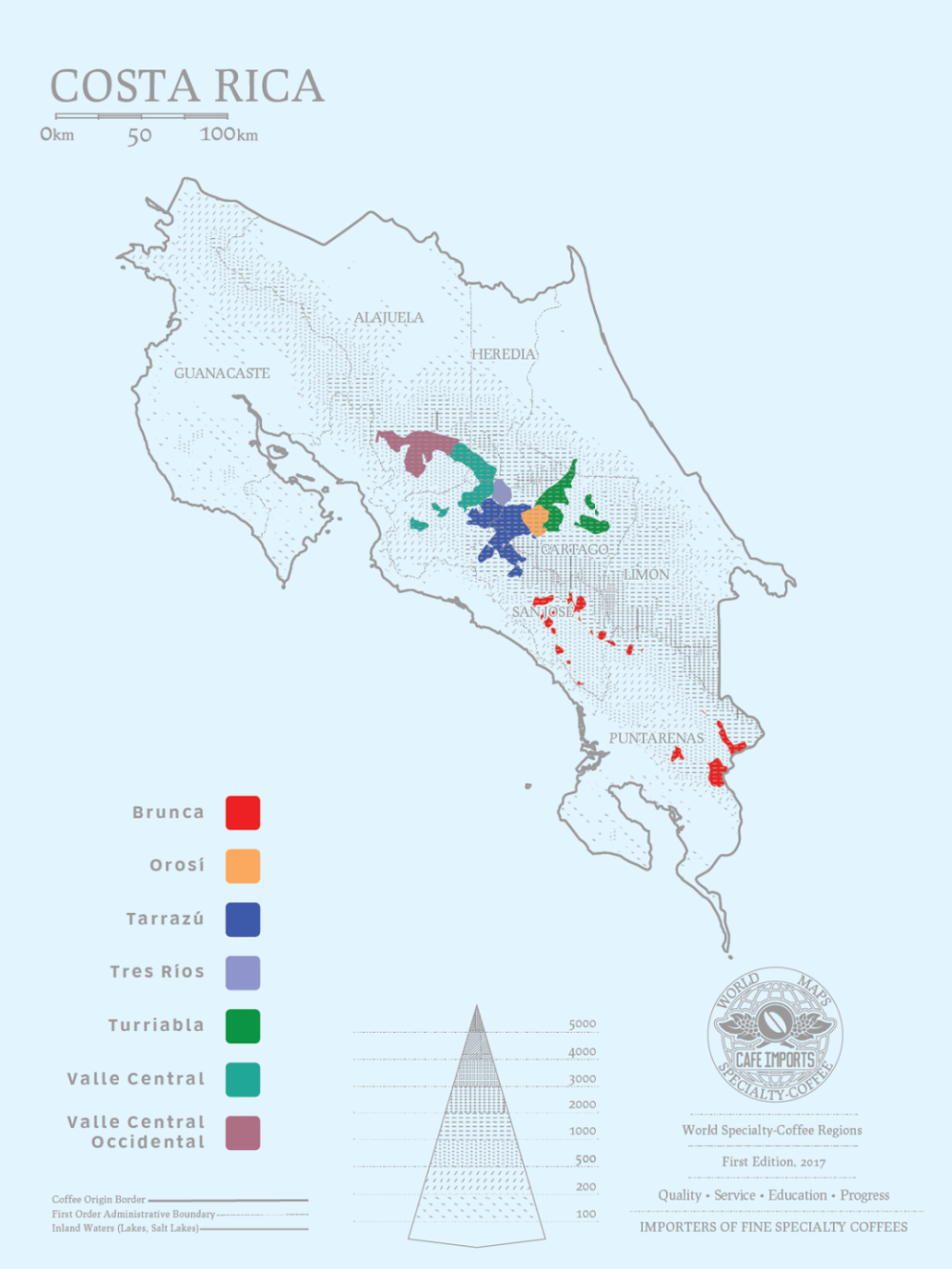
Coffee cultivation in Costa Rica has a history of over two hundred years, initially introduced from Cuba. Notably, the country’s laws explicitly mandate the planting of only Arabica varieties, prohibiting Robusta, reflecting a strong emphasis on coffee quality. Geographically, Costa Rica’s coffee-growing areas are mainly concentrated in a central narrow belt and can be divided into five major regions and three smaller ones, based on terrain and altitude.
Among them, the Tarrazú region is not only the largest-producing area in Costa Rica but also a well-known and highly reputed origin in the international market. Located south of the capital, San José, its plantations generally sit at altitudes between 1200 and 1700 meters. The cool temperatures brought by the high altitude, combined with fertile soils formed from volcanic ash, result in slow growth of coffee plants, allowing them to accumulate richer flavors and acidity. The coffee produced here typically showcases bright acidity, layered fruit aromas, and a full body, making it a benchmark of high quality in the eyes of many coffee enthusiasts.
In terms of varieties, Costa Rica primarily grows traditional Arabica types such as Bourbon, Caturra, and Catuaí, as well as locally selected varieties like Villalobos. Among them, Caturra is a natural mutation of Bourbon, with a shorter tree stature. Although it is less resistant to disease, it offers higher yield per plant and usually features pronounced fruity acidity, particularly berry-like notes. Catuaí, on the other hand, is a hybrid offspring of the New World variety and Caturra. It shares the dwarfing trait but has stronger disease resistance and more stable fruit retention on the tree. Its flavor skews towards nutty and cereal notes, presenting an overall more balanced profile. The country’s standard commercial beans are a blend of Caturra and Catuaí, processed using the washed method, resulting in a mild and harmonious flavor character.
Costa Rica’s coffee bean grading system is mainly based on cultivation altitude. Generally, the higher the altitude, the denser the beans, with firmer texture and the ability to retain richer fruit flavors. The country generally classifies beans grown at altitudes between 1500 and 2100 meters as SHB (Strictly Hard Bean), which is the high-quality grade most commonly specified by international buyers. These high-altitude beans not only demonstrate better extraction efficiency during grinding and brewing but also usually possess more complex flavor profiles.
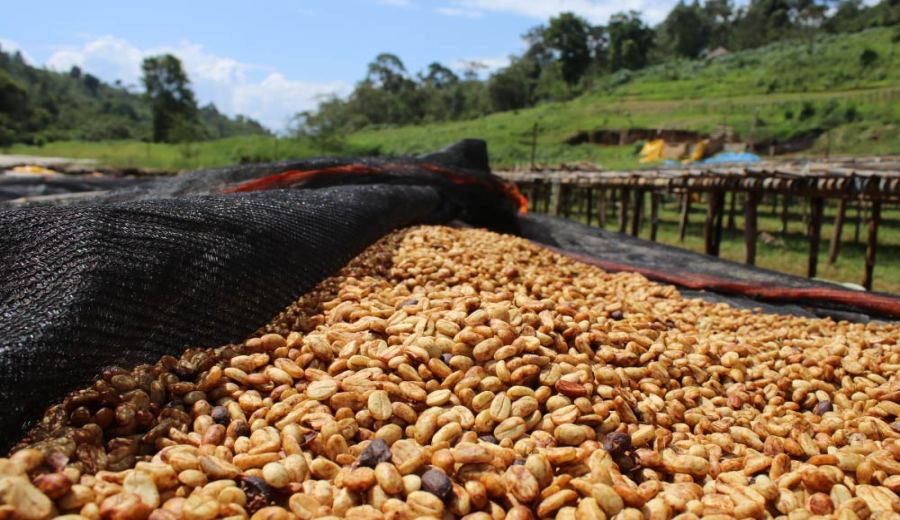
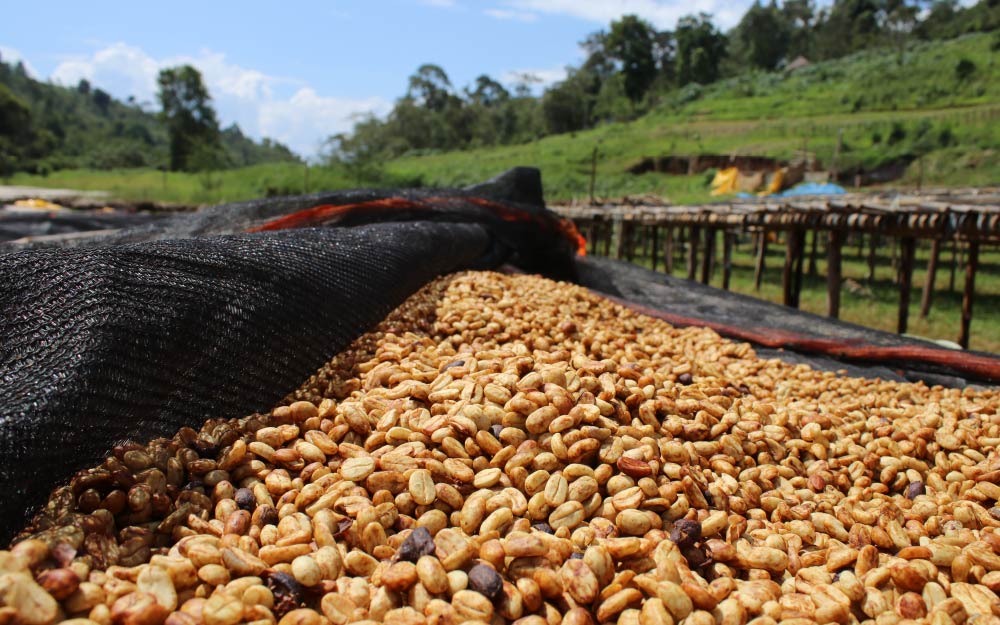
The development of honey processing in Costa Rica is also noteworthy. This method originated from Brazil’s semi-washed (pulped natural) technique and was significantly refined after being introduced to Costa Rica around the year 2000. In the honey process, after floating to remove unripe cherries, the coffee fruit is first depulped to remove the outer skin but the sticky, high-sugar mucilage layer is retained, followed by direct sun drying. Since the sugars in the mucilage penetrate the seed during drying, they impart a richer sweetness and tropical fruit flavors to the coffee, hence the name “honey process.” Compared to traditional washed methods, honey processing not only reduces water consumption but often delivers a richer mouthfeel and unique aromatic expression.
If you wish to brew washed Tarrazú coffee from Costa Rica at home, here are practical hand-brewing reference parameters. It is recommended to use a V60 dripper, with water temperature controlled at 91°C, a coffee dose of about 15 grams, and a coffee-to-water ratio set at 1:15. For grind size, adjust to approximately 80% passing through a standard 20-number sieve, equivalent to a medium-fine grind. For the brewing process, a three-pour method can be used: first pour 30 grams of water for a 30-second bloom, then pour about 95 grams of water within approximately 1 minute (total weight around 125 grams), and when the water level drops to about two-thirds of the coffee bed, pour the final 100 grams of water (total weight around 225 grams). The total extraction time is about 2 minutes and 10 seconds. Please note that coffee beans require a 4 to 7 day resting period after roasting to allow for degassing before their flavors reach their optimal state. Freshly roasted beans not only have brighter aromas but can also showcase the purest regional characteristics and processing flavors during brewing.
In summary, the washed coffee from Costa Rica’s Tarrazú region is known for its bright acidity, rich layers, and good balance. It is a representative origin worth exploring and savoring, whether you are a beginner coffee enthusiast or someone pursuing high-quality single-origin coffee. By understanding its regional characteristics, varietal differences, and processing methods, you can more precisely appreciate the flavor charm of this highland coffee from Central America.
The above content is compiled by CoffeeHunters, a coffee news website.


