








Introduction:Want to understand why the Mozart coffee in the Costa Rica Musician Series has such a unique flavor? This article starts with the geographical advantages of the Canet Estate and the characteristics of the variety, delves into each step of the raisin honey processing method, and provides tested pour over and roasting parameters to help you fully grasp the flavor logic and brewing tips of this popular specialty bean from origin to cup.
The Costa Rica Musician Series is one of the early specialty coffee representatives to enter the market, known for its special processing methods. Among them, the Mozart coffee stands out by using the raisin honey process, exuding intense dried fruit sweetness and a subtle wine fermentation note, making it a classic entry-level choice for many coffee enthusiasts. This article will help you better understand the sources of this bean's charm, covering everything from the producing region and variety selection, to the details of the processing method, and practical roasting and pour over recommendations.
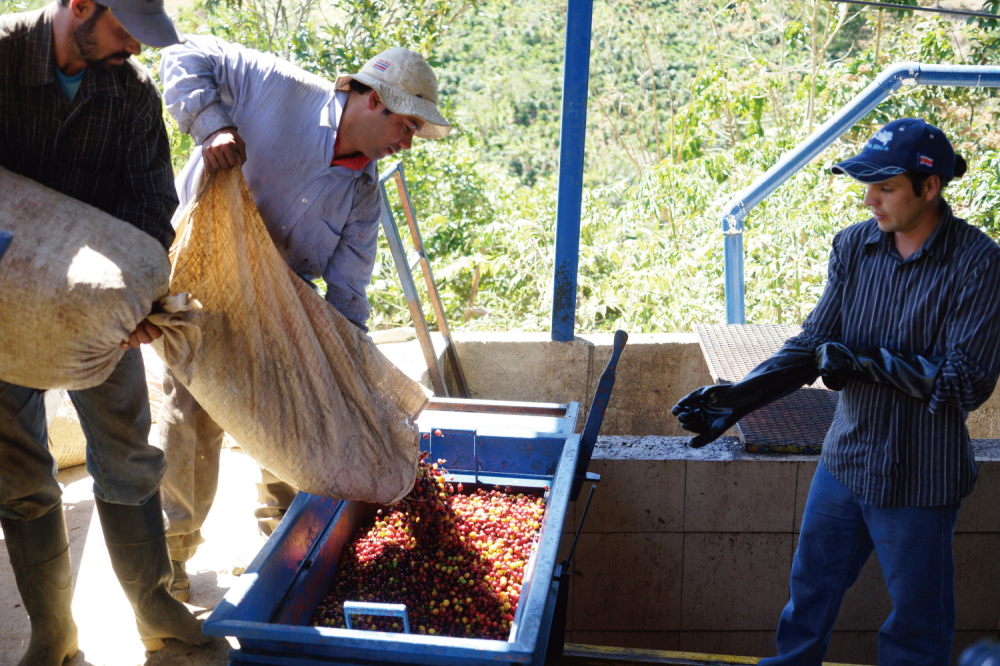
The Canet Estate is located in Costa Rica’s renowned Tarrazú region, famous for its high altitude and superior ecological environment. It has previously received praise from the British royal family and the Pope, and is an important origin for specialty coffee. This estate is situated in the highest-altitude section of Tarrazú, surrounded mostly by tropical fruit plantations such as passion fruit. Coffee is grown in only carefully selected small plots and is known for its refined manual management. All coffee cherries are hand-picked, with only perfectly ripe red fruits selected, and undergo additional screening to ensure consistent quality.

The estate primarily grows two varieties: Caturra and Catuai. Caturra is a natural mutation of Bourbon, known for its clear flavors and strong adaptability; Catuai is a hybrid of Caturra and Mundo Novo, combining stable yield with good flavor potential. Under proper management, both varieties can exhibit rich fruity notes and sweetness, laying the foundation for subsequent special processing.
The Costa Rica Musician Series is curated by Taiwan’s Black Gold Company and includes four beans: Black Gold Bach, Mozart, Chopin, and Beethoven. The first three all use the raisin honey process, with only Beethoven being washed. This variant of honey processing is the key to the unique flavor of Mozart.
Raisin honey processing is a special form of honey processing. The steps are: first, the whole coffee fruit is placed under the sun for a 72-hour pre-drying period, causing the pulp to shrink, moisture to evaporate, and the appearance to gradually resemble raisins; then the outer skin is removed, retaining 100% of the mucilage layer, followed by a second sun-drying phase. Compared to general black honey processing, this method adds an initial drying pre-treatment, resulting in a final coffee bean that exhibits intense dried fruit sweetness, a wine-like fermentation layer, and a clear expression of sweetness.
In terms of roasting, testing was conducted using a Yangjia 800N semi-direct-fire roaster, with a green bean charge of 300 grams. It is recommended to start roasting when the drum temperature reaches 200°C, with an initial power setting of 160 and air vent at 3. The turning point occurs around 1 minute and 36 seconds, maintaining the current settings; when the temperature rises to 140°C, adjust the power to 160 and open the air vent to 4. At approximately 5 minutes and 20 seconds, when the beans turn yellow and grassy notes fade—entering the dehydration phase—reduce the power to 130 while keeping the air vent at 4. At 166°C, reduce power further to 100, leaving the air vent unchanged.
Around 8 minutes and 05 seconds, dehydration is complete, and the bean surface begins to show wrinkles and dark spots. At this point, a toast-like aroma emerges, signaling that first crack is imminent, requiring close attention to the cracking sounds. First crack begins at 8 minutes and 55 seconds; it is recommended to fully open the air vent to 5 while keeping the power unchanged. The development time after first crack is suggested to be controlled at around 1 minute and 30 seconds, with a target exit temperature of 193.2°C, in order to fully express the sweetness and complexity brought by the raisin honey process.
For pour over, it is recommended to use 15 grams of coffee, a 1:15 coffee-to-water ratio, with a medium grind size passing 80% through a #20 sieve, and water temperature controlled at 90°C. A V60 filter is recommended. Brewing can follow a three-stage pouring method: the first stage involves pouring 30 milliliters for a 30-second bloom; the second stage pours water in a circular motion from the center outward until reaching 150 milliliters, then pausing briefly; the third stage, once the water level has dropped by half, continues pouring up to 225 milliliters. Total extraction time is recommended to be maintained between 1 minute and 40 seconds to 2 minutes.
In terms of final cupping flavor, the Costa Rica Mozart coffee often presents rich floral notes and fermented sauce aromas. The entry offers pronounced sweetness along with intense dried raisin and preserved fruit characteristics, with a bright acidity that reveals hints of starfruit and berry tones. The finish lingers with a lasting sugarcane sweetness. The overall profile is well-layered with a long-lasting aftertaste, making it highly suitable for coffee lovers who enjoy a balance of fruitiness and sweetness.
The above content is compiled by CoffeeHunters, a coffee news website.


