







Introduction:From debt repayment exports to a shift toward specialty production, Yunnan coffee has gone through three waves of cultivation, gradually making its mark on the global market. This article takes you through the development trajectory of Yunnan coffee, deeply analyzes the characteristics and differences between the mainstream varieties Catimor and Typica, and through practical cases, explores how planting and processing techniques can enhance flavor potential — helping you find your recommended choice of Yunnan coffee beans.
Yunnan coffee is transitioning from being a traditional supplier of instant coffee raw materials to becoming an important player in the global specialty coffee map. This transformation is not only reflected in the rise of local specialty coffee shops but has also attracted international brands such as Starbucks and local entrepreneurs to invest resources in jointly exploring the flavor potential of Yunnan coffee.
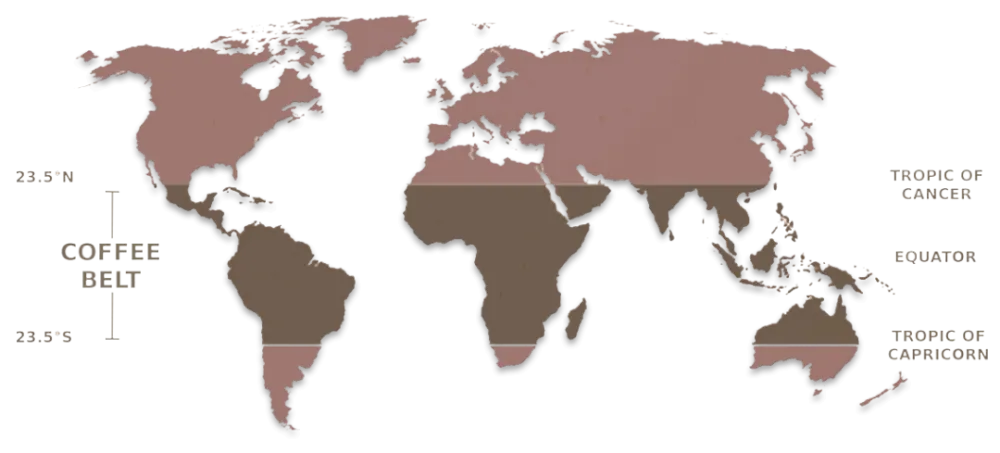
As a crop that is extremely sensitive to climate and altitude, the growing conditions for coffee are crucial. The world’s renowned coffee-growing regions are mostly concentrated within the “coffee belt” between the Tropic of Cancer and the Tropic of Capricorn, and within China, only Yunnan and Taiwan meet both these geographical and suitable elevation criteria. Interestingly, coffee is not native to China — the earliest planting records date back to 1877 in Fujian, where it was introduced as one of the economic crops for the assimilation of indigenous peoples.
The history of coffee cultivation in Yunnan can be roughly divided into three stages. The first stage began in the 1950s and 1960s, when most people in China were still quite unfamiliar with coffee, and the coffee beans grown in Yunnan were mainly for debt repayment and exported to the Soviet Union. Cultivation during this period was led by the Yunnan State Farms system and procured uniformly by the national foreign trade department, with main planting areas including Baoshan Lujang Farm and Dehong Zhefang Farm. The varieties were mostly locally propagated Typica and its Bourbon variants. However, as the debt repayment mission ended and diseases struck, Yunnan’s coffee planting area once shrank drastically to less than 3,000 mu.
The second stage began in the 1980s, with the reform and opening-up bringing new opportunities. In 1988, Nestlé actively invested in Yunnan’s coffee industry, heavily promoting the Catimor variety, which is highly resistant to disease and boasts high yields. This variety yields about three times as much as Typica per unit and shows strong resistance to common diseases. Since growers at the time were more focused on yield and economic returns, Catimor gradually replaced Typica and became the market mainstream, at one point accounting for up to 90% of Yunnan’s total coffee output.
The turning point of the third stage emerged after 2000. With China’s economic takeoff, global specialty coffee brands and consumers began to take notice of Yunnan. The introduction of specialty coffee concepts prompted a re-examination of varietal selection and cultivation techniques locally, pushing Yunnan coffee toward a specialty-oriented path. Although the process is ongoing, Yunnan coffee has gradually begun to showcase unique terroir characteristics and potential.
When it comes to Yunnan small-grain coffee, many people’s first association is still with Typica. This variety is known for its small bean size and full-bodied flavor, and it was also representative of early Yunnan coffee. However, due to Catimor’s advantages in high yield and disease resistance, many farms had to switch to Catimor, which is why today, when people refer to “Yunnan small-grain,” they mostly mean the Catimor variety. If you want to experience the basic flavors of Yunnan coffee, a washed-processed, medium-roasted Yunnan small-grain bean is a good entry-level choice, offering a balanced profile of chocolate, brown sugar, and nuts.
The Catimor variety was developed in 1959 by Portugal’s Centro de Investigação das Ferrugens do Café (CIFC), as a hybrid offspring of the Timor and Caturra varieties. Due to the incorporation of Robusta genetics, Catimor shows good resistance to leaf rust, berry diseases, and certain pests. However, some experts, such as Taiwanese coffee master Han Huai-zong, have pointed out that its flavor may carry earthy or funky undertones. It is worth noting that as planting and post-harvest techniques improve, the flavor performance of Yunnan Catimor is steadily advancing.
To explore the unique expression of Yunnan’s local terroir, a certain brand chose to establish its own estate in Lincang. Lincang is located in the southwest of Yunnan, where the Tropic of Cancer passes through the southern part, neighboring Pu’er, Dali, and Baoshan, and bordering Myanmar. The region generally has an altitude of over 1,000 meters, an average annual temperature of around 17°C, distinct dry and wet seasons, and abundant sunshine — providing an ideal environment for growing Typica.
The brand uses the natural (sun-dried) processing method at its Lincang estate, evenly spreading ripe coffee cherries on raised beds and turning them daily to ensure uniform drying and avoid off-flavors caused by uneven fermentation. This method retains the sugars in the fruit pulp, thereby imparting the coffee beans with intense aroma and bright sweetness, allowing tasters to experience the pure essence of Yunnan specialty coffee.
The above content is compiled by CoffeeHunters, a coffee news website.


