







Introduction:Delve into the unique terroirs and bean variety characteristics of Brazil’s six major coffee regions, from Minas Gerais to Cerrado. This article provides a comprehensive analysis of the differences between Red Bourbon and Yellow Bourbon, along with practical medium-dark roast suggestions and KONO dripper three-stage pour over parameters to help you better grasp the smoothness and layered profile of Brazilian coffee beans.
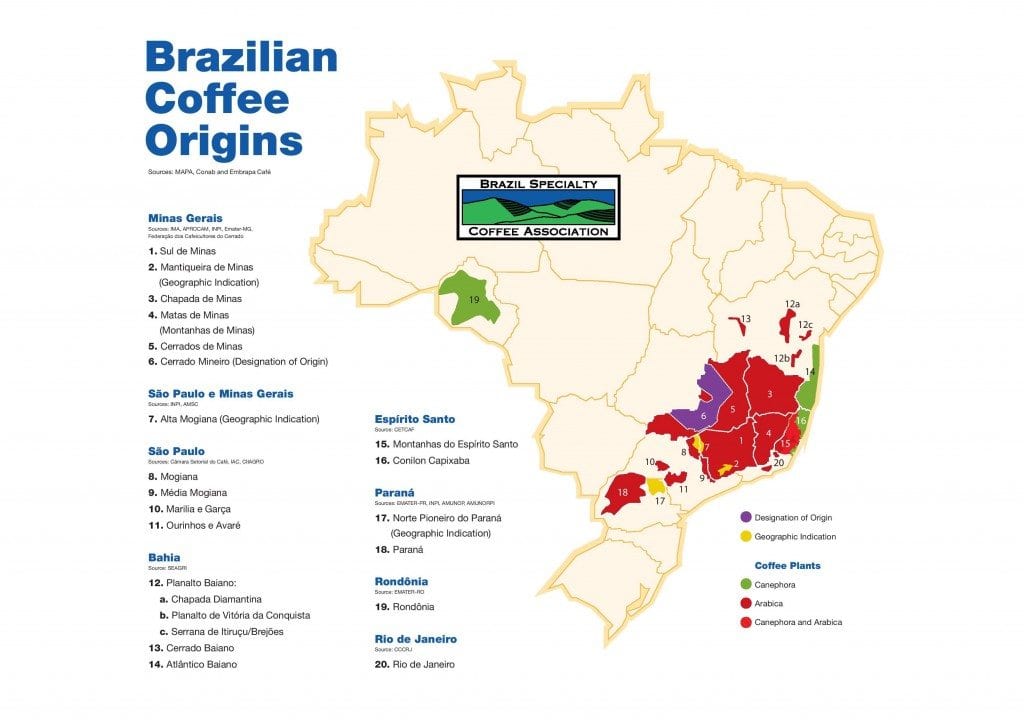
Brazil firmly holds the title of the world’s top coffee producer, with 17 out of its 21 states engaged in coffee cultivation. Among them, six key regions—Minas Gerais, São Paulo, Espírito Santo, and others—stand out for their distinct microclimates and flavor profiles. This article will take you on a tour of these representative regions, analyzing Brazil’s diverse coffee landscape through aspects such as terrain, altitude, and processing methods. It also dives into the characteristic differences between Red Bourbon and Yellow Bourbon, while offering practical medium-dark roast and pour over recommendations to help you understand the secrets behind the smooth taste of these beans.
【Minas Gerais】—The Heart of Brazilian Specialty Coffee
Minas Gerais is Brazil’s largest producer of Arabica beans, contributing over half of the nation’s total output and serving as an important cradle of specialty coffee. The state can be further divided into four sub-regions, each showcasing its own unique personality.
Matas de Minas, with its high humidity and warm climate, produces specialty coffees rich in intense caramel and chocolate aromas, making it a popular choice for many coffee enthusiasts.Minas Highlands, characterized by flat terrain suitable for mechanized farming, yields coffee with pronounced chocolate notes, offering direct and stable flavors.
Located in the plateau region,Cerradois Brazil’s first region to receive coffee origin certification. With distinct seasons and moderate altitude, it is highly suitable for coffee growth and harvesting. Home to numerous medium and large estates, it is an important source of specialty beans.Sul de Minas, with its higher altitude and pleasant temperatures, often produces Arabica beans with distinct fruity notes and full body. Accounting for about 30% of national production, it is one of Brazil’s main coffee export forces.
【São Paulo】—Where Port and History Converge
São Paulo State not only hosts Latin America’s largest port—Santos—but is also one of the oldest coffee-growing regions in Brazil and a vital export hub. The state features two distinctive producing areas:Mogianaboasts fertile red volcanic soil, suitable altitude, and mild climate, yielding coffee with low acidity, rich mouthfeel, and a blend of fruit and chocolate notes. It is the origin of many auction lots. The renowned Fazenda Rainha has achieved remarkable success since the first Brazil Cup of Excellence in 1999, winning 12 awards in 7 years—a synonym for quality.
Another producing areaCentro-Oeste, dominated by hills and mostly small to medium-sized farms, offers coffee with relatively mild flavors, catering to consumers who prefer balanced taste profiles.
【Espírito Santo】—A Highlight of Arabica in a Robusta-Dominated State
Although Espírito Santo State is primarily known for Robusta cultivation, its Arabica coffee should not be overlooked. The state’s plateau terrain and mild climate allow its limited Arabica production to exhibit notable acidity and fruity notes. Ranking second in national output, it represents one of the faces of Brazil’s coffee diversity.
【Bahia】—An Emerging Force in Specialty Coffee
Bahia’s coffee cultivation started relatively late, around the 1970s. However, thanks to modern agricultural techniques, it has achieved remarkable results in recent Brazil Cup of Excellence competitions. In 2015, it even won the championship in the honey-processed category, gradually drawing market attention. The state’s coffee-growing areas feature higher altitudes, with rainy winters and dry summers, contributing to unique flavor expressions.
【Paraná】—A Historic Region Facing Challenges
As one of Brazil’s oldest coffee-producing regions, Paraná once had a glorious history. However, the severe frost in 1975 devastated the local coffee industry, drastically reducing production and indirectly driving Arabica futures prices to historic highs in 1977. Today, although the state remains an important agricultural area, its maximum altitude of only 950 meters makes it difficult to grow high-quality Arabica beans. Both yield and quality fall short of past levels.
【Rondônia】—An Emerging Region Dominated by Robusta
Located in northeastern Brazil, Rondônia currently mainly grows Robusta varieties and is one of Brazil’s important Robusta-producing regions.
【Bourbon Variety Flavor Differences】—Red Bourbon vs Yellow Bourbon
The classic flavors of Brazilian coffee are often synonymous with the Bourbon variety. In the mid-19th century, Brazil introduced the higher-yielding Bourbon variety from Réunion Island to replace the original Typica, significantly boosting overall production. Later, some Bourbon plants produced yellow fruits, which research confirmed to be a mutation of Red Bourbon—Yellow Bourbon.
Generally speaking,Yellow Bourbon has a thicker mucilage layer and higher sugar content, resulting in more pronounced sweetness, often exhibiting soft lemon aroma in cupping and a sweeter taste. Red Bourbon, on the other hand, is known for its stable nutty tones and smooth mouthfeel, representing one of the signature flavors of Brazilian coffee.
【Pour Over Recommendation】Medium-Dark Roast × KONO Three-Stage Extraction
To fully highlight the smoothness and layered profile of Brazilian beans, it is recommended to use a medium-dark roast paired with a KONO dripper and three-stage pouring method. The following are practical parameters and steps:
Reference Beans: Red Bourbon from Cerrado, Minas Gerais (pulped natural), Yellow Bourbon from Fazenda Rainha, Mogiana (natural)
Roast Level: Medium-Dark
Dripper: KONO
Water Temperature: 88°C
Coffee Dose: 15 grams
Coffee-to-Water Ratio: 1:15
Grind Size: Approximately 70% passing through a #20 sieve (medium-coarse)
Pour Over Steps:
1. First pour: Add 30 ml of hot water, bloom for 30 seconds;
2. Second pour: Pour 100 ml in a circular motion. When the water level drops to about half (around 1:05), proceed to the third pour;
3. Third pour: Add 95 ml, keeping the total extraction time around 2 minutes.
Through precise temperature control and segmented pouring, the nutty, chocolatey, and subtle sweet notes of Brazilian beans are more fully released, delivering a smooth and layered drinking experience.
The above content is compiled by CoffeeHunters, a coffee news website.


