







Introduction:Want to dive deep into the origins and brewing secrets of Ethiopia’s Geisha Village Red Label Geisha? This article starts with the roots of the Gori Gesha Forest, exploring the variety’s classification, rigorous grading system, and unique flavor profile. We also provide expert roast curves and pour over parameters to help you understand everything from green bean traceability to cup flavors in one go.
Geisha coffee is now hailed as a representative of top-tier varieties, but do you know where this variety originated? The answer lies in Ethiopia’s Bench-Maji region, particularly in the pristine Gori Gesha forest. As one of the key origins of this variety, Geisha Village Coffee Estate not only inherits the original genetics of Geisha but is also renowned for its strict grading and refined processing. In particular, the Red Label batch is a top choice for many coffee enthusiasts looking to try something new or build a collection.
When it comes to Geisha, many people first think of Panamanian Geisha with its white floral notes, rich fruitiness, and honey-like sweetness. However, the truth is that the Geisha variety was first discovered in the 1930s in Ethiopia’s Gesha Forest, and later brought to the Tropical Agricultural Research and Higher Education Center (CATIE) in Costa Rica during the 1950s–1960s, where it was registered as T2722. By the 1970s, the variety made its way to Panama, and it wasn’t until 2004—when it won the Best of Panama (BOP) competition and fetched astonishing auction prices—that it truly rose to global fame.
Although modern genetic testing shows that Panamanian Geisha and Ethiopia’s native Geisha varieties are not entirely identical in DNA, this does not diminish the remarkable charm and uniqueness of both in terms of flavor expression. For this reason, comparing the differences between Geisha from these two regions has always been a flavorful journey that coffee lovers enjoy, whether for taste or exploration.
As one of Ethiopia’s representative specialty coffee estates, Geisha Village has long been a focal point in the industry. The estate was accidentally discovered in 2007 by documentary filmmaker Adam Overton and photographer Rachel Samuel while they were shooting a coffee documentary for the Ethiopian government. At that time, they ventured into the Gera Coffee Forest in the Bench-Maji region, where they developed a strong interest in the land and its coffee—eventually leading to the idea of establishing their own coffee estate.
In 2009, through exchanges with renowned mule estate owner and BOP judge Willem Boot, the Overtons gained important inspiration: to return to Ethiopia to seek the roots of the Geisha variety. In 2011, they arrived in the Bench-Maji region, now home to Geisha Village. Initially, it was just an undeveloped piece of land with great potential, but with Willem Boot’s help, they discovered astonishing wild Geisha trees in the surrounding forests—especially in the Gori Gesha Forest, where they found what might be the closest to the original Geisha variety.
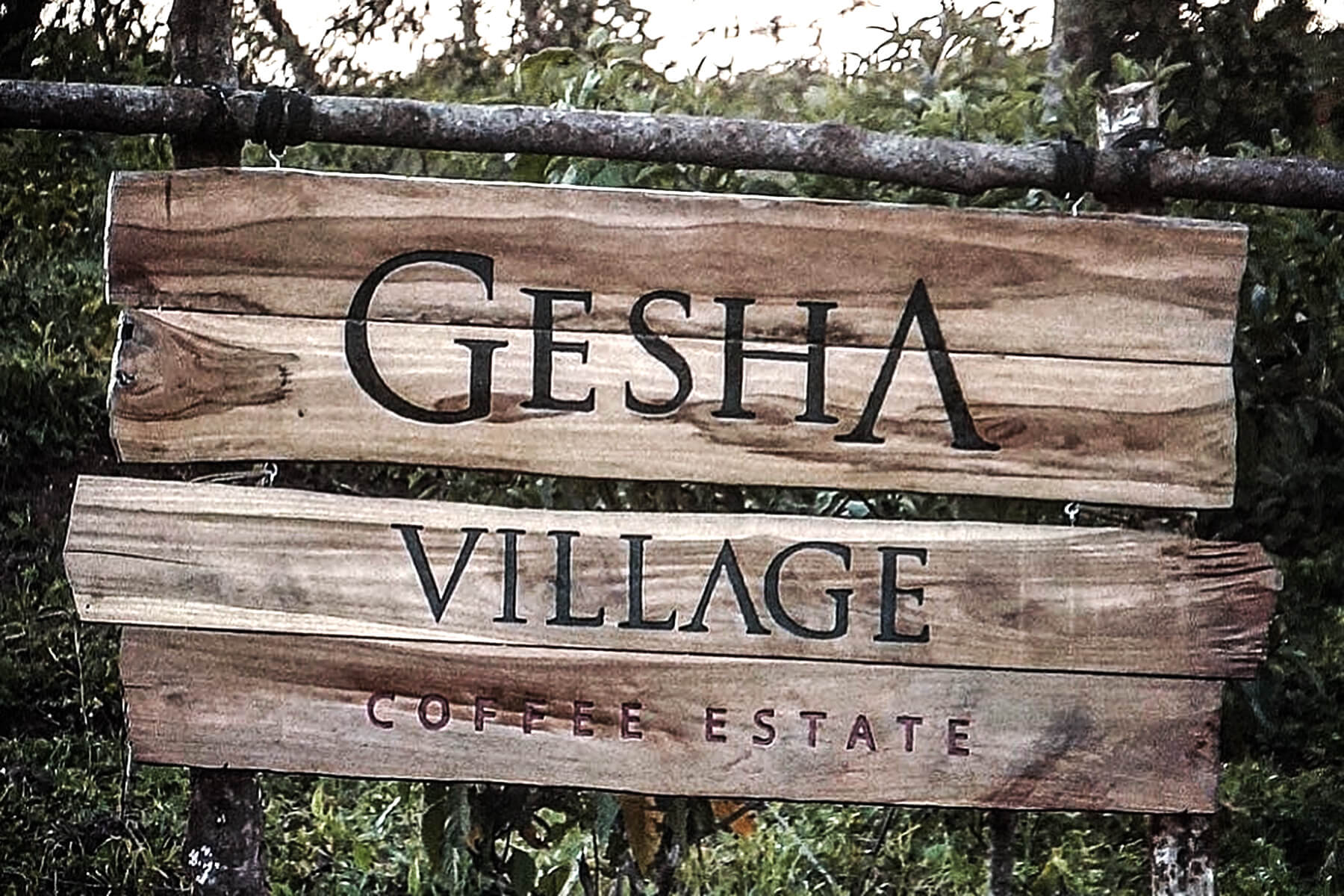
These discoveries led them to establish a large-scale coffee farm spanning 475 hectares, about 12 miles from the Gori Gesha Forest—the current Geisha Village Coffee Estate. Unlike typical smallholder farms in Ethiopia, this estate is not only vast in scale but also has its own washed processing plant and lab. It focuses solely on cultivating the Geisha variety, with all seeds sourced from the nearby forests to ensure purity and traceability.
Geisha Village divides the entire farm into eight blocks and grows three main Geisha varieties. Construction began in October 2011, and the first harvest didn’t occur until 2015. Due to the outstanding results in the first year, on May 31, 2017—with the help of Willem Boot—Geisha Village held its first international auction, offering 21 micro-lots, 19 of which were 120 kg bags. Buyers from around the world participated, and the highest bid reached $85 per pound, setting a historic record for African beans.
Within Geisha Village’s strict grading system, the Red Label represents a high cost-performance and outstanding flavor tier. Red Label batches must have full traceability and achieve an SCA score of 88 or above, showcasing the classic flavor characteristics of Ethiopian Geisha Village. Based on actual cuppings, Red Label Geisha features distinct complex fruit aromas, honey-like sweetness, and elegant floral notes. The acidity is bright and layered. Although its overall complexity is slightly lower than that of the Gold Label, it still holds high value for drinking and collecting.
Taking the Geisha Village Red Label as an example, the processing method used by this supplier is natural (sun-dried). This method emphasizes detail: after harvest, the coffee cherries undergo flotation to remove impurities and unripe beans, then are placed on African-style raised beds in thin layers covered with thin plastic sheeting for sun drying. The process involves frequent turning and sorting to remove insect-damaged or underripe green beans. The entire drying process usually takes 18 to 30 days to ensure stable moisture content and well-developed flavors.
For roasting, to highlight the fruity notes of the Red Label Geisha, the roaster opts for a medium-light roast. Using a Yangjia 800N roaster (300g capacity) as an example, the recommended settings are as follows: Start with a drum temperature of 160°C and drop in the beans, with the air damper at 3 and heat at 130; the turnaround occurs around 1 minute 40 seconds. When the drum temperature reaches 140°C, adjust the air damper to 4 and the heat to 150. Once the bean surface turns yellow and grassy notes disappear, enter the drying phase. Then gradually reduce the heat and stabilize the air damper until first crack begins (around 8 minutes 25 seconds). Continue development for about 1 minute 45 seconds after first crack, and finally drop the beans at 197.5°C.
As for pour over recommendations, you can use a Hario V60 filter, with a water temperature of 91°C, a 1:15 coffee-to-water ratio (15g coffee to 225g water), and a medium-fine grind size (80% passing through a standard Chinese No. 20 sieve). The specific steps are: start with a 30g bloom for 30 seconds, then pour in small streams until reaching 125g for the first pour. When the water level drops and is about to expose the coffee bed, continue pouring up to 225g. Finally, remove the V60. The total extraction time should be controlled to around 2 minutes to fully showcase its clear and bright flavor layers.
After brewing, the Red Label Geisha reveals a diverse and layered flavor profile. Common descriptors include coconut, licorice, cream, chocolate, toffee, citrus, almond, and strawberry, along with subtle fermentation aromas. The overall mouthfeel is rich and balanced, with a particularly prominent nutty character. It’s ideal for coffee lovers who enjoy a combination of fruity notes and complexity.
The above content is compiled by CoffeeHunters, a coffee news website.


