








Introduction:Robusta is often misunderstood as a low-grade coffee bean, but it actually has unique value and potential. This article delves into the origins, characteristics, and market positioning of Robusta, analyzing its key differences from Arabica, and introduces how India’s specialty Robusta breaks traditional perceptions by offering a clean and layered cupping experience. Readers will learn how to identify Robusta, evaluate its quality, and understand its role in blends and single origins.
Robusta is often labeled as “low-end,” but this view is overly simplistic. Originating from the Congo region in West Africa, Robusta has extremely high environmental adaptability, can withstand harsh climates and pests, and grows significantly faster than Arabica. Its caffeine content reaches 2.7% to 4%, nearly double that of Arabica, which is also one of the main reasons for its natural resistance to pests. Globally, Robusta accounts for about 30%of total coffee production, primarily used in espresso blends to enhance body and crema richness. For example, many commercial blends include around 10% Robustato make the coffee taste fuller.
Botanically, Robusta and Arabica belong to different species. Robusta is classified under the Canephora species, while Arabica belongs to a separate, independent species. Although the two are often directly compared in the market, this classification is not precise. It’s worth noting that only Robusta within the Canephora species has been successfully commercialized, so the name is often used as a synonym for Robusta.
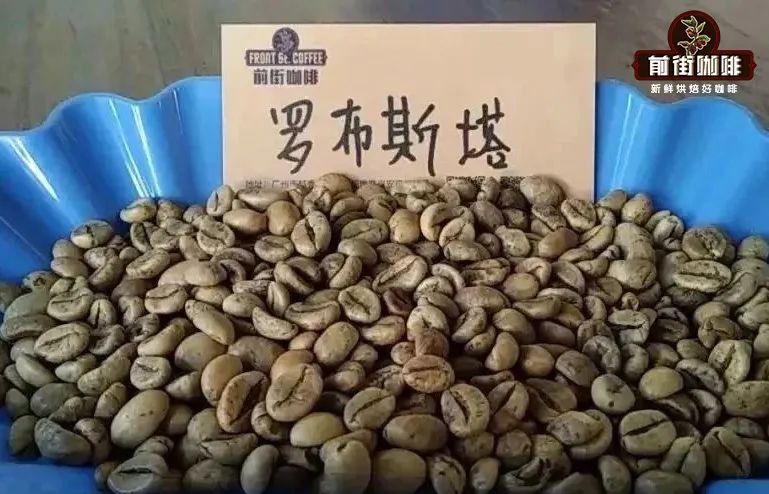
In appearance, Robusta coffee beans are “one fruit, one bean,” with a roundish shape, forming a C-shape, and a straight center line. The raw beans are usually yellow-brown in color. These characteristics help consumers preliminarily identify them when selecting.
The advantages of Robusta mainly lie in adaptability and resistance. It can grow in lower altitudes and high-temperature environments , with far greater tolerance to extreme climates than Arabica, and is thus widely cultivated in Vietnam, Brazil, India, and even Hainan in China. Due to most Robusta being grown at low altitudes and variety traits, its flavor is typically deeper, heavier, and often carries earthy, nutty, or grainy notes, rather than the floral and fruity aromas commonly found in Arabica.
In terms of pest resistance, Robusta demonstrates strong resilience. Its high caffeine content acts as a natural insect repellent, effectively fending off various pests. Additionally, Robusta has 22 chromosomes, fewer than Arabica’s 44 chromosomes , but because it is cross-pollinated, it has higher genetic diversity, giving it a survival advantage in changing environments. This is also one reason why it is less susceptible to large-scale disease outbreaks.
However, the disadvantages of Robusta are also quite apparent. Due to its growing environment and variety traits, its flavor profile is often less delicate than that of Arabica. High caffeine and chlorogenic acid content give it a bitter and astringent taste, often with earthy, woody, or rough nutty aromas, which is why most specialty coffee circles do not hold it in high regard, using it mainly as a blend component or for instant coffee production.
Interestingly, to combine the strengths of both, the industry has developed hybrid varieties — such as Catimor. This is a cross between Arabica’s Typica and Robusta, containing about 25% Robusta genetics. Catimor not only inherits Robusta’s resistance to leaf rust and high-yield traits, but also retains a certain level of Arabica flavor potential. It is an important cultivated variety in many regions, such as Yunnan, where Catimor is widely planted.
Taking Baoshan in Yunnan as an example, the local altitude is about 1200 meters, and the Catimor coffee beans grown there are mostly processed using the washed method to adapt to the rainy climate. The washed method removes the pulp through fermentation, reducing off-flavors and enhancing cleanliness and fruit acidity. After proper roasting, such coffee typically exhibits bright acidity, herbal aromas, and rich layers.
When it comes to brewing, it is recommended to use a Kono filter, with a 1:15 coffee-to-water ratio, and water temperature controlled at 88°C(temperature placeholder retained) 30 grams of water for a 30-second bloom, followed by pouring in small circles until 125 grams for the first pour, then continuing to pour until 225 grams, with a total extraction time of about 2 minutes, which fully highlights the nutty, chocolatey, and herbal notes of the coffee.
Finally, it’s worth mentioning that Robusta also has “specialty-grade” potential. India’s “Kappi Royale” Robusta is a prime example. This Robusta, produced to specialty Arabica standards, comes from at least four private coffee estates, with cultivation and processing following the same high-quality Arabica protocols. The result is a specialty Robusta with a clean and layered flavor profile, free from the off-flavors or defects commonly found in cheap Robusta.
Tasting a “Kappi Royale” grade Robusta reveals a full yet refreshing mouthfeel, with intense nutty, peanut butter, and hazelnut aromas. The flavor is familiar yet distinctive, completely overturning people’s stereotypical impression of Robusta. For consumers wanting to explore diverse coffee flavors, this is undoubtedly a new realm worth trying.
The above content is compiled by CoffeeHunters, a coffee news website.


