







Introduction:To brew a pour over coffee with balanced flavors, understanding the Golden Cup extraction standard is key. This article delves into the definitions and calculation methods of extraction yield and concentration, and explains the reference ranges from the Specialty Coffee Association of America and Europe. Through a practical pour over example, it takes you step by step to master the use of a refractometer and data analysis techniques, helping you find your own ideal extraction balance point.
During the coffee brewing process, many coffee enthusiasts face a common challenge: how to balance flavors and avoid under-extraction or over-extraction. The Golden Cup Extraction Standard (Gold Cup Standard) is a widely used reference model in the professional field. It clearly defines the ideal ranges for extraction yield and concentration, helping brewers adjust parameters more scientifically. This article will detail the origins of the Golden Cup Standard, the reference values from specialty coffee organizations around the world, and break down the calculation logic of concentration and extraction yield. In addition, we will also use an Ethiopian Huila 4.0 pour over example, along with the operation steps of a refractometer (such as ExtractMoJo), to help you easily understand how to use this data to optimize your brewing process.
The so-called Golden Cup Standard is actually a baseline to help coffee beginners establish flavor cognition, but its more important significance is to provide an adjustable and experimental framework. Whether you are a beginner or a seasoned barista, you can further fine-tune according to this standard to find the brewing method that best suits your taste buds and the characteristics of the coffee beans. The key lies in, with the assistance of scientific data, continuously trying and tasting, in order to truly achieve your own 'Golden Cup' state.
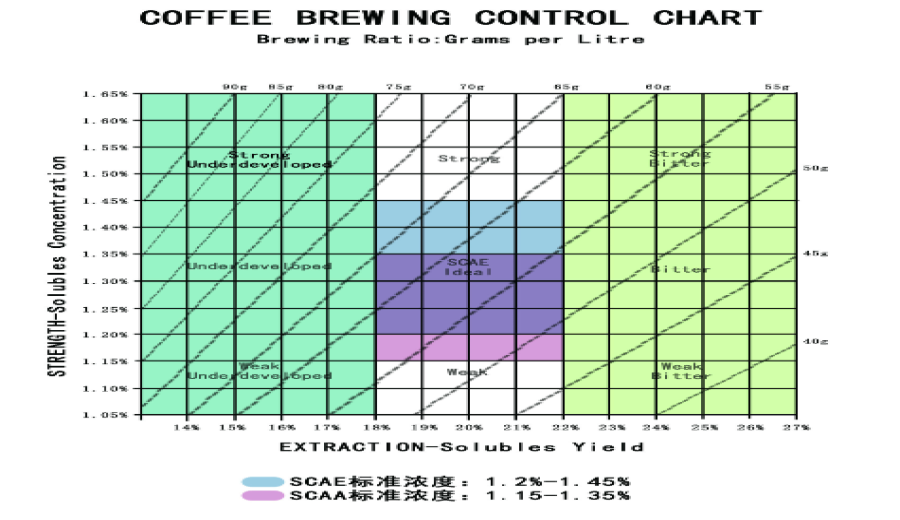
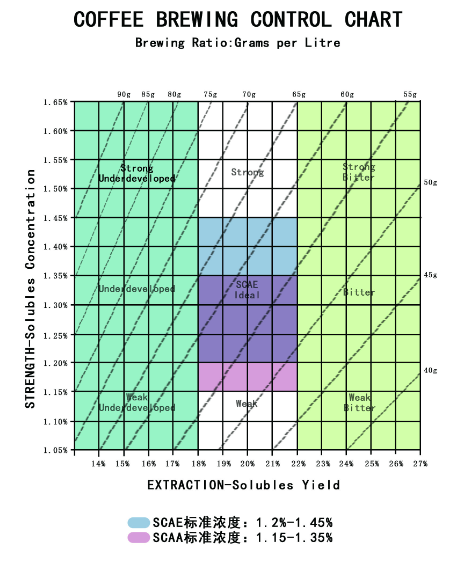
Currently, several major international specialty coffee organizations have slightly different recommended ranges for extraction yield and concentration, but they generally fall within similar intervals: the Specialty Coffee Association of America (SCAA) recommends an extraction yield of18%–22%, and a concentration of1.15%–1.35%; the Specialty Coffee Association of Europe (SCAE) has a slightly wider range, with a recommended concentration of1.2%–1.45%; the Norwegian Coffee Association (NCA) accepts a higher concentration, up to1.3%–1.55%; and even the Brazilian Coffee Industry Association (ABIC) sets an even higher concentration upper limit, up to2%–2.4%. But no matter which standard, the extraction yield basically remains within the18%–22%golden range. Going beyond or below this range can easily lead to flavor defects.
Concentrationrefers to the proportion of soluble coffee substances actually extracted into the coffee liquid relative to the total volume of the liquid, whileextraction yieldrefers to the proportion of soluble substances successfully extracted from the coffee beans used, relative to the original bean weight. Simply put, concentration relates to the 'intensity of flavor', while extraction yield affects the 'layers and quality of flavor'. An extraction yield below 18% usually leads to under-extraction, where the flavor may seem thin, sour, astringent, and lacking depth; while an extraction yield above 22% can easily bring about over-extracted bitterness, burnt notes, and a harsh mouthfeel. Similarly, a concentration below 1.15% may taste watery and lack personality; above 1.55%, it may become overly intense, masking the delicate aromas and layers of the coffee.
When it comes to the origins of the Golden Cup Extraction, we must go back to 1952. At that time, the National Coffee Association of America (NCA) commissioned Dr. Ernest Eral Lockhart, a chemistry PhD from the Massachusetts Institute of Technology, to establish the 'Coffee Brewing Institute'. The goal was to study how to improve the quality of filter coffee and promote the acceptance of Central and South American coffee in the American market. Dr. Lockhart led his team in in-depth research on the chemical components of coffee beans and discovered that only about28%–30%of the soluble substances in roasted beans could be extracted, with the rest mostly being indissoluble fibers. He was also the first scientist to translate coffee flavors into concrete data.
Between 1952 and 1960, the team conducted extensive surveys and experiments to study American consumers' preferences for coffee strength, and invited participants to taste coffee samples with different extraction yields and concentrations. The research showed that Americans generally preferred coffee with an extraction yield of17.5%–21.2%and a concentration of1.04%–1.39%, which became the prototype of the early 'Golden Cup Standard'. Later, after multiple validations and adjustments by authoritative institutions such as the Midwest Research Center, the values were revised to an extraction yield of18%–22%and a concentration of1.15%–1.35%, and it has since become one of the recognized standards in today's specialty coffee industry.
Understanding the calculation methods of concentration and extraction yield is the foundation for applying the Golden Cup Standard. The formula for concentration is:weight of extracted coffee substances (g) ÷ total volume of coffee liquid (ml), reflecting the concentration of flavor substances per unit volume. A value that is too low will taste weak and insipid, while one that is too high will be overly heavy.Extraction yieldis:weight of extracted coffee substances (g) ÷ weight of coffee grounds used (g), measuring the proportion of flavor substances successfully extracted from the coffee beans, affecting the overall balance and richness of the flavor. For example, using 15 grams of coffee grounds, with a brew ratio of 1:16, to yield 216ml of coffee liquid, if the measured concentration is 1.31%, then the weight of extracted substances is 2.8 grams (1.31% × 216ml), and the extraction yield is 2.8 ÷ 15 ≈ 18.6%. This data can help you determine whether this cup of coffee falls within the ideal range.
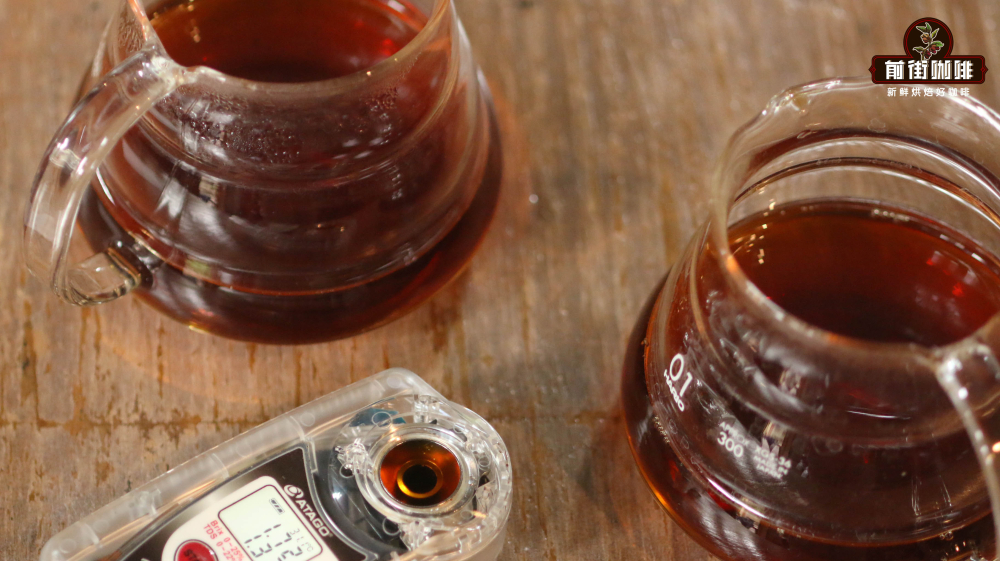
To accurately measure coffee concentration, in the past it required tedious drying and weighing processes, but now professional refractometers like ExtractMoJo can greatly simplify the process. By simply dropping a few drops of cooled coffee liquid into the instrument, it can quickly display the concentration value. If you don’t have a professional instrument, you can also use the traditional drying method to calculate: dry the brewed coffee grounds to the same dryness as the original beans, weigh them, and then use '(weight of coffee grounds before brewing – weight of dried grounds) ÷ weight of coffee grounds' to get the extraction yield, and 'weight of extracted substances ÷ volume of coffee liquid' to get the concentration. However, this method requires the coffee grounds to be completely dry and the weighing to be accurate, otherwise errors can easily occur.
For example, if using 15 grams of coffee grounds, with the dried grounds weighing 12.17 grams after brewing, a brew ratio of 1:16, and a coffee liquid volume of 216ml, the weight of extracted substances would be 15 - 12.17 = 2.83 grams, the extraction yield would be 2.83 ÷ 15 ≈ 18.8%, and the concentration would be 2.83 ÷ 216 ≈ 1.31%. This data can help you determine whether it meets the Golden Cup’s recommended extraction and concentration ranges.
Finally, we take an example of an Ethiopian Yirgacheffe Guji region natural-processed Huila 4.0, to illustrate how these data can be applied in a real pour over process. The brewing parameters are set as: 15 grams of coffee grounds, a brew ratio of 1:15, fine grind (80% passing through a #20 sieve), water temperature of 91°C, using a V60 filter. The brewing process is divided into three pours, totaling 225 grams of water, and takes about 2 minutes to complete the drip. After brewing, a refractometer measures the value at 1.45%, and through a simple formula, the estimated coffee liquid volume is about 195 grams, calculating the extraction yield as 1.45% × 195 ÷ 15 ≈ 18.85%. From this, we can see that this cup of coffee has a relatively high concentration but the extraction yield is still within the ideal range. You can further adjust the brew ratio or grind size based on personal taste preference, to find your own optimal balance point.
Although the Golden Cup Extraction Standard provides a scientific basis, flavor ultimately depends on personal preference and the characteristics of the coffee beans. It is recommended that everyone, after understanding the basic principles, experiment and taste more, in order to truly brew the perfect coffee with your own unique flavor profile.
The above content is compiled by CoffeeHunters, a coffee news website.


