








Introduction:To brew a pour over coffee with balanced flavors, the coffee-to-water ratio and extraction yield are key factors. This article delves into the golden standards of the SCA’s Golden Cup Theory — an extraction yield of 18%–22% and a concentration of 1.2%–1.45%. It explores the science behind the coffee-to-water ratio, clarifies common misconceptions, and teaches you how to flexibly adjust parameters to avoid under- or over-extraction, helping you find your own optimal flavor.
To brew a satisfying cup of pour over coffee, the coffee-to-water ratio and extraction yield are absolutely two core elements. The Golden Cup Extraction Theory proposed by the SCA (Specialty Coffee Association) clearly states that the ideal extraction yield should fall between 18% and 22%, while the coffee liquid concentration should be maintained within the range of 1.2% to 1.45%. This range is considered the "Golden Cup Extraction Range" that can deliver the best flavors. However, many coffee enthusiasts often mistakenly believe that simply applying the recommended Golden Cup coffee-to-water ratio will easily result in a great cup of coffee — this is actually a common misunderstanding.

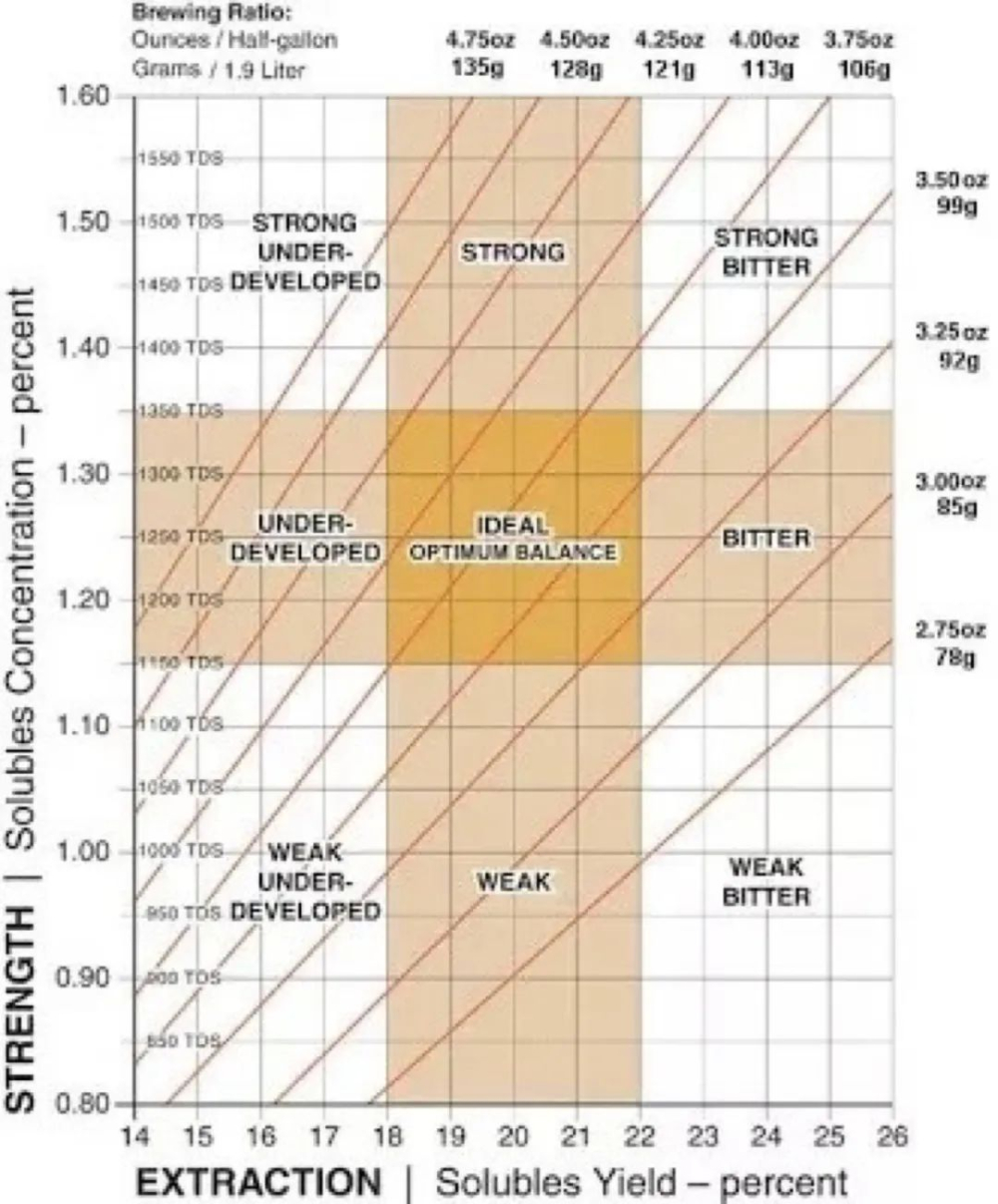
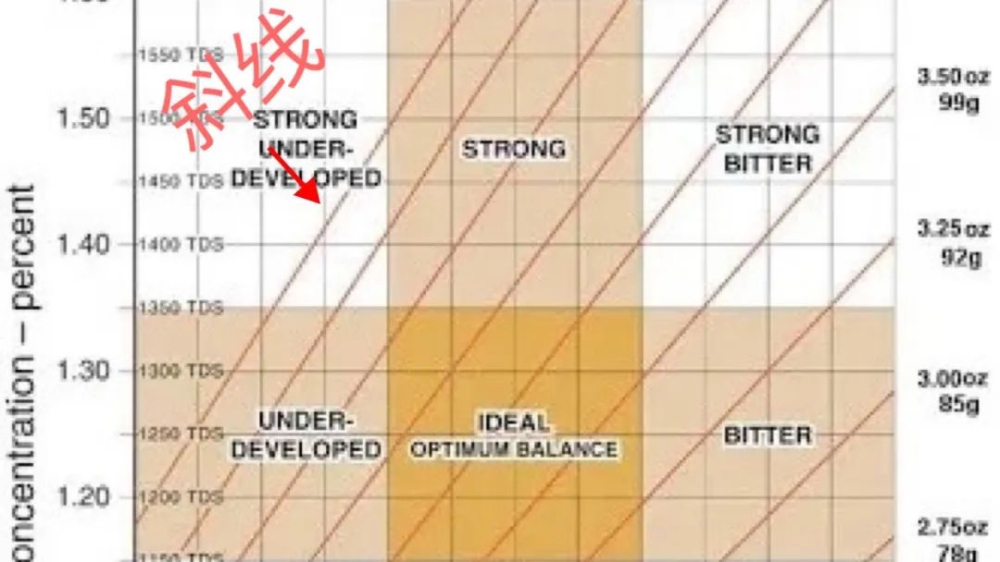
In fact, just by doing a simple calculation, you can more intuitively understand the concept of the coffee-to-water ratio. For example, if the total brewing water volume is 1900 milliliters and the amount of coffee grounds used is 135 grams, then 1900 divided by 135 results in approximately 14.07, which means the coffee-to-water ratio for those parameters is about 1:14.07. By the same token, when we observe the extraction curve chart, we’ll find that certain slope lines correspond to values that fall right within the dark area on the graph.

This dark area is precisely what the SCA’s Golden Cup Theory defines as the ideal extraction status range — also known as the “Golden Cup Extraction Zone”: with an extraction yield maintained between 18% and 22%, and a concentration within 1.2% to 1.45%. If the actual extraction yield or concentration of the brewed coffee falls outside this range, issues such as over- or under-extraction may occur, thereby affecting flavor performance.
However, there is one point that is very easy to misunderstand. Many people see a slope line on the chart falling within the Golden Cup range and assume that as long as they brew using that coffee-to-water ratio, they will definitely get a cup of coffee with an excellent flavor — a so-called “Golden Cup coffee.” But that’s not the case. Even if the coffee-to-water ratio falls within the Golden Cup range, it doesn’t guarantee that the final cup of coffee will necessarily taste good.
The coffee-to-water ratio lines in the Golden Cup extraction chart mostly serve as a “reference benchmark,” helping us understand that these parameters are more likely to result in an extraction that falls near the ideal zone. But it is not a cure-all, nor should it be treated as the only standard. What truly matters is understanding the principles behind the Golden Cup theory, and learning to adjust various variables according to actual conditions — such as grind size, water temperature, brewing time, and technique — in order to gradually approach the flavor profile you prefer.
In other words, the real value of studying the Golden Cup extraction theory lies not in memorizing a specific “golden ratio” of coffee-to-water, but in using this systematic set of reference indicators to help us more scientifically analyze and adjust the brewing process, thereby controlling extraction yield and concentration, avoiding common extraction mistakes, and ultimately brewing coffee with balanced flavors that match your personal taste preferences.

For example, if you find that the brewed coffee tastes too thin or lacks complexity, it may be a sign of under-extraction. In this case, you might consider grinding finer, extending the brewing time, or slightly increasing the water temperature to boost extraction yield. Conversely, if the coffee tastes overly bitter or has pronounced off-flavors, it may indicate over-extraction. In that case, it is recommended to use a coarser grind, shorten the brewing time, or lower the water temperature to avoid releasing undesirable compounds excessively.
In addition, many beginners often focus solely on the number of the coffee-to-water ratio while neglecting the interaction of other variables. For instance, with the same 1:15 coffee-to-water ratio, using an extremely fine grind versus an extremely coarse grind could lead to vastly different extraction results. Therefore, when adjusting parameters, it is advisable to change only one variable at a time, and record each brewing condition along with the corresponding flavor feedback, in order to gradually identify the brewing setup that suits you best.
In summary, the SCA Golden Cup Theory provides a scientific set of extraction reference standards to help us understand what kind of extraction yield and concentration can produce better coffee flavors. However, it does not intend for us to rigidly follow rules, but rather hopes that we can apply this knowledge to flexibly adjust brewing variables, avoid the pitfalls of under- or over-extraction, and ultimately brew the perfect cup of coffee in our own eyes. Remember, the best coffee-to-water ratio is always the one that makes you happy and brings out the flavors you enjoy.
The above content is compiled by CoffeeHunters, a coffee news website.


