







Introduction:The French press is the go-to brewing method for many coffee beginners and home users due to its simplicity, but improper grind size or wrong parameters often lead to unsatisfactory flavor. Taking the classic Huakui coffee beans as an example, this article delves into the historical background and structural principles of the French press, and provides a detailed explanation of the ideal coffee bean characteristics, optimal water temperature, coffee-to-water ratio, grind size, as well as practical brewing steps. By comparing it with pour over, it helps you master the key to a coarse grind—avoiding over-extraction bitterness or under-extraction—and brew a rich, balanced cup of coffee.
The French press (French Press), known for its intuitive operation and lack of complicated equipment, has become a practical tool for many coffee enthusiasts to brew at home. However, to make a cup of coffee with clear flavors and a smooth mouthfeel using it, selecting the right coffee beans and mastering the correct grind size are crucial. This article will use the classic "Huakui" coffee beans as an example to guide you through the historical evolution and basic principles of the French press, and provide an in-depth analysis of various brewing parameters including water temperature, coffee amount, coffee-to-water ratio, and grind fineness—so you can easily replicate a balanced and rich coffee flavor at home.
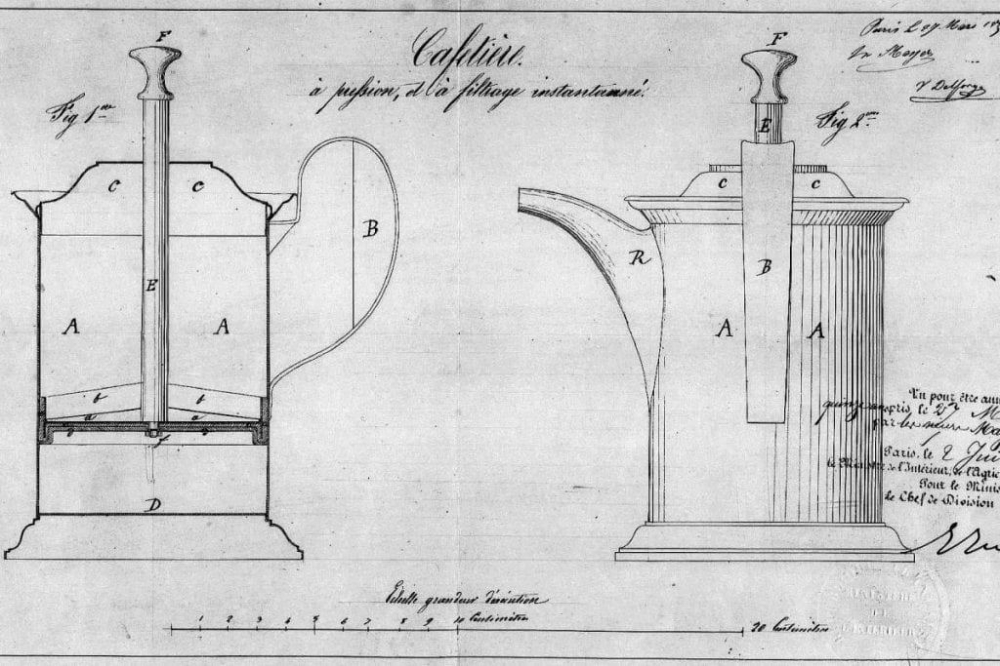
The prototype of the French press can be traced back to the mid-19th century, when a craftsman and merchant jointly applied for a patent for a "piston-type coffee filtering device." The device consisted of a metal canister and a movable plunger, with a filter structure at the bottom that separated coffee grounds from the liquid by manually pressing down, resulting in clearer-tasting coffee. Over time, especially in the late 20th century, a company in Milan, Italy further refined the design and registered the now-widely recognized French press patent, gradually establishing its classic status.
Interestingly, the French press was initially more commonly used for brewing tea rather than coffee. Since the extraction characteristics of tea leaves differ from those of coffee, the fineness of the filter also varies. For those who don’t want to invest in elaborate pour over equipment, or wish to quickly enjoy a cup of coffee with full flavor, the French press is indeed a convenient and practical choice. It especially preserves the coffee’s rich oils and body feel, delivering a richer taste compared to filtered methods.
Take the "Huakui" coffee beans as an example. These sun-dried beans, sourced from the Hambela region of Ethiopia's Guji zone, are meticulously processed by the Buku Abel washing station. In 2017, this batch of sun-dried beans participated in the TOH (Taste of Harvest) competition, winning the local sun-dried category championship for their intense strawberry cream notes. Later introduced to China by domestic importers, they were named "Huakui"—meaning "the queen of flowers"—due to their exceptionally outstanding flavors and promising post-processing potential. Between 2018 and 2022, successive versions such as Huakui 2.0 to 6.0 were released, continuously evolving each year and gaining immense popularity among coffee lovers.
Huakui coffee beans typically exhibit prominent berry, citrus, and tea-like flavor notes. The medium-light roast allows the delicate fruit acidity and layered complexity to shine. However, to recreate a similarly balanced flavor at home using a French press, the key lies in using a coarser grind and appropriate extraction parameters to avoid over-extraction that leads to bitterness, or a grind that’s too coarse causing under-extraction, resulting in a weak and sour cup.
In practice, it’s recommended to use the following parameters: water temperature around 90°C, 15 grams of coffee, with 225 grams of water, achieving a coffee-to-water ratio of 1:15. For grinding, a medium-coarse grind akin to approximately 70% passing through a Chinese standard No. 20 sieve—slightly coarser than typical pour over—is advised. This grind lengthens extraction time while preventing excessive release of bitter compounds from fine particles.
The specific steps are as follows: First, preheat the French press with hot water and discard it. Then add 15 grams of Huakui coffee grounds, followed by 225 grams of 90°C hot water. Stir gently to ensure even saturation, then pull up the plunger and cover with the lid. Let it steep for about 4 minutes. Once the time is up, slowly and steadily press the plunger down to about a quarter of the way, then pour out the coffee to enjoy. This method effectively controls extraction time and reduces the risk of over-extraction.
It’s worth noting that because the French press is an immersion brewing method where coffee grounds are in contact with hot water for a longer period, using too fine a grind significantly increases the likelihood of over-extraction, resulting in noticeable bitterness and astringency. Conversely, if the grind is too coarse, it may lead to under-extraction, making the flavor profile thin and overly acidic. Therefore,mastering the right level of coarseness is key to successful extraction with the French press..
Compared to pour over, the French press generally requires a coarser grind. Pour over often uses a medium-fine grind with about 80% passing through a No. 20 sieve, suited for short brew times and pulsed pouring to achieve a brighter, clearer flavor. The French press, on the other hand, extracts flavor through prolonged immersion, thus needing a coarser grind to balance extraction rate and achieve a rich, layered mouthfeel.
The above content is compiled by CoffeeHunters, a coffee news website.


