







Introduction:Kenyan coffee stands out in the global specialty coffee scene with its bright acidity, clear layers, and rich aftertaste—particularly the AATOP grade, which is considered the pinnacle by many coffee enthusiasts. This article delves into the cultivation background, regional characteristics, and official grading system of Kenyan coffee, while highlighting how the washed processing method shapes its unique flavor profile. Practical light roast pour-over recommendations are also provided, including filter choice, water temperature control, grind size judgment, and a three-stage pouring method, helping you easily replicate a Kenyan pour-over with notes of black plum, cherry tomato, and citrus.
Kenyan coffee has long been beloved in the global specialty market for its clean and bright taste, solid body, and pronounced acidity—especially the AATOP grade. Whether you’re a beginner exploring pour-over or an advanced enthusiast chasing nuanced flavors, understanding the regional background and processing techniques of Kenyan coffee will help you master key details at home, replicating a café-quality flavor profile.
Many beginners, after trying specialty coffee, are often amazed that coffee can have such captivating acidity and wonder: “Which coffee has the most distinct acidity?” Among specialty baristas, Kenyan coffee is often the top answer. Its clean and refreshing base, paired with a robust body and vibrant acidity, creates a highly recognizable flavor profile—and is a major reason why many fall for Kenyan coffee upon first try.
Kenya is located in East Africa, with the equator crossing its central region and the East African Rift Valley stretching from north to south. The country is predominantly highland terrain, with an average elevation of about 1,500 meters. Mount Kenya (also known as Mount Kirinyaga), Africa’s second-highest peak, rises to 5,199 meters and is capped with snow year-round. The high-altitude environment extends the ripening period of coffee cherries, aiding the accumulation of aromatic compounds within the beans, resulting in brighter acidity and harder beans that are well-suited for delicate processing and storage.
Kenya’s coffee cultivation history dates back to the late 19th century, when missionaries introduced Bourbon variety beans from Brazil. In 1895, Britain colonized Kenya, incorporating it into the "East Africa Protectorate" and taking full control of crops, including coffee. Between 1900 and 1933, the colonial government established the Coffee Board (CB) to oversee promotion, inspection, and management of coffee. The first coffee auction was held in 1935, and the Coffee Marketing Board (CMB) was formed in 1946 until its dissolution in 1971. Overall, Kenya’s coffee industry developed a relatively comprehensive and refined management system during the colonial period, laying a strong foundation for later quality grading.
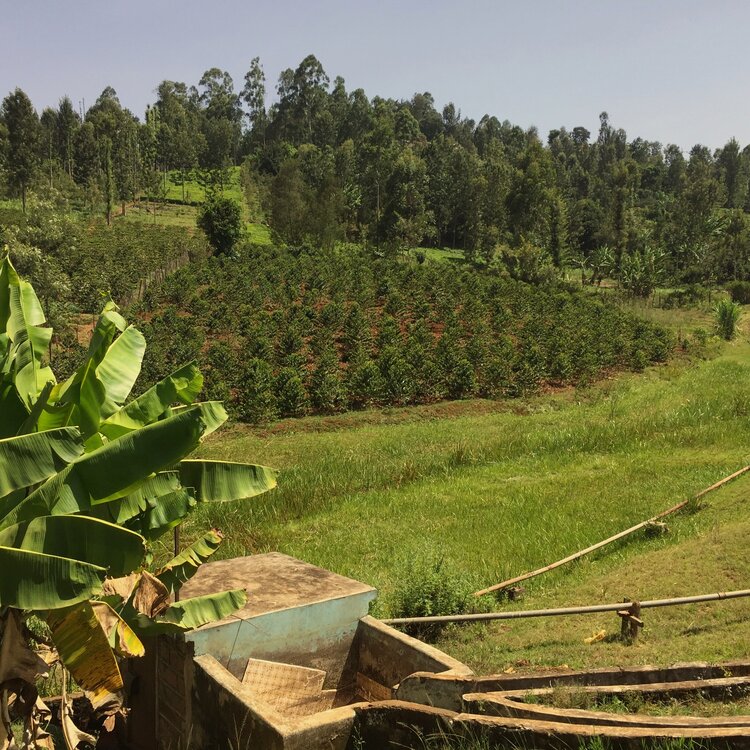
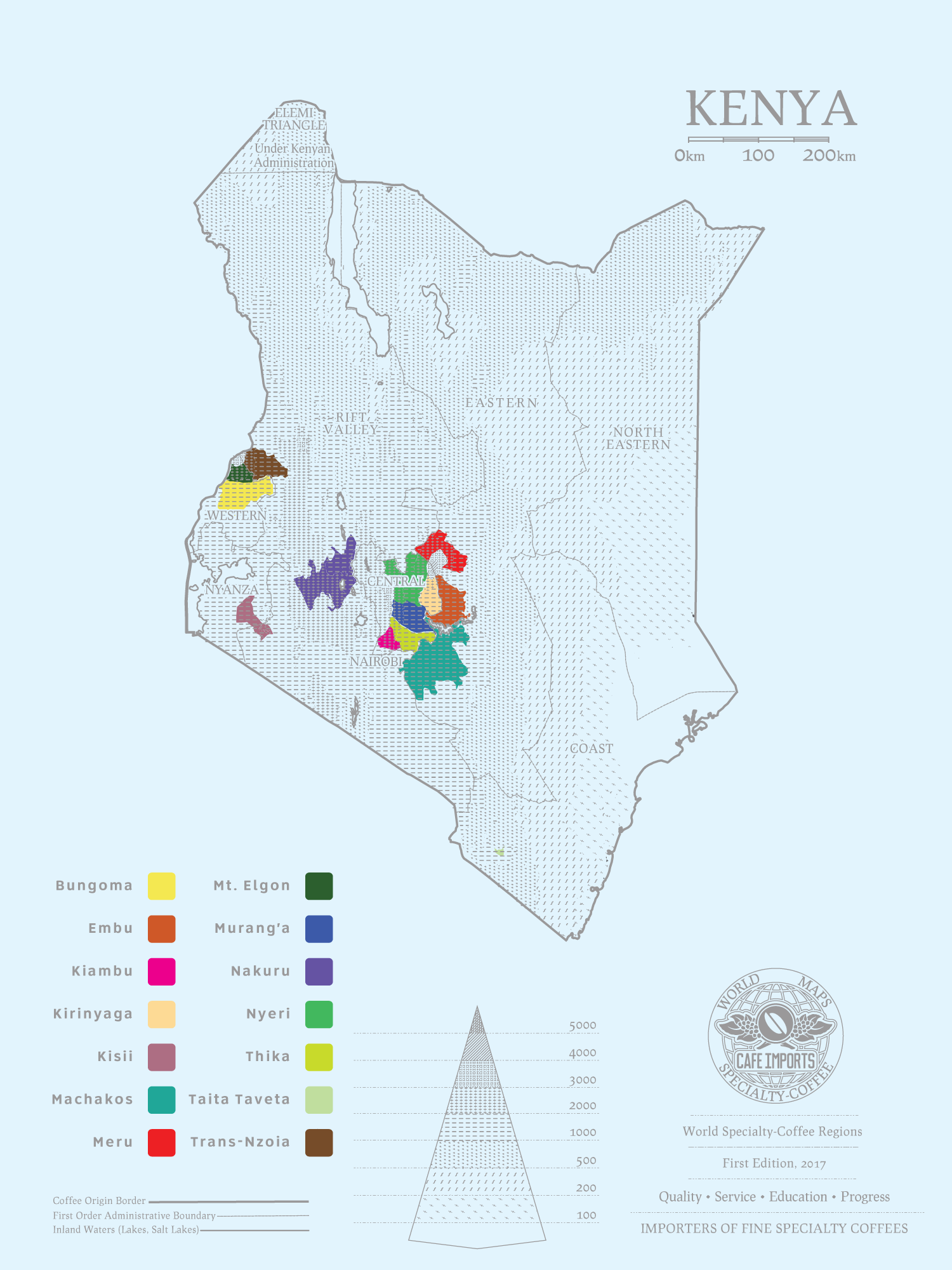
Kenya has ten major coffee-growing regions, including Nyeri, Murang’a, Kirinyaga, Embu, Meru, Kiambu, Machakos, Nakuru, and Kisii. These regions are mostly concentrated in volcanic soil areas at elevations of 1,600 to 2,100 meters, where the mineral-rich volcanic soil plays a crucial role in shaping coffee flavors.
Take Nyeri as an example: this region is home to Mount Kenya, an extinct volcano, with fertile red volcanic soil providing ideal conditions for coffee growth. The area is dominated by smallholder cooperatives, with elevations ranging from 1,200 to 2,300 meters. Murang’a was one of the first areas settled by missionaries and has numerous smallholder farms, with planting elevations around 1,350 to 1,940 meters. Neighboring Kirinyaga, like Nyeri, is also known for its volcanic soil, with smallholder production as the norm and elevations between 1,300 and 1,900 meters. Regions like Embu and Meru are mostly operated by small family farms, with limited output but stable quality, planted at elevations of roughly 1,300 to 1,950 meters.
Although Kiambu has large estates, their numbers have gradually declined due to urbanization, with many products sold under sub-region names like Thika, Ruiru, and Limuru, at elevations between 1,500 and 2,200 meters. Machakos, Nakuru, and Kisii each have their own characteristics: Nakuru has the highest-altitude planting zones in the central region but faces challenges like coffee berry disease due to the high elevation. Kisii, near Lake Victoria, is dominated by small cooperatives, with elevations between 1,450 and 1,800 meters.
Kenya’s coffee grading system is a standout feature of its quality management. Beans are graded based on size, shape, and weight, primarily categorized as E (Elephant bean, over 18 mesh), AA (17–18 mesh), AB (15–16 mesh, a mix of A and B grades), PB (peaberry, about 10% of yield), TT (light beans screened from AA and AB via air classification), C, T, and HE grades. Among these, AA and AB are the most commonly exported grades, with AA often regarded as the hallmark of specialty coffee.
Additionally, ungraded green beans that don’t meet official standards are classified as UG (Ungraded), further divided into UG1 (E, AA, AB, PB) and UG2 (C, TT, T, HE). MBUNI refers to sun-dried green beans, split into MH (heavy beans, flawless, exhibiting typical sun-dried flavors) and ML (light beans, may have minor defects but no serious off-flavors).
Notably, in addition to the official grading, some exporters further classify AA and AB grades with labels like TOP, PLUS (+), and FAQ—though unofficial, these carry reference value in the international market.
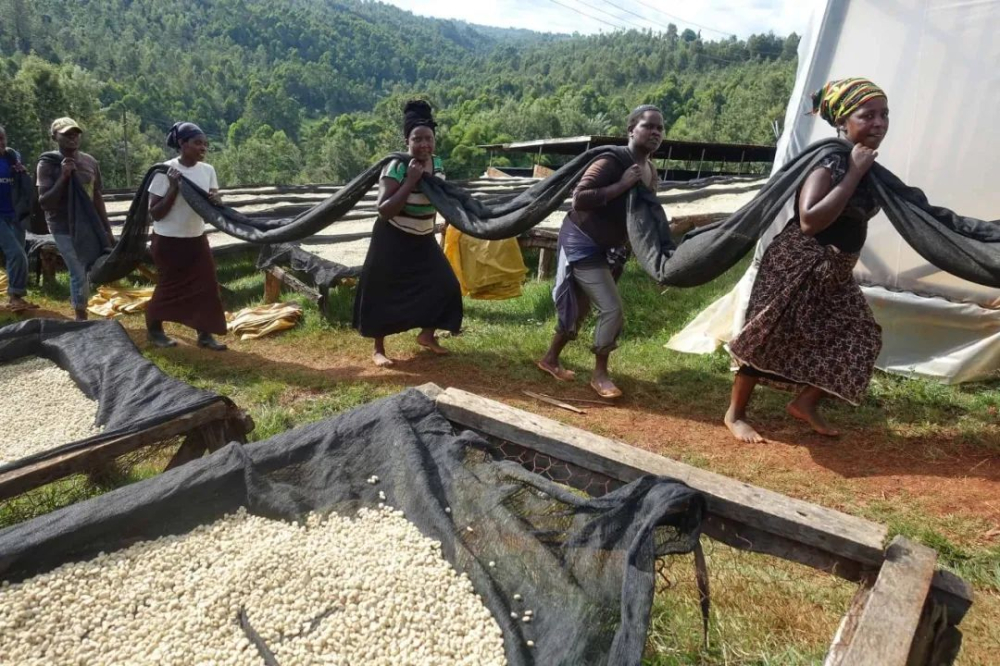
The distinctive flavor profile of Kenyan coffee hinges on its unique processing method. While washed fermentation for Central and South American beans typically lasts under 36 hours, Kenya employs a 72-hour fermentation process. After 30 to 48 hours, the parchment beans are washed but then undergo an additional 24-hour soaking in clean water. This extra fermentation and soaking step is believed to be key to the clean, bright acidity and clear flavor profile of Kenya AA coffee.
In terms of actual tasting, take the popular Kenyan Assaliya as an example—beans from the Asali factory in the Thika region, using SL28 and SL34 varieties, processed via K72 washed method, and grown at 1,550 to 1,750 meters. Flavor notes often include black plum, cherry tomato, pear, brown sugar, and plum, with balanced acidity and sweetness, a tea-like aftertaste, and is considered a classic among many pour-over enthusiasts.
To replicate similar flavors at home via pour-over, pay attention to the following key parameters: For filter choice, prioritize designs with smooth flow, such as the V60. Its spiral ridges help release gas from the coffee bed, accelerating water flow and preventing fine particles from clogging the bottom, which could otherwise dull overall clarity and acidity.
For water temperature, aim for 90–93°C. If you prefer brighter acidity and a tea-like aftertaste, go for 90–91°C; to enhance the richness of fruit acidity and body, increase to 92–93°C. Grind size directly affects extraction time—adjust based on total brew time (ideally around 1:40 to 2:20) and actual flavor. Under-extraction may result in sour, thin tastes, while over-extraction can bring bitterness and heaviness.
For coffee-to-water ratio, 1:15 to 1:16 are common ranges. For a bold berry and oolong tea profile, choose 1:15; to highlight bright floral and citrus acidity, 1:16 allows the flavors to open up more.
For practical brewing, use a three-stage pour: First, pour 30g of water and bloom for 30 seconds to activate the coffee grounds; second, pour 95g with slightly more flow to lift the coffee bed and promote even extraction; finally, pour 100g with a finer stream to control the tail end and avoid over-releasing impurities. Total water volume is about 225g, with dripping time around 2 minutes—to craft a Kenyan pour-over with clear flavors and balanced acidity-sweetness.
The above content is compiled by CoffeeHunters, a coffee news website.


