








Introduction:As an important coffee-producing region in China, Yunnan’s small-bean Arabica has garnered significant attention in recent years. But when faced with varieties like Typica and Catimor on the market, do you know their flavor profiles and historical backgrounds? This article takes you deep into the three major development stages of Yunnan coffee, the characteristics of its mainstream varieties, and shares the practice of growing natural-process Typica in Lincang, providing detailed pour over parameters and flavor evaluations to help you find the Yunnan coffee beans that suit you best.
Yunnan coffee has sparked a wave of enthusiasm domestically in recent years, with more and more consumers actively asking if there are beans from the Yunnan region when ordering at cafes. What exactly is the charm of Yunnan coffee? In fact, it’s not just about the origin story—it also involves the interplay of variety evolution, climatic conditions, and market demand. This article will explore the full picture of Yunnan’s small-bean coffee from aspects such as growing environment, historical context, and variety characteristics.

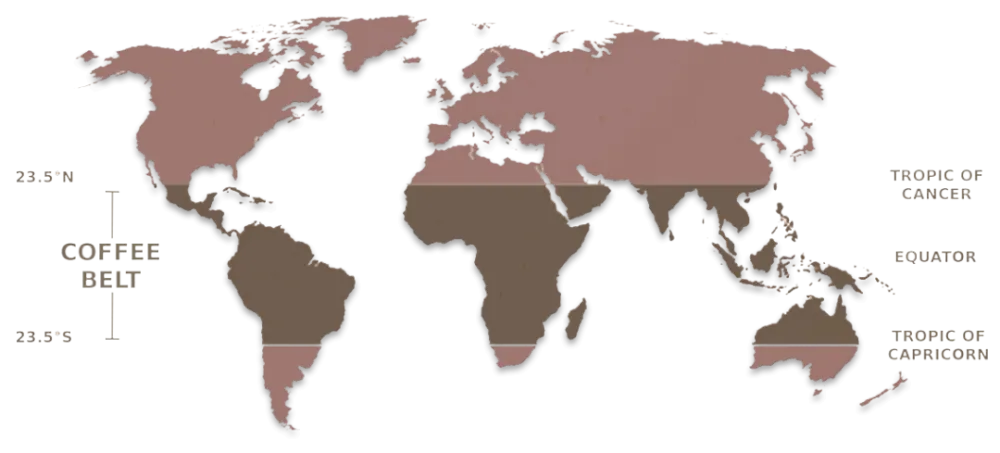
When talking about Yunnan coffee, we must start with its geographical conditions. The world’s major coffee-producing regions are mostly concentrated between the Tropic of Cancer and the Tropic of Capricorn, commonly known as the “coffee belt.” Within China, the regions that meet both this latitude range and suitable altitude are, first and foremost, Yunnan and Taiwan. However, coffee was not a traditional crop in Chinese dietary culture and was initially introduced as a cash crop. According to historical records, as early as 1877, Ding Richang, the governor of Fujian, proposed in his “Post-Suppression Regulations for Indigenous Peoples and Mountain Development” to encourage the cultivation of various cash crops, including coffee. The earliest region on the Chinese mainland to systematically cultivate coffee was indeed Yunnan.
According to the “Binchuan County Annals” and the “History of Catholicism in Yunnan,” in the 30th year of the Guangxu reign (1904), French Catholic missionary Térence Desflèches was sent to Zhukula Village in Binchuan Prefecture. While building a church, he personally planted the first coffee tree. These coffee trees were mainly for personal consumption but also marked the starting point of Yunnan coffee. The subsequent history of coffee cultivation can be roughly divided into three important stages.
The first wave of coffee planting enthusiasm emerged in the 1950s and 1960s. At that time, most people were still quite unfamiliar with coffee, and the main purpose of planting was export, targeting the Soviet Union to repay loans. The planting was managed by the Yunnan State Farm system, with varieties mainly consisting of locally propagated Typica and a few Bourbon variants. Planting bases included state farms such as Longjiang in Baoshan, Xincheng Youth Farm, Zhefang in Dehong, Ruili, Wanding, Babu and Tianbao in Wenshan. However, as the loan repayment period ended and coffee diseases ravaged the crops, leading to the death of many plants, numerous farms were forced to cut down infected trees, and the planting area once shrank drastically to less than 3,000 acres.
The second wave of development began after the reform and opening up in the 1980s. In 1988, the international coffee brand Nestlé entered Yunnan, revitalizing the local coffee industry and promoting the Catimor variety, which is disease-resistant and high-yielding. This hybrid, developed by Portugal’s CIFC in 1959, is a descendant of Timor and Caturra, with Robusta genes, thus offering stronger resistance to leaf rust, berry disease, and certain pests, with a yield per unit nearly three times that of Typica. For farmers, high yield and disease resistance were more practical considerations, so Catimor gradually replaced Typica and became the mainstay of Yunnan coffee, once accounting for up to 90% of total production.
The third wave of coffee then unfolded after 2000, alongside China’s economic rise. With the popularization of specialty coffee concepts, consumers’ demands for flavor and quality increased, and Yunnan producers also began focusing on improving variety selection, processing, and roasting techniques. To this day, the specialty transformation of Yunnan coffee is steadily progressing, and market interest in its potential continues to grow.
Speaking of the origin of the name “Yunnan small-bean coffee,” it actually stems from the early introduction of the Typica variety. Compared to the medium-bean Robusta grown in places like Hainan, Typica beans are smaller in size, hence the name “small-bean.” However, due to Catimor’s high-yield characteristics, many growers switched to this variety, so today’s “Yunnan small-bean coffee” often refers to Catimor. If you want to experience the foundational regional flavors of Yunnan coffee, you can try a washed-process, medium-roast Yunnan small-bean bean, which often presents warm notes of chocolate, brown sugar, and nuts.
Although Catimor has advantages in yield and disease resistance, the Robusta genes in its genetic makeup may also bring negative flavors, such as earthy or musty notes, which some experts liken to a “devilish aftertaste.” However, with advancements in processing techniques and improved agronomic management, the flavor profile of Catimor in the Yunnan region is gradually improving and remains worthy of continued attention.
To explore the unique expression of Yunnan’s terroir, the industry established its own estate in Lincang, focusing on the cultivation and processing of the Typica variety. Lincang is located in the southwest of Yunnan, with the Tropic of Cancer passing through its southern area. It neighbors Pu’er, Dali, and Baoshan, and borders Myanmar, making it a green jewel in the border region. The region generally has altitudes exceeding 1,000 meters, an average annual temperature of around 17°C, distinct dry and wet seasons, and abundant sunshine, providing an ideal growing environment for Typica.
The Lincang estate uses the natural (sun-dried) processing method, evenly spreading ripe coffee cherries on raised beds and turning them daily to ensure even drying and avoid off-flavors. This method preserves the sugars from the fruit pulp as they penetrate the seeds, imparting richer aroma and sweetness to the coffee, showcasing the essential flavors of Yunnan specialty coffee.
For this natural-process Typica, the roaster chose a medium roast to balance aroma, sweetness, and taste layers while retaining the classic characteristics of small-bean coffee. Below are the tested pour over recommendations, suitable for home brewers:
Brewing device:Hario V60
Water temperature:87°C
Coffee dose:15 grams
Coffee-to-water ratio:1:15
Grind size:75% passing rate through a Chinese Standard No. 20 sieve (medium-coarse to slightly fine)
Resting period:Recommended to rest for 4–7 days after arrival to allow CO₂ release
Bloom:Pour 30 grams of hot water, bloom for 30 seconds
First pour:Slowly circle from the center, pouring up to 125 grams
Second pour:When the water level drops to just about to expose the coffee bed, continue pouring up to 225 grams
Total brew time:Approximately 2 minutes

This 2013 natural-process Typica, when brewed using pour over, exhibits a full body with a well-balanced acidity and sweetness, featuring bright notes of citrus and berries, accompanied by hints of fermented wine-like aroma and caramel sweetness. The aftertaste is creamy and smooth, with lingering notes of light black tea, making it an excellent choice for experiencing the terroir characteristics of Yunnan coffee.
The above content is compiled by CoffeeHunters, a coffee news website.


