







Introduction:The Geisha coffee from Panama's Hacienda Esmeralda is hailed as a legend in the specialty coffee world. Its unique floral and fruity aromas, along with its clear and layered flavor profile, have captivated coffee enthusiasts worldwide. However, the Esmeralda Geisha commonly found on the market is often categorized into Red Label and Green Label grades, which differ significantly in terms of cultivation altitude, processing methods, and flavor characteristics. This article will delve into the origins of Geisha, how Hacienda Esmeralda has shaped its classic flavor, compare the differences between the Red and Green Labels, and provide professional pour over recommendations and extraction parameters to help you discover your own Geisha flavor.
When it comes to specialty pour over coffee, the name "Geisha" is almost a must-have on any tasting list. Whether at coffee exhibitions, competitions, or everyday brewing, Geisha has become a symbol of high-end coffee thanks to its distinctive floral notes, fruity tones, and clean mouthfeel. However, to truly experience the classic Geisha flavor, one cannot overlook its birthplace—Panama’s Hacienda Esmeralda.
Hacienda Esmeralda is located in the Boquete region of western Panama, situated in a high-altitude mountainous area with a typical tropical maritime climate. The region features significant day-night temperature variations, mineral-rich volcanic soil, and a perpetually misty environment, providing nearly perfect growing conditions for coffee trees.
In fact, the Geisha variety did not originate in Panama but was introduced from Ethiopia. Initially, due to its low yield and unremarkable flavor, it was not widely cultivated. It wasn’t until the 1960s that American banker Rudolph A. Peterson retired and moved to Panama, purchasing Hacienda Esmeralda—which was then primarily a dairy farm—and began expanding coffee cultivation in the 1970s. By the 1990s, some coffee trees on the estate were affected by leaf rust, but the Geisha variety demonstrated stronger resistance, prompting the farm to gradually relocate it to higher altitudes.
The turning point came in 2003 when the farm unexpectedly discovered through cupping that Geisha exhibited intense floral aromas, citrus and bergamot notes, and an exceptionally clean taste. This discovery completely changed the fate of Geisha. The following year, Hacienda Esmeralda entered Geisha into the Best of Panama (BOP) competition, not only winning first place but also claiming the title for several consecutive years, propelling Geisha onto the international specialty coffee stage.
Hacienda Esmeralda was also the first farm in the world to systematically grade Geisha. Based on altitude, microclimate, processing methods, and cupping results, the farm divided Geisha into different grades and batches, the most famous being the Red Label and Green Label. These labels not only represent quality but also directly influence flavor profiles and market value.
The Geisha plantations of Hacienda Esmeralda are mainly concentrated in three key areas: Cañas Verdes, Jaramillo, and El Velo. Among these, Jaramillo is regarded as the birthplace of Geisha, with an average altitude exceeding 1650 meters. Its cool, foggy environment fosters highly distinctive floral and fruity aromas. This area is further divided into multiple micro-lots, such as Mario, Bosque, and Reina. Geisha from these sub-lots often performs exceptionally well in competitions and serves as the primary source for Red Label batches.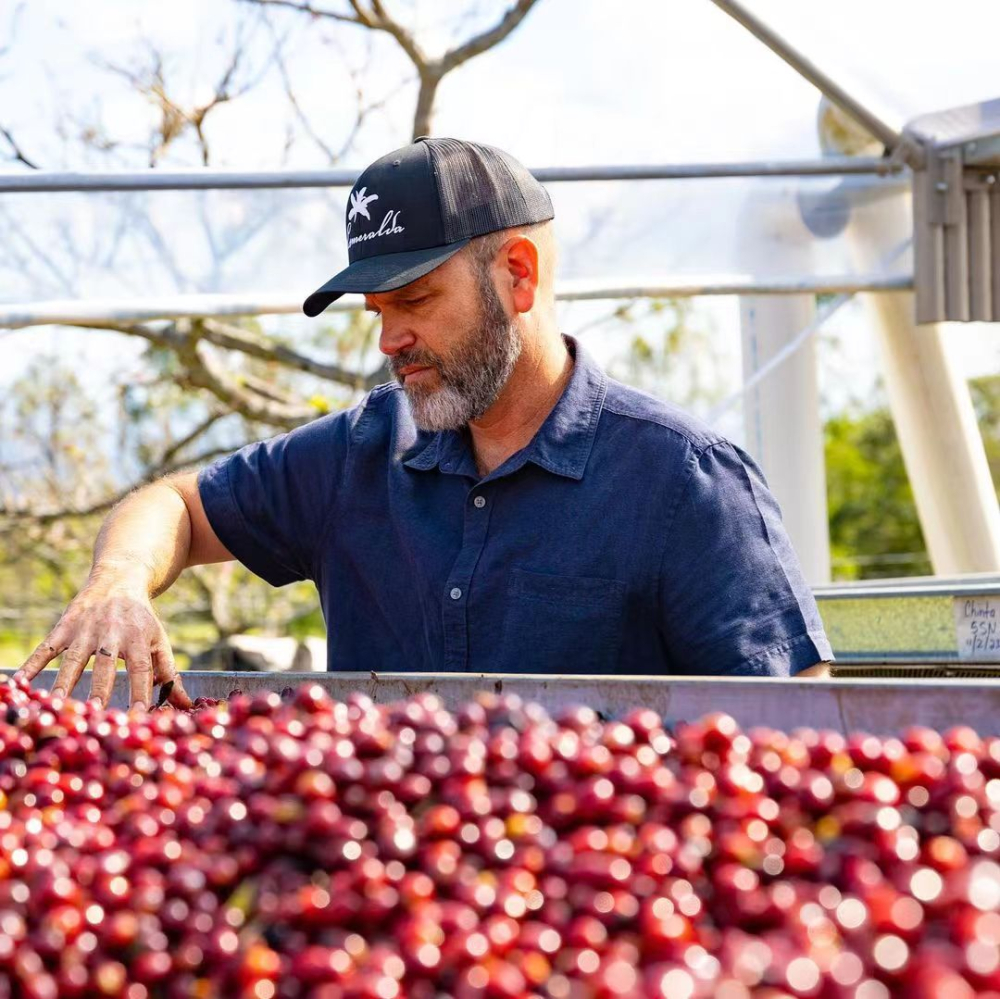
The so-called Red Label Geisha belongs to the ESMERALDA SPECIAL grade, typically reserved for auction-only batches with cupping scores of 90 or above. These beans are grown at altitudes between 1600 and 1800 meters in the Jaramillo and Cañas Verdes regions. They are not only rare but also consistently fetch record-breaking auction prices. Red Label Geisha is mostly processed using the natural (sun-dried) method, allowing the coffee cherries to slowly dry in the sun, fully preserving the fruity sweetness and aromatic compounds from the pulp. This results in rich flavors of tropical fruits, berries, and flowers, a velvety mouthfeel akin to cream, and a long-lasting finish.
The key to natural processing lies in controlling the drying time and environment. Hacienda Esmeralda typically spreads the harvested coffee cherries evenly on concrete patios, turning them daily and protecting them from rain. They undergo 3–5 days of sun drying (about 8 hours per day) before being moved to a dryer for the final stabilization phase, taking approximately two weeks in total. This process imparts Red Label Geisha with rich fermented aromas and fruity acidity and sweetness, making it a "dream coffee" for many enthusiasts.
In contrast, Green Label Geisha falls under the PRIVATE COLLECTION grade. Although it does not participate in auctions, it is still sourced from the same high-altitude regions. The main difference is that it does not specify individual plots and is not part of competition batches. Green Label is mostly washed processed, emphasizing a fresh and clean profile. Common flavors include lemon, grapefruit, berries, and a light tea-like note, reminiscent of Tieguanyin’s aftertaste, making it ideal for those who prefer a crisp taste.
The steps of washed processing include: first removing the outer skin and pulp of the coffee cherry, then fermenting the mucilage-covered seeds in water for about 24 hours, followed by rinsing with clean water to remove residual fruit mucilage, and finally drying the parchment-covered green beans either naturally or mechanically to a moisture content of around 12% before removing the parchment. This method preserves bright and clear acidity while enhancing overall flavor stability and complexity.
In terms of brewing recommendations, since Geisha is typically a high-altitude hard bean with high density and abundant flavor compounds, a medium-light roast is recommended to highlight its floral and fruity characteristics. For pour over, a slightly higher water temperature of 92–93°C can help release more aromatic compounds. Baristas recommend using the pulse pouring method: first, place the ground coffee in the filter, pour 30 grams of hot water for a 30-second bloom; then pour 95 grams of water, wait for it to drip, followed by another 100 grams, keeping the total extraction time around 2 minutes, with adjustments as needed.
In actual tasting, Red Label Geisha usually showcases intense floral notes such as rose and jasmine, with distinct tropical fruit flavors like mango and passion fruit upon entry. It has a rich and layered mouthfeel. In contrast, Green Label Geisha offers a cleaner flavor profile, dominated by lemon and berry notes, with a subtle tea-like finish, making it suitable for consumers who prefer a refreshing taste.
In summary, the reason why Geisha coffee from Hacienda Esmeralda in Panama has become a benchmark for specialty coffee lies not only in its exceptional growing environment but also in its rigorous grading system and diverse processing methods. Whether you prefer the rich and complex flavors of the sun-dried Red Label or the bright and clean profile of the washed Green Label, you can find your own coffee experience within this classic bean variety.
The above content is compiled by CoffeeHunters, a coffee news website.


