







Introduction:Jamaican Blue Mountain coffee is hailed as one of the world’s top-tier coffees, but its wide range in pricing and quality often puzzles consumers. This article delves into the growing environment of Blue Mountain coffee, its three official grading standards, the historical reasons behind its high prices, and offers pour over brewing recommendations along with methods to identify authentic beans. It also introduces the differences between the washed and natural versions from the Clifton Estate, helping you fully understand this legendary coffee.
What exactly makes Blue Mountain coffee so special? Why do some shops offer it at reasonable prices while others charge astronomical rates? To uncover the truth about Blue Mountain coffee, we must explore everything from its origin and grade, to varietal traits, historical pricing background, and proper brewing methods. This piece not only systematically breaks down the core knowledge of Jamaican Blue Mountain coffee, but also teaches you how to identify genuine products through wooden barrel packaging and official export documents. It further details the differences between the washed and natural processing methods at the Clifton Estate, and concludes with practical pour over suggestions and parameters to help you brew a cup that approaches professional-grade Blue Mountain flavor.
 Many coffee enthusiasts share this question: “Blue Mountain coffee sounds premium, but prices vary wildly—some shops sell it at moderate prices, while others charge a fortune. How can you tell if it’s real?” To answer this, we need to start with the definition of Blue Mountain coffee.
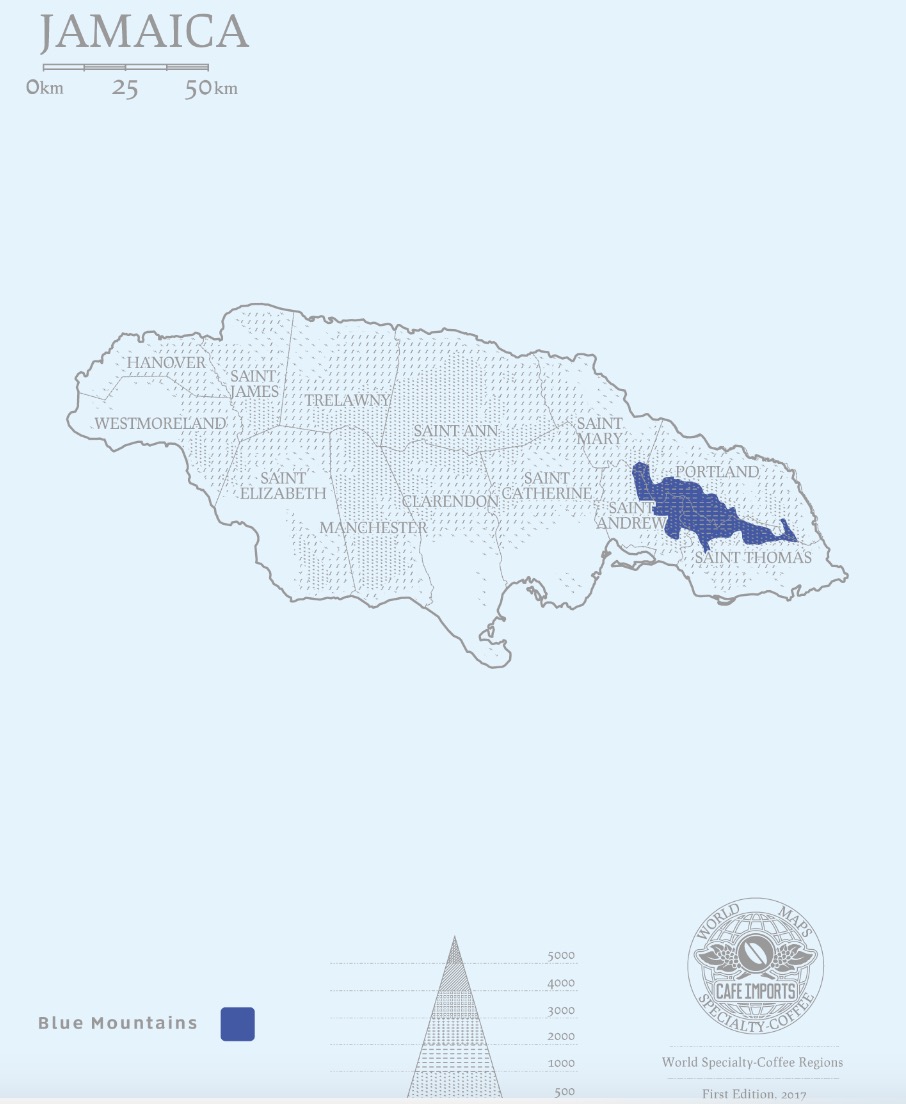
So-called “Blue Mountain coffee” isn’t just any high-altitude-grown coffee. The name is subject to extremely strict geographical limitations—only coffee grown within specific altitude ranges of the Blue Mountain range in Jamaica qualifies for this designation. The Blue Mountains are located in eastern Jamaica, the country’s highest region, with its main peak reaching approximately 2,256 meters. However, the area truly suitable for coffee cultivation is limited to elevations between 1,000 and 1,700 meters, spanning the four administrative parishes of Saint Andrew, Saint Thomas, Portland, and Saint Mary. Areas above 1,700 meters are designated as protected zones where cash crops are entirely prohibited.
Coffee grown between altitudes of 460 to 910 meters can only be referred to as “Jamaican High Mountain Coffee,” while those grown below 460 meters can only be called “Jamaican Prime Coffee.” None of these may bear the “Blue Mountain” name.
But even if coffee is grown within the designated Blue Mountain region, it doesn’t automatically mean it’s the top-tier “Blue Mountain No. 1.” Based on rigorous criteria such as bean size and defect rate, Blue Mountain coffee is divided into three grades: Blue Mountain No. 1, Blue Mountain No. 2, and Blue Mountain No. 3. Among them,Blue Mountain No. 1 requires 96% of the coffee cherries to be sized at 17 mesh or above, with a post-roast defect rate not exceeding 2%.Blue Mountain No. 2 requires cherries to be 16 mesh or above, also with a defect rate within 2%; Blue Mountain No. 3 requires 15 mesh or above, with the same defect standard.Blue Mountain Peaberry also has its own independent standard, requiring 96% of the beans to be 10 mesh or above, with a defect rate also not exceeding 2%..
So, how can the average consumer ensure they’re buying genuine Blue Mountain coffee? The vast majority of Blue Mountain coffee entering the Chinese market is Blue Mountain No. 1, and all of it is shipped in traditional wooden barrels. It’s worth noting thatJamaica is the only coffee-producing region in the world that still exports coffee beans in wooden barrels.Therefore, the wooden barrel itself is one important clue for identifying authenticity. In addition, all coffee beans meeting Blue Mountain standards must carry an official export certification issued by the Jamaica Coffee Industry Board—this certificate is another key proof of authenticity.
 The coffee variety planted for Blue Mountain is Typica, one of the oldest Arabica varieties, known for its clean, delicate, and layered flavors. This variety was first introduced to Jamaica from Martinique in the 1720s and developed unique flavor characteristics in the Blue Mountains’ distinctive microclimate and volcanic soil. Its long cultivation history has also enabled the Blue Mountain Typica variety to evolve stronger disease resistance, especially against berry diseases, surpassing ordinary Typica. Coupled with the warm, rainy climate and significant day-night temperature variations in the Blue Mountain region, the high altitude imparts a distinct sweetness and subtle aroma to the beans. The balance of acidity, sweetness, and bitterness is excellent, with a rich mouthfeel and a long-lasting aftertaste, making it a prized coffee among enthusiasts worldwide.
Is Blue Mountain No. 1 the most expensive coffee bean? The answer isn’t absolute. With an annual production of only around 600 to 1,000 tons, Blue Mountain coffee is rare. Furthermore, after being severely damaged by a hurricane in 1969, it was revived with funding from Japanese companies. Consequently, in 1972, Jamaica and Japan signed an agreement allowing Japan to purchase 90% of the yield—a factor that made it difficult for other regions to access and drove up prices. However, starting in 2012, Jamaica canceled Japan’s priority purchase right, and Blue Mountain No. 1 gradually became available in other markets. While prices remain relatively high, they are no longer the most expensive. For instance, Panamanian Geisha coffee can cost upwards of 40,000 yuan per pound, far exceeding Blue Mountain.
If you’re looking to purchase genuine Blue Mountain No. 1, consider products from the Clifton Estate—the largest and oldest coffee estate on the Blue Mountain range, grown at around 1,310 meters elevation, and the only one in Jamaica with Rainforest Alliance certification. Its wooden barrels clearly display the certification logo. Before 2020, the Clifton Estate only offered washed-process Blue Mountain No. 1, but in that year, it debuted its first natural-process batch, which also delivered outstanding flavor. Washed Blue Mountain has a crisper profile, with clear balance among acidity, sweetness, and bitterness, while the natural version features a richer berry character and brighter acidity—though due to limited market feedback, no natural batches have been released since 2022.
Regarding roasting, to preserve the balanced and full-bodied acidity, sweetness, and bitterness of Blue Mountain coffee, a medium-dark roast is recommended. Freshly roasted beans usually exhibit their best flavors 5 to 6 days after roasting; it’s advised to let them rest briefly before brewing.
As for pour over parameters, it’s recommended to use a Kono filter. Water temperature should be controlled at88°C, with a1:15powder-to-water ratio,using 15 grams of coffee groundsas the base, and a grind size suggested at70–75% passing through a 20-mesh sieve.The specific steps are: begin with a 30-second bloom using 30 grams of water, then pour up to 125 grams of water. When the water level drops halfway, add the remaining 90 grams to reach a total of 225 grams. The total extraction time is approximately 2 minutes and 10 seconds. These parameters help fully extract the delicate flavor layers of Blue Mountain coffee at a lower water temperature.
In terms of flavor, washed-process Blue Mountain No. 1 typically exhibits rich notes of dark chocolate and nuts, with a creamy-smooth mouthfeel and well-balanced acidity, sweetness, and bitterness—making it a classic flavor favored by many coffee connoisseurs.
The above content is compiled by CoffeeHunters, a coffee news website.


