







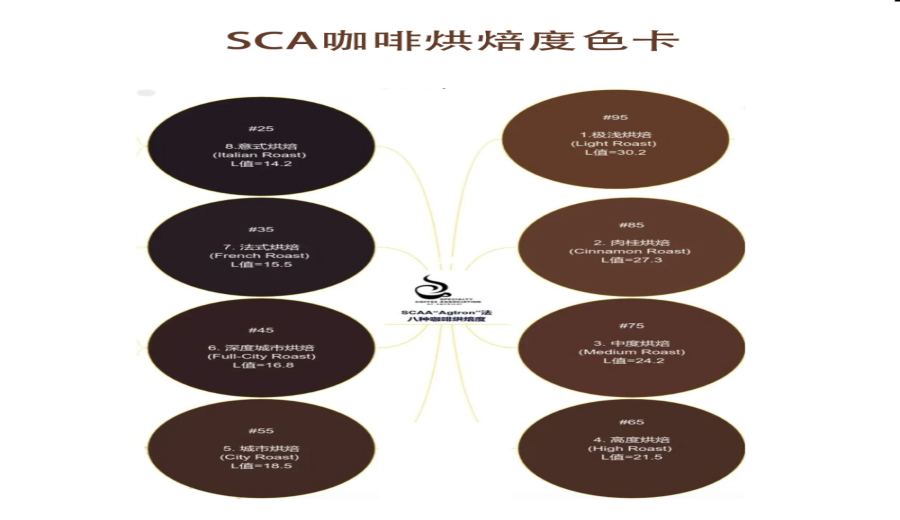
Introduction:Understand the eight roast levels of the SCA color chart, grasp the color value changes, flavor development, and practical roast parameters from very light to very dark roasts, helping you control the roast curve more precisely. This article details each stage’s bean color, weight loss ratio, typical flavor characteristics, and suitable applications, and provides key points for identifying green bean defects—enabling you to make better pour over or espresso coffee from bean selection to roasting.
Coffee roasting not only affects the color of the beans but also directly determines the final flavor profile. The SCA (Specialty Coffee Association) has established eight standard roast levels, each with a clear color value range and corresponding sensory characteristics. From very light roast to very dark roast, each stage can be understood by observing the bean surface color and understanding the weight loss ratio to grasp the direction of its flavor development.
This color chart is not only a reference for professional roasters but also an important tool for coffee enthusiasts to adjust their own roasting or select beans. Below, we will delve into the specific characteristics of each roast level—from bean surface color, weight loss rate, acid-sweet balance to suitable brewing methods—to help you understand the impact of roasting on flavor more scientifically.
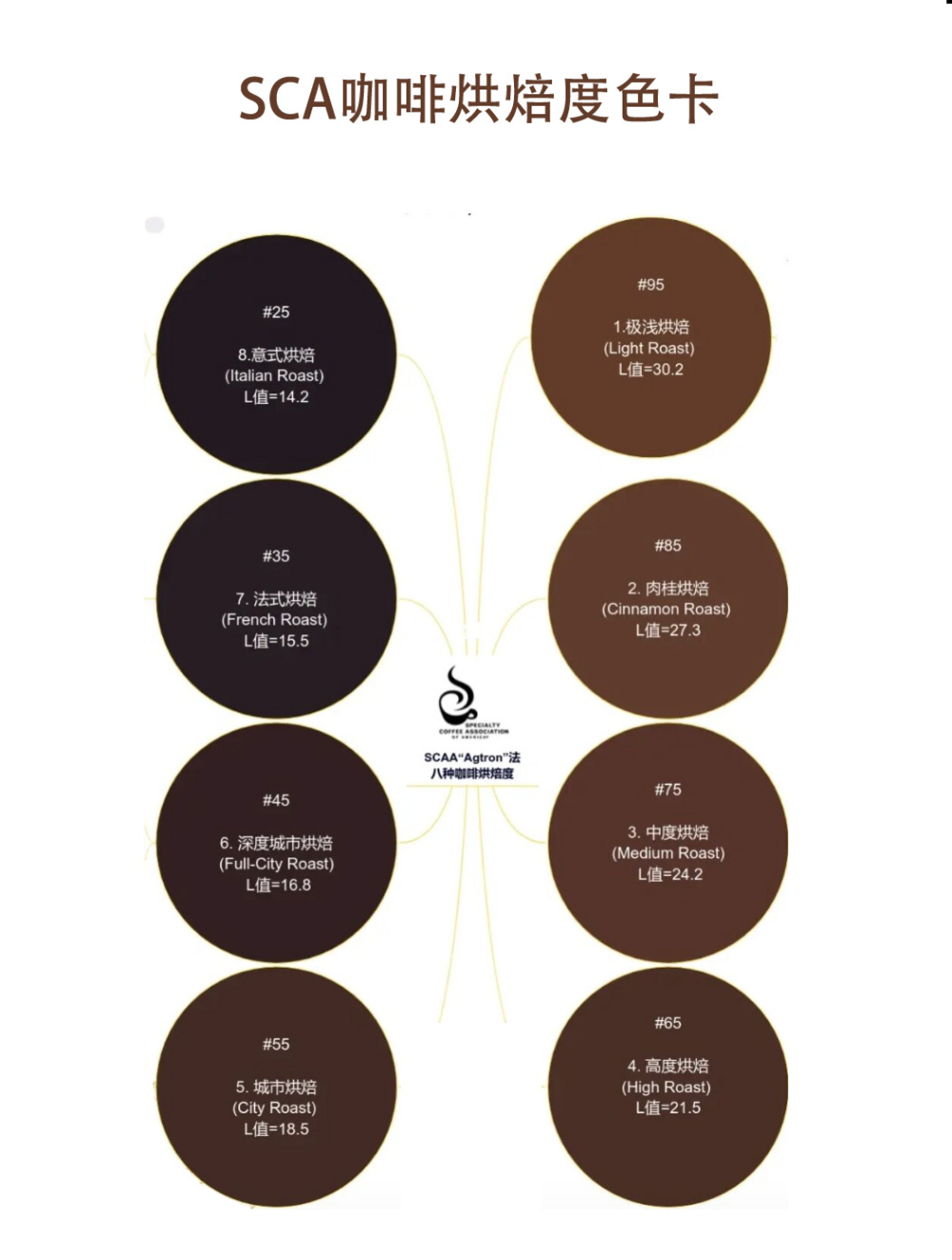
The SCA divides roast levels into eight grades, which can also be simplified into a few broader categories for practical use. First are the very light roasts L1 and L2. These beans have colors leaning toward cinnamon to light brown, typically dropped just after or before the first crack ends, with an overall weight loss rate of around 11% to 13%. This stage features very pronounced acidity, often with bright citrus, floral, and fruity notes, but sweetness is not yet fully developed. Improper handling can easily result in grassy, grainy, or astringent off-flavors. For pour over, it is recommended to use slightly higher water temperature and moderately finer grind to help enhance sweetness and overall balance.
Moving into medium-light roasts L3 and L4, the bean surface turns light brown, usually dropped around the end of the first crack, with a weight loss rate of about 14% to 16%. The acidity in this range remains lively but has softened from sharp to rounder, with common citrus and berry acids beginning to integrate. Sweetness gradually emerges with caramelization reactions, making it a key stage where many specialty coffees showcase regional characteristics. Beans like Yirgacheffe and Sidamo processed via natural methods often fall within this roast range, preserving rich floral-fruity aromas and fermented sweetness, suitable for users who enjoy layered flavors.
In the medium roast range M0 and M1, the beans turn medium brown, typically dropped after the first crack has fully ended but before the second crack begins, with a weight loss rate of about 17% to 19%. At this point, the balance between acid and sweetness is optimal, and the flavor profile shifts toward warm notes such as nuts, cocoa, and caramel—making it the preferred roast level for many baristas when making espresso or daily pour overs. For example, beans like Golden Mandheling and Colombian Huila can exhibit a full body and long-lasting sweetness at this stage, suitable for coffee lovers seeking balance and aftertaste.
Going deeper, M2 and D1 belong to medium-dark roasts, with the beans showing dark brown surfaces, typically dropped when the second crack has just begun sporadically, with a weight loss rate of about 20% to 22%. In this range, acidity significantly diminishes while bitterness and smoky characteristics begin to intensify. Meanwhile, bean surface oils start to emerge, making it suitable as a base for blends or for consumers who prefer intense flavors. If roasted further to D2, D3, and D4—these dark to very dark roast levels—the beans appear black-brown or even with glossy oiliness, with weight loss rates often exceeding 23%. The flavors are dominated by intense bitterness, charred notes, and smoke, with acidity almost indiscernible. These are commonly used in Italian-style blends that emphasize flavor structure or chosen by those who prefer bold profiles.
However, color chart values are only for reference. Different bean varieties and processing methods may still show significant flavor differences even when roasted to the same color value. Therefore, it is recommended to combine cupping for judgment to more accurately grasp the bean’s characteristics.
In addition to roast stages, the quality of the green beans themselves is also crucial. Below are several common types of green bean defects. These defects can usually be identified by appearance before roasting, but their off-flavors often only become fully apparent during cupping.
• Appearance characteristic: Dried berry state
• Cupping characteristic: May present fermentation, moldy, or chemical agent irritation
• Cause: Berries not fully depulped or dried berries mixed in during harvest
• Appearance characteristic: Yellow, yellow-brown, or reddish-brown spots on the green bean surface, sometimes with a powdery appearance
• Cupping characteristic: Off-flavors may vary, including fermentation, mustiness, mold, earthiness, and chemical odors, either individually or in combination
• Cause: Infected by fungal spores during harvest, post-processing, or storage, especially prone in humid and warm environments
• Appearance characteristic: Non-coffee foreign objects, such as branches, stones, metal fragments, etc.
• Cupping characteristic: Triggers various off-flavors
• Cause: Poor quality control during processing
Combining these defects with the SCA roast color chart offers clearer insight: Even if beans with fermentation or mold issues are roasted to any color value, the off-flavors may only be partially masked by caramelization or carbonization reactions and cannot be completely eliminated. Therefore, the color chart helps us decide "how dark to roast," but "whether it can be roasted" entirely depends on the quality of the green beans themselves. It is recommended to hand-sort and remove obvious defective beans before roasting to ensure the color chart readings reflect clean regional flavors, rather than remedied results masked by defects.
The above content is compiled by CoffeeHunters, a coffee news website.


