







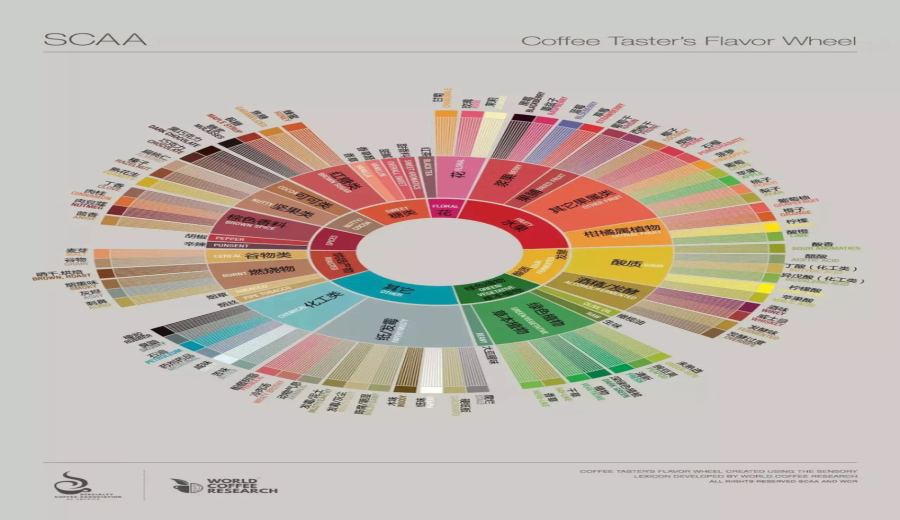
Introduction:The coffee flavor wheel is an essential tool for professional cupping and roasting. For the first time in 21 years, the SCAA has collaborated with the World Coffee Research organization to release a major update. This revision introduces over 30 new fruit and plant-based flavor descriptors such as strawberry and blueberry, and reorganizes the classification logic of negative flavors. This article provides a visual comparison between the old version’s left-right partition design and the new integrated circular structure, analyzes the adjustments in sensory categorization, and offers suggestions on how to access high-resolution versions — helping coffee professionals and enthusiasts accurately master flavor description vocabulary.
In the specialty coffee field, the flavor wheel is like a dictionary that translates between different languages, and the latest revised edition released by the SCAA (Specialty Coffee Association of America) is bringing revolutionary changes. This update comes 21 years after the last revision, developed jointly by the World Coffee Research (WCR) and the SCAA, mobilizing global sensory evaluation experts, agricultural scientists, and roasting technical teams. It not only expands with over 30 new flavor descriptions but also completely reconstructs the classification framework.
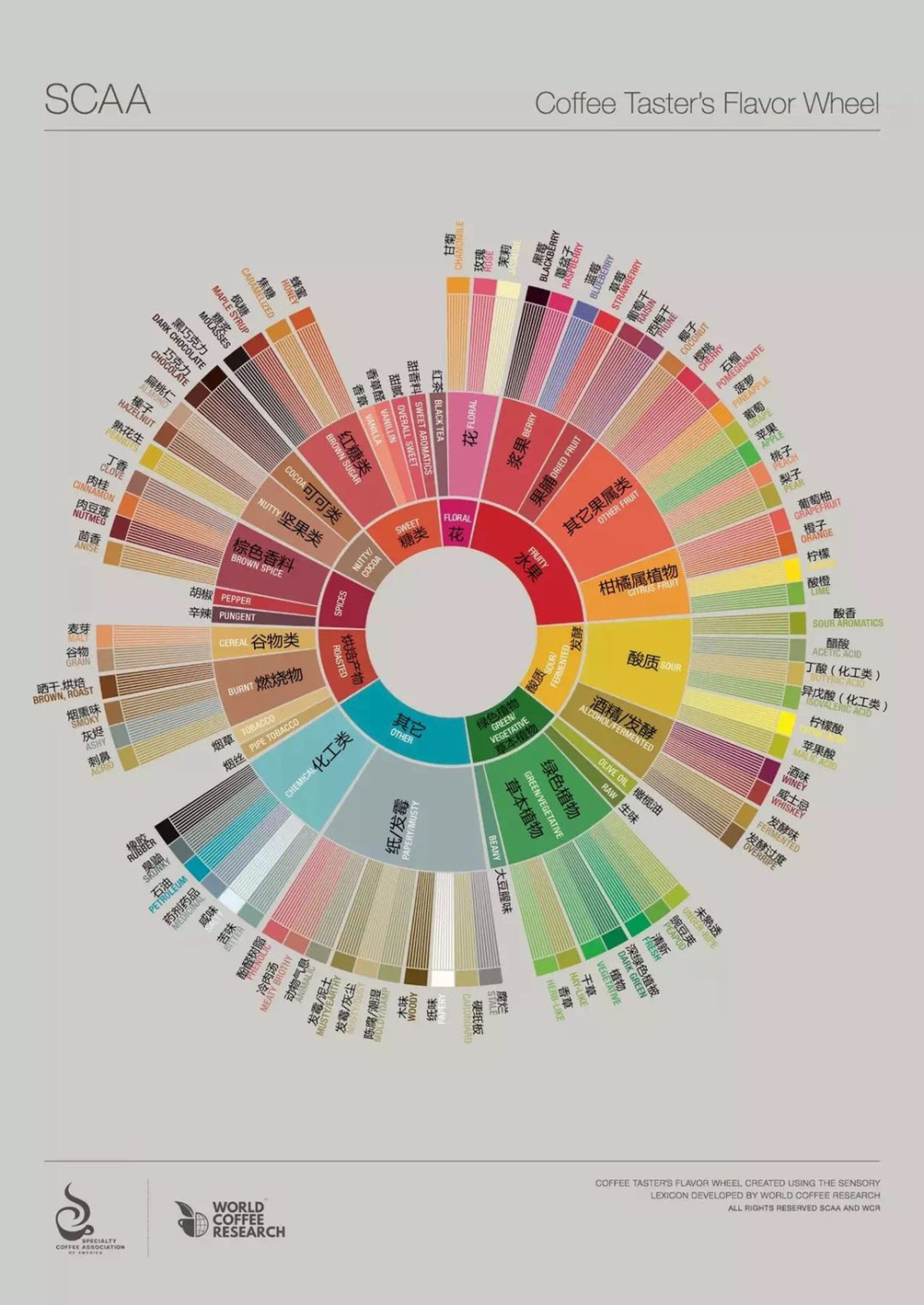
Looking back at the original flavor wheel design, it featured a clearly divided left-right layout: the left half focused on negative flavors resulting from roasting errors or green bean defects, while the right half expanded along the traditional dual axes of aroma and taste. Common negative flavors on the left, such as “leather,” “rotten wood,” or “over-fermented,” often stem from unripe fruit being mixed in during harvest, improper fermentation control during post-harvest processing, or deviations in the roasting temperature curve. These flavor defects often directly impact consumers’ first impression of coffee quality.
Turning to the positive expression area on the right, aroma and taste are divided into two main branches. The taste component strictly corresponds to the basic reactions of human taste buds — acidity (such as the brightness of citric acid), sweetness (like the lingering notes of caramel or honey), bitterness (the richness of dark chocolate), and saltiness (the mineral tones of certain special processing methods). The aroma dimension, on the other hand, shows a richer hierarchy, ranging from floral notes (rose, jasmine), fruitiness (citrus, berries) to nutty and spicy profiles. These are mainly conveyed through volatile aromatic compounds, and their complexity far exceeds what taste alone can discern.
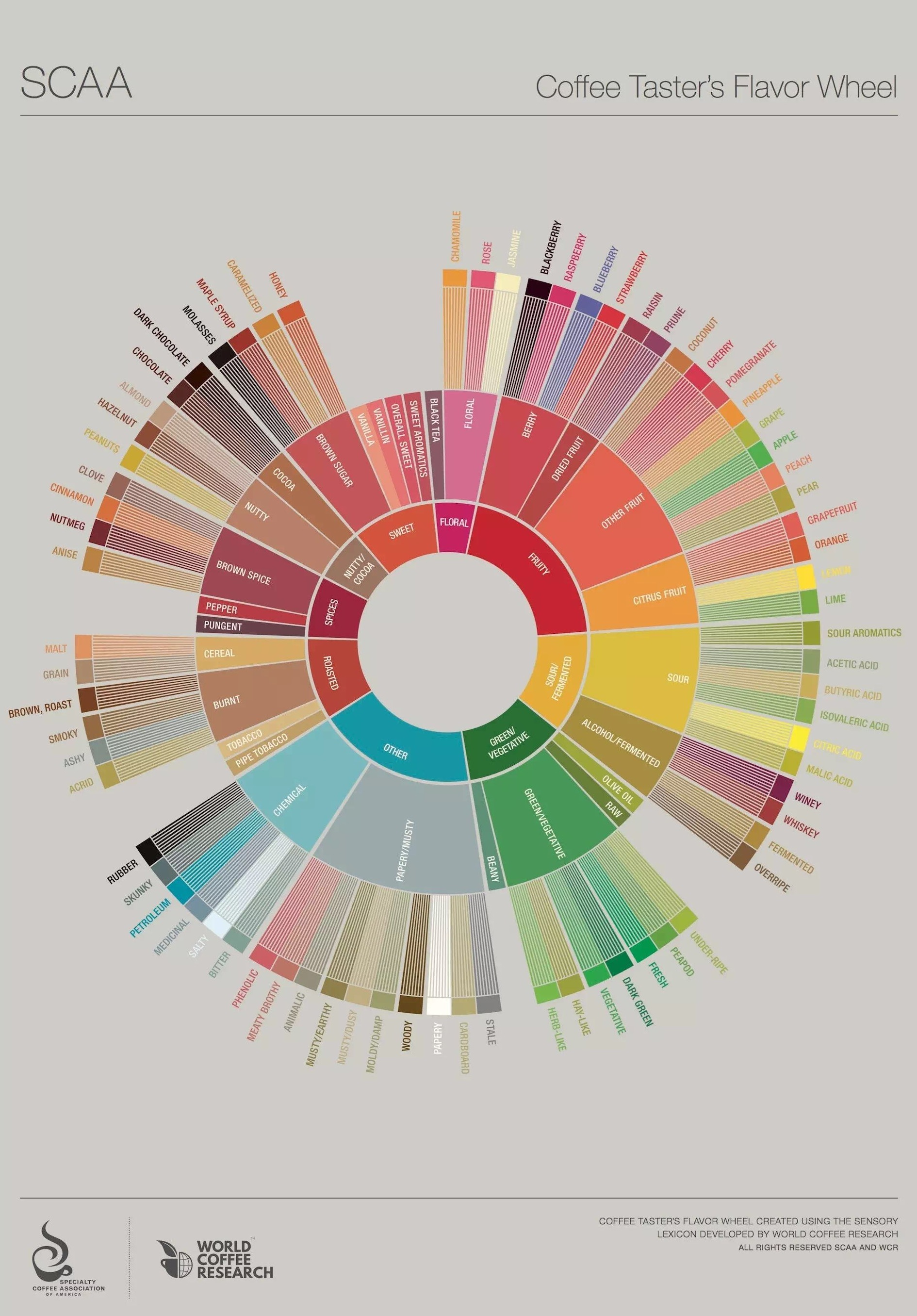
The latest version presents a complete circular structure. The most notable change is the removal of the old version’s left-side concentrated block of negative flavors, instead distributing more nuanced vocabulary across the outer edge of the entire wheel. Observers will immediately notice the addition of a diverse range of fruit elements: in addition to common ones like strawberry and blueberry, it includes red berries such as raspberry, cherry, and pomegranate, as well as tropical fruits like pineapple and mango. Plant-based flavors have also been significantly expanded, featuring tea-like floral notes such as chamomile and jasmine, as well as unique texture descriptions like olive oil and raw.
Notably, the new version incorporates terms reflecting the trend of very light roasting, such as “under ripe” and “dark green,” which are commonly used in popular lightly roasted beans to express grassy or vegetal aftertastes reminiscent of unripe beans. Additionally, finer subdivisions within citrus categories like “lime” and “grapefruit” help users more precisely pinpoint specific manifestations of acidity.
In practical application, whether conducting cupping records or formulating roasting plans, it is recommended to first observe the basic categories on the outer ring of the flavor wheel (such as fruit, floral, sweet), then gradually locate the more detailed descriptor words in the inner ring. By pairing this with brewing parameter records (such as grind size, water temperature, extraction time), one can build a personalized flavor database. High-resolution wallpaper versions can be obtained through official channels of professional coffee organizations and are recommended to be printed in A2 size for easy reference during cupping.
The above content is compiled by CoffeeHunters, a coffee news website.


