







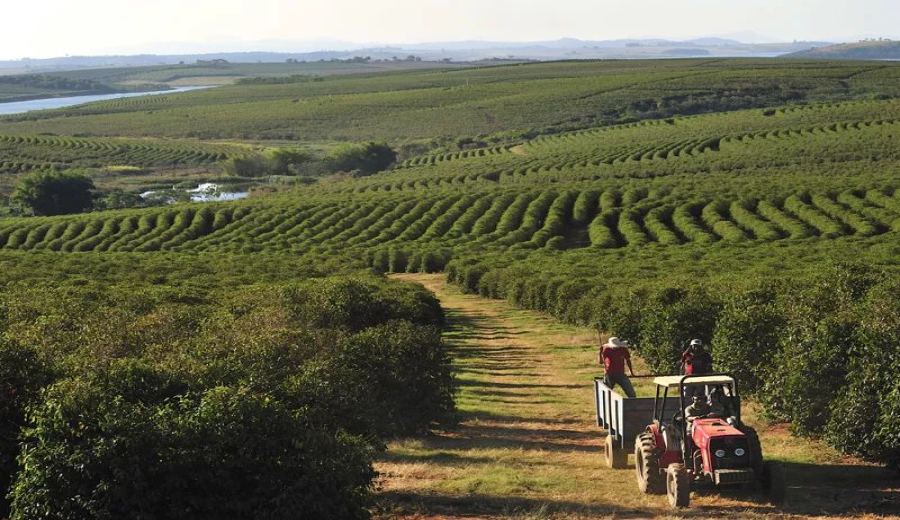
Introduction:Brazil is the world’s largest coffee-producing country, not only supplying one-third of the world’s coffee exports but also renowned for its nutty and cocoa-rich, full-bodied flavors. However, beyond its solid foundational profile, Brazil actually harbors a rich and diverse specialty potential. This article will take you deep into an understanding of Brazil’s three major renowned producing regions—South Minas, Cerrado, and Mogiana—analyze the variety characteristics of Red Bourbon and Yellow Bourbon, and provide practical pour over and SOE extraction parameters, allowing you to comprehensively grasp the charm of Brazilian coffee from origin to flavor.
When it comes to Brazil, many people might first think of football and Carnival, but this South American powerhouse is actually the global coffee kingdom. Not only does it rank first in the world in both coffee production and export volume, but its coffee beans also account for one-third of global coffee exports. Brazilian coffee often gives the impression of being solid and full-bodied, with a primary profile of nuts and cocoa, but if you think it only has a monotonous “mass-market taste,” you’re very much mistaken.
From 1727, when a single coffee seed crossed the ocean to Brazil, to today’s formation of a diverse range of specialty coffee regions, the evolution of Brazilian coffee is itself a fascinating story. Especially in the specialty coffee field, the three major regions of South Minas, Cerrado, and Mogiana, each with their unique geographical and climatic conditions, nurture coffee beans with rich flavor layers. In addition, the two classic varieties, Red Bourbon and Yellow Bourbon, further demonstrate the excellent balance that Brazilian coffee achieves between sweetness and body.
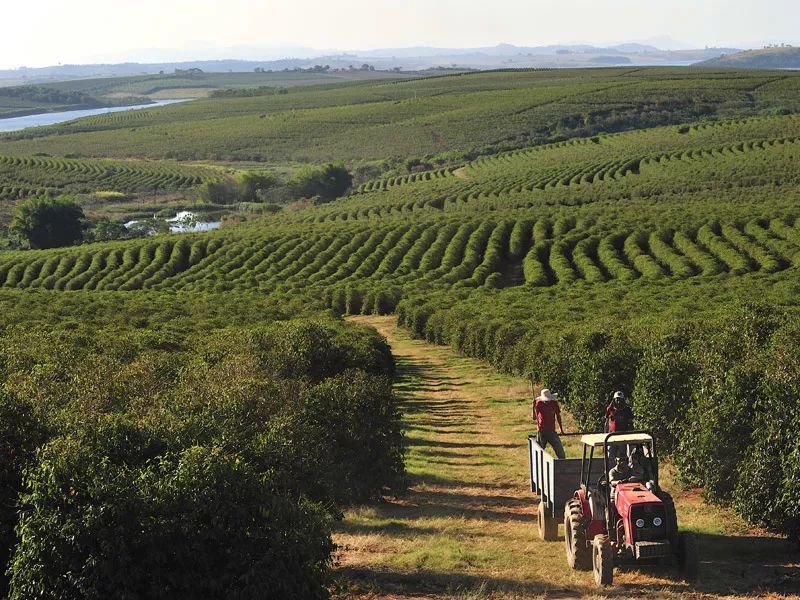
The history of coffee cultivation in Brazil began in 1727, when a Portuguese army captain named Francisco de Mello Palheta was sent to French Guiana. As France strictly controlled the export of coffee seeds at the time, he managed to obtain a coffee seedling by building a good relationship with the wife of the local governor and brought it back to Brazil. This seedling quickly adapted to the local environment and spread across various states in Brazil.
By 1830, coffee had become an important cash crop in Brazil, accounting for 30% of global exports, driving economic takeoff in multiple regions including São Paulo. Railways were even built specifically for coffee export. However, in 1965, due to a global oversupply of coffee and a sharp price drop, Brazil participated in signing the International Coffee Agreement to limit exports, until it withdrew in 1989 and established the Brazilian Specialty Coffee Association (BSCA) in 1991, officially promoting the development of specialty coffee.
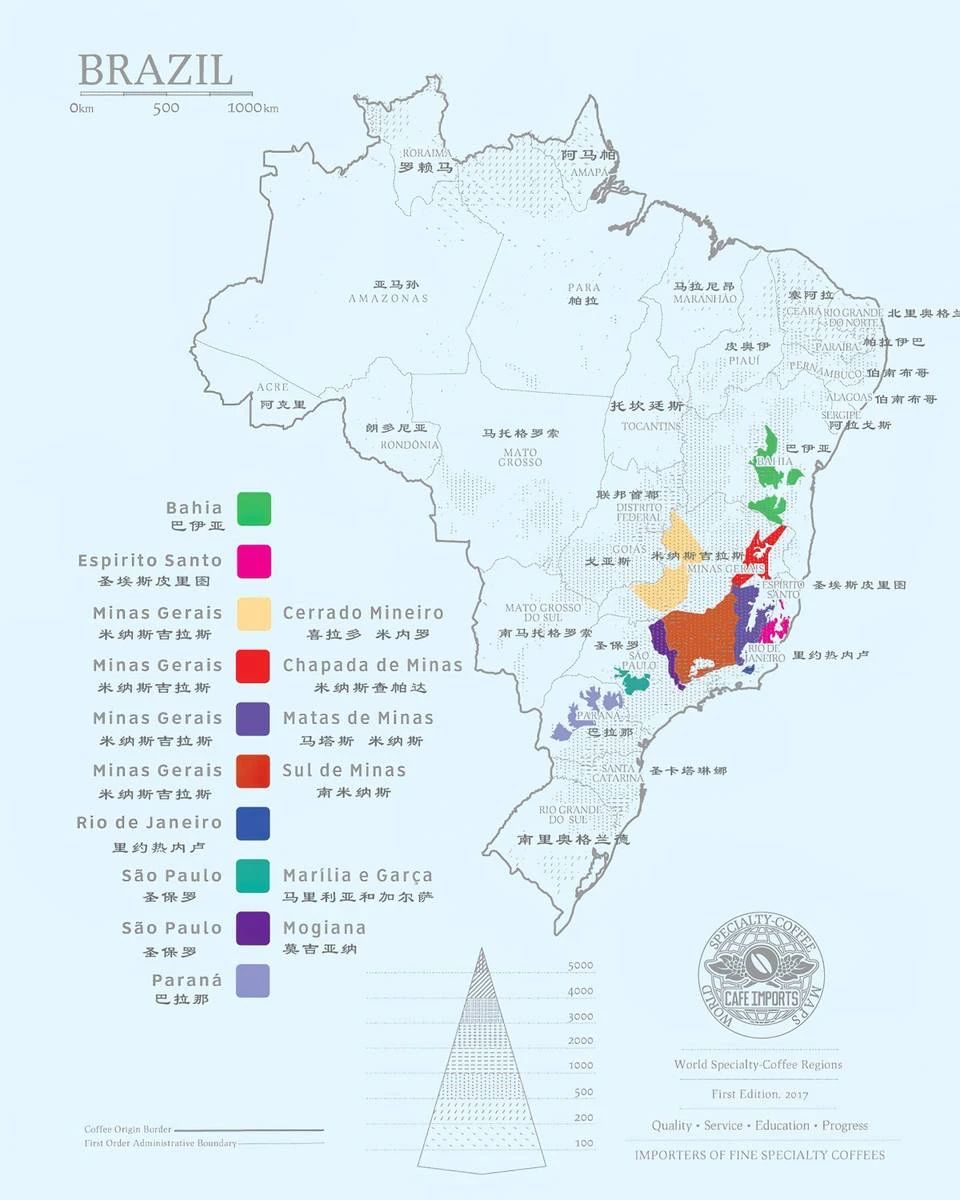
There are 26 states in Brazil, 17 of which are involved in coffee cultivation, with the main producing areas concentrated in Paraná, São Paulo, Minas Gerais, and Espírito Santo. The output of these four states accounts for 90% of the national total. Among them, South Minas and Cerrado in Minas Gerais, as well as Mogiana near the border of São Paulo, are regarded as the three strongholds of specialty coffee.
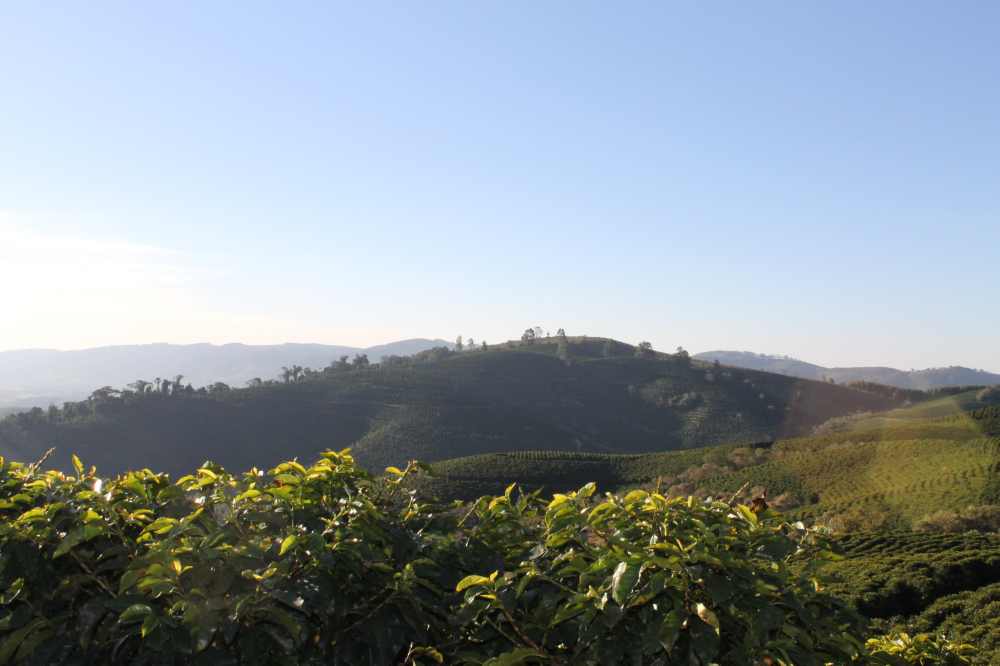
South Minas is located in Minas Gerais and is an important base for Brazilian specialty coffee. The altitude of the producing area ranges between 700 and 1400 meters, with a terrain mainly consisting of hills, distinct wet and dry seasons, and diverse microclimates, making it very suitable for planting varieties such as Bourbon and Yellow Bourbon. The coffee produced here typically exhibits good acidity and delicate aromas, with rich flavor layers.
Cerrado is located in the Brazilian inland and features a highland savanna landscape. Although the name Cerrado means “closed land” in Portuguese, the coffee-producing areas here are carefully selected high-altitude blocks, with an average altitude exceeding 1000 meters. The region has fertile soil and large day-night temperature differences, which are conducive to the accumulation of sugars in coffee cherries. The resulting coffee beans often have a high level of sweetness, a full body, and excellent clarity. Typical flavors include nuts, caramel, cream, and subtle floral notes.
Mogiana, adjacent to South Minas, has an altitude of about 900 to 1100 meters and a varied terrain, featuring both traditional large farms and many small modern plantations. This diversity in cultivation and processing methods gives Mogiana’s coffee beans a unique personality in flavor expression, with common tonalities including a balanced acidity-to-sweetness ratio and rich layering.
In terms of varieties, Red Bourbon is one of the most commonly planted varieties in Brazilian coffee. As a mutation of Typica, Red Bourbon is known for its solid mouthfeel, bright acidity, and wine-like aroma. When ripe, the coffee cherries are red, making it a mainstay variety of Brazilian specialty coffee. It is widely planted in multiple regions and is suitable for coffee lovers who enjoy a full-bodied foundation with a delicate balance of flavors.
Yellow Bourbon is another mutation of the Bourbon variety, characterized by its yellow-colored cherries when ripe, rather than the more common red. This color change stems from the selective expression of genetic traits and was first discovered in the 1930s. When grown at high altitudes, Yellow Bourbon can accumulate a higher proportion of fructose, thus delivering a sweeter and juicier flavor profile. Its cupping characteristics often include nuts, chocolate, soft acidity, and a clean finish. It has stood out multiple times in Brazil’s Cup of Excellence competition and is a star variety in the specialty coffee market.
In terms of extraction and pour over application, Brazilian coffee, with its full-bodied and balanced characteristics, is very suitable for pour over using medium-fine grinding. It is recommended to use a KONO filter, with water temperature controlled at around 88°C, a powder-to-water ratio of 1:15, and a grind size of approximately medium-fine, equivalent to 80% passing through a Chinese No. 20 sieve. Use a three-stage extraction method: first, perform a 30-second bloom with twice the amount of coffee powder’s weight in water (about 30 grams), then pour water in a small stream up to 125 grams and pause briefly, and finally continue pouring up to 225 grams to complete the extraction, with a total time of about 2 minutes. These parameters are suitable for most Brazilian single-origin beans and can fully showcase their sweetness and full-bodied depth.
If you want to further explore the espresso performance of Brazilian coffee, you can also try making an SOE (Single Origin Espresso). Taking Yellow Bourbon as an example, it is recommended to use a commercial or home espresso machine with 9 bar or above pressure, paired with a double basket (about 18–20 grams of coffee powder), with a powder-to-water ratio controlled at 1:2, and an extraction time suggested to be between 28–30 seconds. Such an espresso is not only suitable for drinking on its own but can also serve as the base for an SOE Americano or SOE Latte. Adjust the ratio according to personal taste to enjoy different levels of coffee flavor experiences.
In summary, Brazilian coffee is not just synonymous with solid and full-bodied flavors. From the delicate balance of South Minas, the sweet clarity of Cerrado, to the diverse personalities of Mogiana, coupled with the varietal charm of Red Bourbon and Yellow Bourbon, this coffee powerhouse offers a rich and diverse range of specialty choices. Whether you are a pour over beginner or an SOE enthusiast, you can find your own perfect cup in Brazilian coffee.
The above content is compiled by CoffeeHunters, a coffee news website.


