







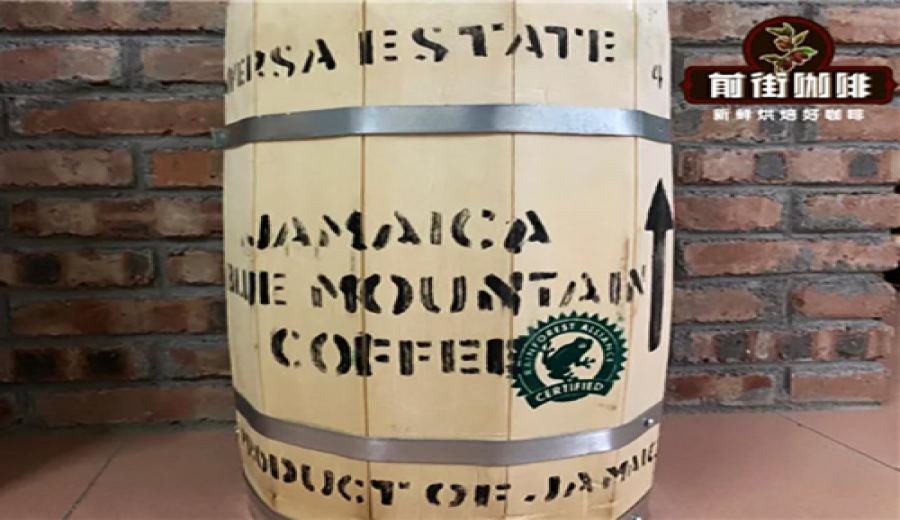
Introduction:Jamaica Blue Mountain coffee is renowned for its unique flavor and rare production, but its rigorous grading system and price variations often cause confusion. This article delves into the geographical conditions of the Blue Mountains that nurture top-tier coffee, helping you understand the differences among the three grades of Blue Mountain coffee, the bean size standards for green beans, and the specifications of export barrels. It also compares the price gap between specialty Blue Mountain (No.1 beans) and Embu No.1 beans, equipping you with key knowledge for selecting high-quality Blue Mountain coffee.
In the eastern part of Jamaica lies a mountain range surrounded by the Caribbean Sea — the Blue Mountains. On clear days, sunlight shines on the sea, reflecting blue ripples onto the mountaintops, enveloping the hills in a soft blue glow. This is how the "Blue Mountains" got their name. With altitudes exceeding 2,100 meters, the area enjoys a cool, foggy climate and abundant rainfall throughout the year. Such a uniquely favorable natural environment has given rise to the world-famous Blue Mountain coffee.
Based on planting altitude and green bean size, Blue Mountain coffee is strictly divided into three major grades: Jamaica Blue Mountain Coffee, Jamaica High Mountain Coffee, and Jamaica Prime Washed Coffee. The commonly referred to "Jamaica coffee" mostly comes from mid-to-low altitude regions and is generally classified as Prime Washed Coffee. Additionally, while specialty Blue Mountain (No.1 beans) and Embu (No.1 beans) are both high-end products, the latter typically costs about 300 to 400 yuan more per pound than the former.
If further categorized by green bean size, premium Blue Mountain coffee can be divided into three grades: No.1 beans, No.2 beans, and No.3 beans, with their respective mesh size standards as follows:No.1 beans are 17–18 mesh and above,No.2 beans are 16 mesh,No.3 beans are 15 mesh. It should be specifically noted that 17 mesh is approximately equivalent to 17/64 of an inch. There is actually no significant difference in flavor among these three grades, as all must undergo rigorous evaluation by cuppers certified by the Jamaican government to ensure consistent quality. Their primary differences lie in bean size, which also affects market pricing and grading labels. Regardless of grade, green beans must be packaged in officially regulated wooden barrels for export. The barrel sizes include70 kilograms, 30 kilograms, and 15 kilograms, ensuring quality stability during transport.
The production region and grading system of Blue Mountain coffee are quite strict. Only coffee beans that meet specific altitude and processing standards can bear the name "Blue Mountain." Many consumers, upon hearing the term "Blue Mountain," assume it must be top-tier, overlooking how grade and mesh size actually impact flavor and price. Understanding these details not only helps you select your desired Blue Mountain coffee more accurately but also prevents you from paying a premium for a product that doesn’t meet your expectations.
In summary, the value of Jamaica Blue Mountain coffee lies not only in its exceptional geographical environment but also in its stringent grading and quality control systems. From altitude and bean size to export packaging, every step influences the final flavor and worth in your cup. Whether you're new to Blue Mountain or an experienced coffee enthusiast, mastering this basic knowledge will make your tasting or purchasing experience much smoother.
The above content is compiled by CoffeeHunters, a coffee news website.


