







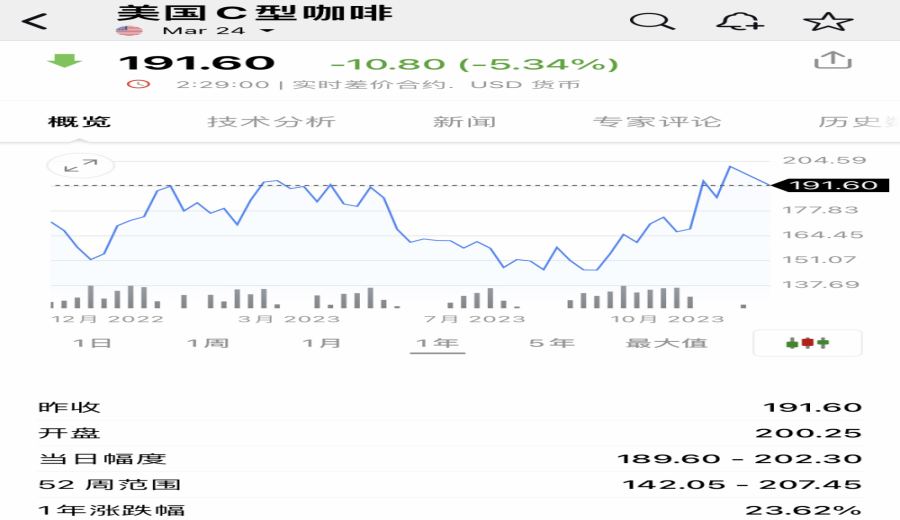
Introduction:The New York coffee futures market in the United States is a key benchmark for global coffee prices, with the C-type Arabica coffee futures contract being a focal point for both producers and buyers. This article delves into the trading rules and historical background of this contract, and breaks down the core variables influencing coffee bean prices from five major aspects: supply, weather, policy, market sentiment, and seasonality. It also reviews the dramatic price fluctuations caused by the 1999 Brazilian drought, helping readers understand the logic behind futures pricing.
As a commodity with global trading volume second only to crude oil, the dynamics of the coffee futures market deeply impact the economic stability of producing countries. The C-type Arabica coffee futures listed on the New York Coffee, Sugar and Cocoa Exchange (CSCE) is the primary futures benchmark for the global Arabica variety, with delivery sources spanning 19 countries (excluding Brazil). Notably, the exchange once also traded the Brazilian B-type coffee futures contract, but it was delisted as early as 1982 due to insufficient liquidity, leaving only the C-type contract still active.
The delivery price of the C-type futures is not uniform, but is adjusted according to the origin of the beans. Among them, Colombia is the only origin that enjoys a premium—its highest-grade coffee beans can be priced up to 2 cents per pound higher than the standard rate; in contrast, some countries, including Ethiopia, may have their highest-grade beans discounted by as much as 6 cents per pound due to quality or market perception factors.
The core factors influencing the price of C-type Arabica coffee futures can be summarized into five categories. The first is changes in supply—since demand is relatively stable, production adjustments in major producing countries (especially Brazil, the world’s largest producer, which although not a C-type delivery origin, its output fluctuations remain highly indicative) are often the main drivers of short-term price movements.
Weather and pests are another key factor. Brazil’s coffee-growing regions face frost threats every year between June and July, and severe frost during this period can directly impact production expectations for the year, thereby driving up futures prices. In contrast, East Hemisphere producers (such as those in Southeast Asia) more frequently deal with pest issues, but with advances in prevention and control technology, this factor’s influence on prices has gradually diminished.
Government policies of various countries and interventions by the International Coffee Organization (ICO) are also not to be overlooked. The Brazilian government has repeatedly stabilized the market by stockpiling domestic coffee beans, which can boost prices in the short term but may also encourage other regions (such as Colombia and Central America) to seize the opportunity to expand their market share. Meanwhile, the ICO previously maintained price balance by setting export quotas, but after the mid-1980s, the mechanism’s effectiveness gradually weakened due to opposition from consuming countries over high costs and violations by producing countries exceeding export limits.
On the market sentiment front, rumors of strikes at major export ports (even if not yet materialized) often trigger expectations of inventory stockpiling, driving short-term price fluctuations. However, unless strikes persist for an extended period, the impact is usually limited. Additionally, seasonal factors also play an important role—Brazil, as the largest producing region, typically sees price lows during its harvest season from April to August (with June to July being particularly critical), while the Northern Hemisphere winter (January to February of the following year) often sees prices rebound due to increased consumption demand.
Historical cases show that the coffee futures market has highly speculative characteristics. Starting in July 1999, Brazil experienced a prolonged drought, and the market anticipated impaired coffee tree flowering and sharply reduced yields, causing futures prices to surge to a high of $1.50 per pound in October of that year. However, as rainfall in December alleviated the disaster, prices quickly plummeted, demonstrating the amplifying effect of market sentiment on prices.
It is worth noting that coffee farmers need a selling price of over $1 per pound to be profitable. When prices fall below this threshold, producing countries often initiate “coffee stockpiling” programs—where governments purchase excess coffee beans from the market and store them in warehouses to reduce circulation and support prices. However, if consecutive years of disasters occur (such as already declining yields compounded by further calamities), the effectiveness of such measures may be limited. Overall, understanding these key factors helps traders and industry professionals more accurately assess the price trends of C-type Arabica coffee futures.
The above content is compiled by CoffeeHunters, a coffee news website.


