







Introduction:Jamaican Blue Mountain coffee has long been revered by coffee enthusiasts worldwide for its balanced and mellow flavor. But do you know where the true Jamaican Blue Mountain coffee is produced, how it is graded, and how to identify authentic products? This article delves into the geographical background of Blue Mountain coffee, the official CIB grading standards, common certification documents, and offers practical pour-over brewing suggestions and parameters to help you master the core knowledge of this classic coffee in one go.
Jamaican Blue Mountain coffee is globally recognized as one of the finest coffees. Its elegant and balanced flavor and consistent quality have won the love of countless coffee lovers for decades. However, with more and more products on the market claiming to have a “Blue Mountain flavor,” many have begun to wonder: what exactly is genuine Jamaican Blue Mountain coffee? What makes it unique in terms of origin and conditions? And how can we distinguish its authenticity? This article will provide a comprehensive overview of the ins and outs of Blue Mountain coffee, from its growing environment and grade classification to official certifications and pour-over recommendations, helping you gain a deeper understanding of the charm of this classic coffee.
Over the years, Jamaican Blue Mountain coffee has become a “benchmark” in the hearts of many coffee drinkers for its rich yet not overpowering flavor and well-balanced acidity, sweetness, and bitterness. It may not be the most expensive, but it is definitely one of the representatives of quality and flavor. Drinking Blue Mountain coffee is neither outdated nor a sign of not understanding coffee—it is a mark of respect for the classics and a refined taste.
The fame of Jamaican Blue Mountain coffee stems from its unique geographical and climatic conditions. The Blue Mountains are located in the northeastern part of Jamaica, embraced by the Caribbean Sea. When sunlight shines on the azure sea surface, the mountain peaks reflect a faint blue glow, hence the name “Blue Mountain.” The main peak rises to an elevation of 2,256 meters, making it the highest point in the entire Caribbean region and a renowned tourist destination.
However, not the entire Blue Mountain range is suitable for coffee cultivation. The Jamaican government has clearly designated that only coffee grown at elevations between 910 meters and 1,700 meters qualifies to be called “Jamaican Blue Mountain coffee.” This altitude range lies within the coffee belt and features fertile volcanic soil, fresh mountain air, along with a high-humidity, foggy, and rainy climate. With an average annual rainfall of 1,980 mm and an average temperature of around 27°C, it creates the unique flavor characteristics of Blue Mountain coffee.
The coffee produced here is renowned for its delicate and balanced taste, with acidity, bitterness, and sweetness perfectly harmonized. There is almost no strong bitterness, but rather a gentle fruit acidity paired with rich dark chocolate and nutty aroma notes. According to professional cupping results, Blue Mountain coffee processed with medium to dark roasts often exhibits a full-bodied texture and a layered, lingering aftertaste.
However, not all coffee grown on the Blue Mountain range is called Blue Mountain coffee. According to the regulations of the Jamaica Industrial Development Corporation (JIDC or CIB), only coffee grown between 910 and 1,700 meters can be called “Jamaican Blue Mountain coffee.” Coffee grown between 460 and 910 meters is classified as “Jamaican High Mountain Coffee,” and anything below 460 meters is categorized as “Jamaican Prime Coffee.”
In addition, Jamaican Blue Mountain coffee is further subdivided into four grades based on bean size and defect rate: Blue Mountain No. 1, Blue Mountain No. 2, Blue Mountain No. 3, and Blue Mountain Peaberry. Among these, Blue Mountain No. 1 is the grade most commonly found in the Taiwanese market. The grading standards are as follows:
- Blue Mountain No. 1: Coffee beans must be 17 mesh size or larger, accounting for 96%, with a post-processing defect rate not exceeding 2%;
- Blue Mountain No. 2: Coffee beans must be 16 mesh size or larger, accounting for 96%, with a defect rate also not exceeding 2%;
- Blue Mountain No. 3: The minimum bean size is 15 mesh, accounting for 96%, with a defect rate limited to within 2%;
- Blue Mountain Peaberry: Coffee beans must be 10 mesh size or larger, accounting for 96%, with a defect rate also not exceeding 2%.
So, how can consumers identify genuine Blue Mountain coffee? While many coffee shops or retailers often promote products labeled as having a “Blue Mountain flavor,” these are mostly blends of other bean varieties that use dark roasting to mimic the taste of Blue Mountain coffee, and they are not the real thing. In fact, authentic Blue Mountain coffee uses only the Typica variety—an ancient and pure-flavored Arabica bean—and is never blended.
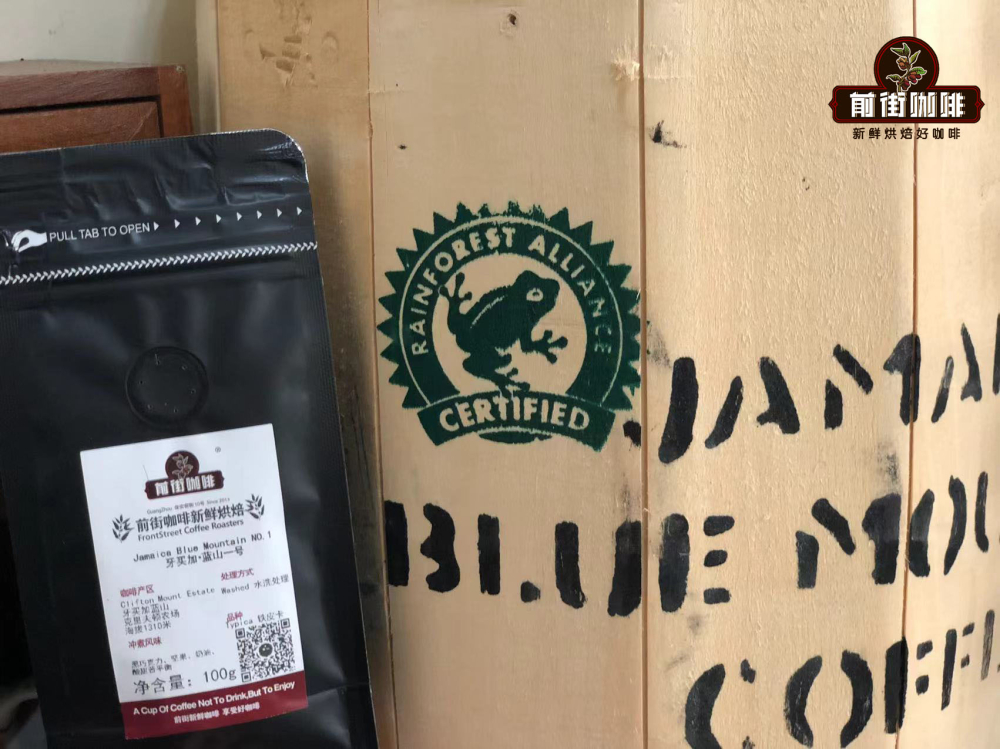
For exports, the Jamaican government has strict regulations for Blue Mountain coffee, stipulating that it must be shipped in wooden barrels and accompanied by three official certification documents: a quality certificate issued by the Jamaica Coffee Industry Board, an authorized sales certificate from the producer (currently only 4 government-certified factories and 16 exporters are qualified), and a certificate of origin. These certificates effectively guarantee the authenticity of your Blue Mountain coffee purchase. In some physical stores, you may even see these wooden barrels and certificates on display.
In the past, due to its scarcity and high price, Blue Mountain coffee was often seen as a luxury item. But today, compared to other specialty coffee beans, its price is relatively reasonable. For example, a well-known coffee shop offers Blue Mountain No. 1 roasted beans at approximately 158 yuan per 100 grams, offering excellent value among top-tier coffees.
If you want to brew Blue Mountain coffee at home, you can refer to the actual brewing parameters used by a well-known coffee shop’s retail locations: it is recommended to use a Kono filter, with water temperature controlled at around 88°C, a coffee-to-water ratio of 1:15—that is, 15 grams of coffee grounds to 225 ml of water. The grind size is recommended to have a 70%–75% passing rate through a 20-mesh sieve. Specifically, start by pouring 30 grams of water for a 30-second bloom, then add water up to 125 grams. When the water level drops halfway, continue pouring to reach a total of 225 grams. The total extraction time is approximately 2 minutes and 10 seconds.
This brewing method fully highlights the delicate flavors of Blue Mountain coffee, typically featuring dominant notes of rich dark chocolate and nuts, with a silky-smooth mouthfeel. The balance among acidity, sweetness, and bitterness is harmonious, and the aftertaste is long-lasting. It is a classic way to experience the charm of Blue Mountain coffee.
The above content is compiled by CoffeeHunters, a coffee news website.


