







Introduction:In response to recent online rumors claiming that "Feihe has imported raw materials from Japan," Feihe Dairy has officially issued a statement to clarify the matter and has filed a report with the public security authorities. In fact, this misunderstanding stems from a letter of intent for technical cooperation signed between Feihe and Japan’s Kyowa Hakko, which was originally intended for joint research and development of fermented lactoferrin technology but was misinterpreted as involving raw material imports and capital partnerships. This article details the sequence of events, clarifies the truth, and analyzes the importance of lactoferrin and the progress of its domestic production.
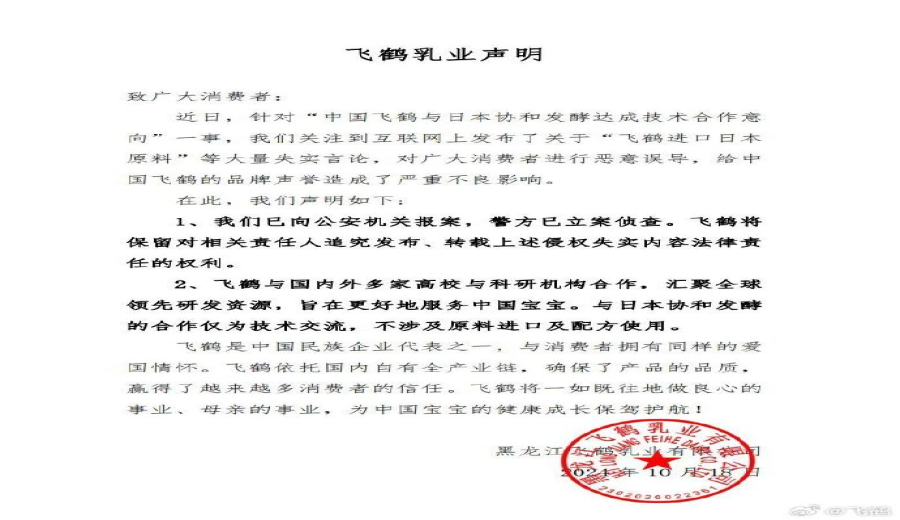
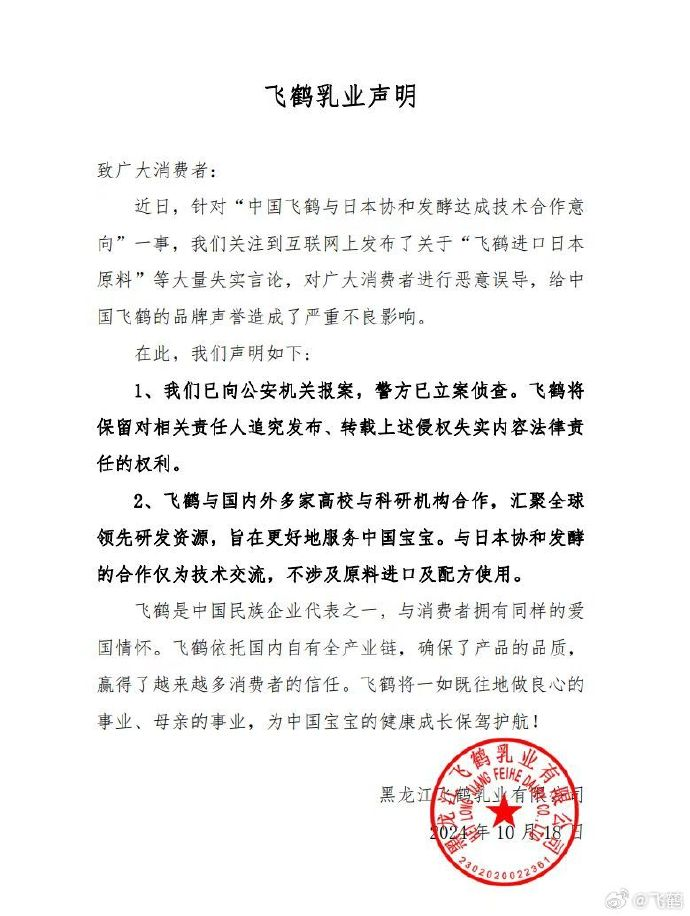
On October 18, Heilongjiang Feihe Dairy Co., Ltd. issued an official statement through its channels in response to the recent wave of false claims online about "Feihe importing Japanese raw materials." Feihe stated that these rumors not only misled consumers but also severely damaged the brand’s image. The company has reported the matter to the public security authorities, and the case has been officially filed for investigation.
The origin of this controversy can be traced back to the letter of intent for technical cooperation signed between Feihe and Japan’s Kyowa Hakko on October 3. The two parties announced the establishment of a joint innovation laboratory aimed at developing fermentation-based lactoferrin production technology. This laboratory is a China-Japan collaborative project, focusing on using fermentation technology to simulate functional components in breast milk, such as lactoferrin.
However, some individuals misinterpreted this purely technical collaboration as "Feihe being funded by a Japanese company" or "importing Japanese raw materials." Others even made unfounded associations with pollution incidents in Japan, leading to the rapid spread of related misinformation online, which had a negative impact on the brand’s image.
According to Feihe’s official explanation, the collaboration with Japan’s Kyowa Hakko is currently only at the "letter of intent" stage and does not involve any raw material procurement or capital-level cooperation. Even if a formal agreement is reached in the future, its content will be limited to "mutual technical cooperation" and "the development of fermented lactoferrin technology," and it has nothing to do with raw material imports.
Lactoferrin (LF) is an iron-binding glycoprotein from the transferrin family, widely present in human milk and various secretions, especially in breast milk, where it is most abundant—in particular, in colostrum. It is an important core immune-function protein. Lactoferrin can compete with pathogenic microorganisms for the iron they need, thereby resisting their invasion and helping to protect infants from immune damage.
In the past, China’s lactoferrin supply mainly relied on imports, and its price skyrocketed more than tenfold within just a few years. To break this dilemma, Feihe has successfully established the country’s first lactoferrin production line in recent years, demonstrating its determination and capability for domestic substitution and striving to gradually achieve self-sufficiency in key raw materials.
It is worth mentioning that the other party in this collaboration—Japan’s Kyowa Hakko—is a globally renowned high-tech fermentation industry enterprise founded in 1949. The company possesses leading technologies in the pharmaceutical and food sectors, particularly in the research, development, production, and sales of ingredients such as amino acids, human milk oligosaccharides (HMOs), and postbiotics, exerting global influence. Kyowa Hakko is also the world’s first company to successfully produce amino acids using fermentation methods, showcasing its strong technical capabilities.
In fact, Feihe has long maintained collaborations with multiple universities and research institutions both domestically and internationally, pooling global R&D resources. This letter of intent for technical cooperation is also one step in Feihe’s international R&D collaborations, rather than a single or exclusive partnership model.
Public information shows that Feihe Dairy was founded in 1962, with its headquarters located in Qiqihar, a key hub of China’s dairy industry. It is one of the earliest infant formula companies in the country. Over the past 56 years, Feihe has remained focused on the research, development, production, and sales of infant formula. It now owns eight core processing bases and has a sales and R&D center in Beijing, with a marketing network covering all 32 provinces and municipalities across the country. In 2019, Feihe was listed on the Main Board of the Hong Kong Stock Exchange, becoming the domestic dairy company with the highest initial market value in the history of the exchange at that time.
In summary, although this misunderstanding originated from a well-intentioned technical collaboration, it led to a brand trust crisis due to misinterpretation. Feihe’s swift response and legal action not only safeguard the company’s reputation but also highlight once again the efforts and progress of domestic infant formula brands in the independent R&D of key raw materials.
The above content is compiled by CoffeeHunters, a coffee news website.


