







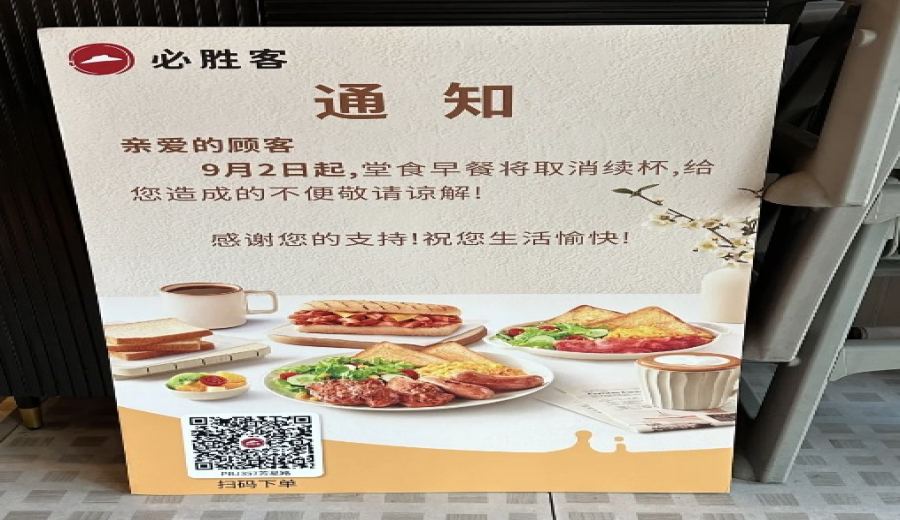
Introduction:On September 2, Pizza Hut announced the cancellation of free refills for dine-in breakfast beverages, sparking widespread discussion among consumers. This change reflects the cost challenges faced by the Western fast-food industry—from rising prices of fresh milk to broader operational strategy shifts. This article delves into the reasons behind Pizza Hut’s decision and compiles market feedback and industry trends to help readers understand the current state and future direction of the fast-food sector.
Recently, the well-known chain restaurant Pizza Hut announced that starting September 2, it will no longer offer free refills for dine-in breakfast beverages, a move that quickly sparked extensive discussion among consumers. Many customers expressed disappointment with the change, viewing refill services as an essential part of the breakfast experience. In fact, this adjustment is seen as one of the cost-reduction and efficiency-improvement measures taken by Yum China in response to cost pressures.
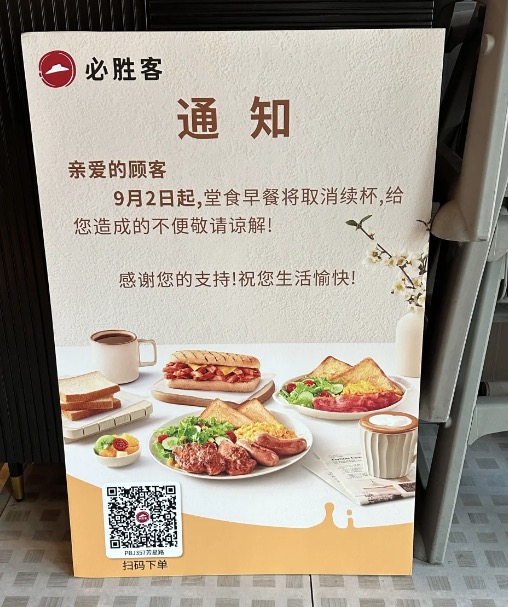
According to in-store notices, Pizza Hut clearly stated, “Starting September 2, free refills for dine-in breakfast beverages will be discontinued. We apologize for any inconvenience caused.” Although initial customer service responses indicated that “specific restaurants may vary,” subsequent confirmations from multiple outlets revealed that the policy had been fully implemented on September 2, with free refills for breakfast drinks no longer available.
On social media platforms, many consumers expressed their disappointment. One netizen reminisced, “As a kid, I loved the free refills at Pizza Hut breakfast—now it’s history?” Another customer bluntly stated, “If refills aren’t allowed, the appeal of breakfast drops significantly.” Some even said that while they personally only drank two cups, the complete removal of refills would affect their likelihood of returning.
Industry analysis points out that this adjustment is primarily related to rising costs. It is understood that the purchase price of Yoplait fresh milk used in Pizza Hut’s breakfast has risen sharply, making the cost of refill services unsustainable. To balance product quality and operational efficiency, the brand ultimately chose to cancel refills. An insider revealed that besides the increase in raw material costs, the cup size design also makes unlimited refills a significant burden for stores—an arrangement that has been maintained until now only with great difficulty.
Notably, Pizza Hut is not the only Western fast-food brand facing such adjustments. As early as May this year, U.S. media reported that McDonald’s was gradually phasing out free refills in some regions. According to feedback from customers in the Pittsburgh area, local McDonald’s outlets have begun charging for beverage refills, with the official explanation being the nationwide phase-out of self-serve drink stations, which previously allowed customers to refill drinks themselves in the dining area.
From an industry-wide perspective, Yum China has recently been actively pursuing cost-reduction and efficiency-improvement strategies. According to its latest financial report, Pizza Hut’s performance in the first quarter fell short of expectations, with both revenue and profits showing a downward trend. Specifically, operating income decreased by 0.68% year-on-year, net profit dropped by 5%, store profit margins fell by 1.7 percentage points, and average customer spending declined by 12% to just RMB 90.
Additionally, many loyal customers have noticed subtle adjustments in Pizza Hut’s products and services. For instance, one customer commented, “Even the butter cubes are gone after the pandemic—the breakfast quality isn’t what it used to be.” “The bacon portion has gotten smaller; there used to be two slices, but now it’s often just one.” “The bread slices seem smaller too, and there’s less egg.” These cumulative changes have left some consumers feeling let down.
Notably, KFC’s recent “sauce restrictions” have indirectly affected Pizza Hut as well. Some consumers have observed that when ordering pizza for delivery, even without specifying, multiple sauce packets were usually included, but recent orders often come with only two. In response, KFC officials stated that Chicken McNuggets come with sweet and sour sauce and barbecue sauce, while fries are standardly paired with ketchup. Any additional sauces must be requested separately from the restaurant.
Faced with a series of brand adjustments, some netizens expressed understanding, seeing them as a response to the broader challenges confronting the foodservice industry. One comment noted, “Meal combos on Douyin and Meituan are getting cheaper and cheaper—the profits are all taken by the platforms, employee salaries aren’t rising, and one person is doing the work of three. The food industry is caught in a price war.” Insiders revealed that Pizza Hut part-time workers earn around RMB 14 per hour, and under these circumstances, the brand can only seek cost control through materials and service items.
According to Yum China’s financial report as of June 30, 2024, the group’s total number of stores has reached 15,423, including 10,931 KFC outlets and 3,504 Pizza Hut locations. Under the dual pressures of intensified market competition and shifting cost structures, balancing quality, service, and operational efficiency will be a critical challenge for Western fast-food brands in the future.
The above content is compiled by CoffeeHunters, a coffee news website.


