








Introduction:A deep dive into the origin profile, varietal characteristics, and roast recommendations of the washed beans from the Gotiti Cooperative in Yirgacheffe, Ethiopia, along with detailed pour over and cold pour over parameters. Not only does it introduce you to the yellow peach, sweet orange acidity, and tea-like finish of this high-altitude coffee, but it also includes practical brewing steps, suitable for beginners and advanced users alike to adjust flavors.
Yirgacheffe, a place name originating from Ethiopia, has now become one of the most iconic coffee regions in the specialty coffee industry. Renowned worldwide among coffee enthusiasts for its bright acidity, clear floral and fruity aromas, and unique tea-like aftertaste, the Gotiti Cooperative located in this area is particularly noted for the stable flavor profile of its washed coffee beans, making them a choice for many roasters and baristas.
Originally just a small town in the Sidamo region, Yirgacheffe gradually stood out due to the refreshing and pleasant flavors of the coffee grown there. After the Ethiopian administrative division was restructured in 1995, the area came under the jurisdiction of the Gedeo Zone. Despite the change in administrative names, the coffee produced in this region continues to be world-renowned under the name "Yirgacheffe."

Compared to the traditional mainstream style of dark roasting with bold body, Yirgacheffe’s citrus tones, honey sweetness, and tea-like aftertaste bring a refreshing experience to many consumers accustomed to tea culture. Its charm mainly comes from three key factors: the high-altitude growing environment, the diverse mix of native varieties that remain uncategorized, and the continuation of traditional washed and natural processing methods.
In particular, the washed process establishes a clean and bright acidity foundation for Yirgacheffe. This technique relies on stable water sources and processing facilities, removing the fruit pulp, fermenting to remove the mucilage, and then washing with clean water and sun-drying. The whole process is complex and meticulous, which also makes the final green bean quality more consistent. Compared to the natural process, which often carries intense fermentation notes, the washed method better highlights the bean’s regional characteristics and layered fruit aromas.
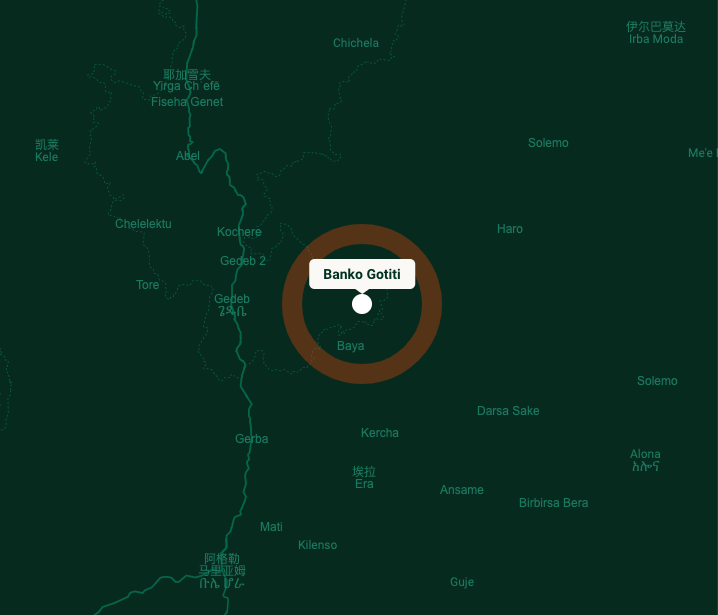
Among the many processing stations and cooperatives in Yirgacheffe, Gotiti is highly regarded for its consistently stable performance under medium-light roasts. These beans come from highlands at an altitude of approximately 1900 to 2300 meters, cultivated from local native varieties (commonly referred to as Heirloom), and are processed using the washed method. The high-altitude environment allows the coffee cherries to ripen slowly, resulting in dense beans that suit medium-light roasting to preserve lively acidity and delicate aromas.
In terms of roast and extraction recommendations, a medium-light roast is advised to highlight its floral and fruity notes. For pour over, it is recommended to control the water temperature between 90–91°C, with a grind size similar to fine sugar, referencing about 80% extraction through a 20-mesh Chinese standard sieve. The extraction can be done using a three-stage method: the first stage involves blooming 30 grams of water for 30 seconds; the second stage adds 95 grams of hot water, and after the coffee bed settles, the third stage injects 100 grams of hot water, with the full brew dripping through to completion. Note that throughout the process, use a small stream of water and circle around the center to help achieve even extraction and avoid over- or under-extraction in localized areas.

When brewed with appropriate parameters, the Gotiti washed beans present clear flavors: during grinding, subtle jasmine floral and citrus aromas can be detected; upon brewing, the cup offers bright lemon acidity, with sweetness primarily centered around sugarcane, and as the temperature slightly drops, a refreshing green-tea-like aftertaste emerges, with a long-lasting and layered finish.
If you wish to further explore its juicy and tangy potential, cold pour over is an excellent option. By adjusting the coffee-to-water-to-ice ratio, controlling the pouring rhythm, and applying moderate stirring, it can bring out juicy acidity and sweetness reminiscent of yellow peach, sweet orange, and grapefruit, while retaining a tea-like clean and smooth texture.
Recommended cold pour over parameters are as follows: use 15 grams of coffee grounds, paired with 160 grams of hot water and 75 grams of ice, achieving a coffee-to-water ratio of about 1:11, with a grind size around EK43s setting 9.5 (or C40 around 22 clicks). Use a Hario V60 filter cone, and apply a three-stage pouring method — the first stage injects 30 grams for blooming; the second stage uses a larger stream to pour 90 grams of hot water while lightly stirring (recommended to draw 5 circles along the inner wall of the filter with a small spoon), pausing when the total water volume reaches 120 grams; the final stage slowly adds 45 grams with a small stream until the dripping completes, with the overall time controlled between 1 minute 55 seconds and 2 minutes 5 seconds.

During the process, you can first place the ice cubes at the bottom of the server, then add the coffee grounds. Maintain a small, center-circling stream during blooming and the first pour to ensure even saturation. The second stage’s larger stream not only improves extraction efficiency, but moderate stirring further releases fruity acids and aromatic molecules. Finally, slowly add the remaining water with a small stream, allowing the coffee to present a more restrained and refreshing taste under the effect of the ice, akin to a chilled fruit tea that refreshes the palate.
This method not only highlights the bright acidity of yellow peach and sweet orange, but also uses the cooling effect of ice to amplify the fresh tea-like nuances and layered aftertaste, giving the overall flavor more dimension. It is suitable for coffee lovers who enjoy a balanced sweet-and-acid profile and seek a refreshing taste experience to try and adjust.

The above content is compiled by CoffeeHunters, a coffee news website.


